

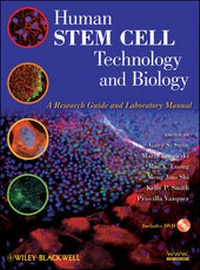
Human Stem Cell Technology and Biology
Description

Reviews / Votes
"The topic is intrinsically fascinating and clinically relevant ...I recommend this book for novice and experienced scientistsinterested in stem cell biology. It will serve as an excellentreference manual and practical laboratory workbook." (Doody's, 17February 2012) "We would recommend this readable and well-organised book to alllaboratories dealing with human ES cells ... This book will act asan excellent guide." (Development Journal, 1 December 2011)More details
Other editions
Additional editions
Persons
Gary Stein, lead Editor for this publication, is currently Professor & Chairman of the Deartment of Cell Biology at the University of Massachusetts Medical School (Worcester, MA); Deputy Director of the UMASS Memorial Cancer Center; Appointed Haidak Distinguished Prof. & Chair of Cell Biology; Interim Director of the Center for Stem Cell Biology and Regenerative Medicine; and Interim Director of the UMASS Cancer Center. He is Executive Editor of Journal of Cellular Biochemistry, Journal of Cellular Physiology, Critical Reviews in Eukaryotic Gene expression, and Molecular Biology Reports, and has served on numerous Editorial Boards. He has published over 700 full length research articles, and has authored numerous books.
Content
Preface.
Acknowledgments.
Editors and Contributors.
SECTION I: INTRODUCTION.
1 Introduction to Pluripotent Stem Cells: Biology and Applications (Maria Borowski and Gary S. Stein).
2 Researching and Obtaining Established Stem Cell Lines (Mai X. Luong, Kelly P. Smith, and Gary S. Stein).
SECTION II: LABORATORY GUIDE FOR HUMAN STEM CELL CULTURE: PLURIPOTENT STEM CELL CULTURE.
3 Basics of Cell Culture (Alicia Allaire, Mai X. Luong, and Kelly P. Smith).
4 The Stem Cell Laboratory (Alicia Allaire, Mai X. Luong, and Kelly P. Smith).
5 Reagent Preparation (Alicia Allaire, Mai X. Luong, and Kelly P. Smith).
6 Preparation of Mouse Embryonic Fibroblasts for Culture of Human Embryonic Stem Cells (Meng-Jiao Shi, Maria Borowski, and Kimberly Stencel).
7 Thawing and Seeding of Frozen Mouse Embryonic Fibroblasts (Meng-Jiao Shi, Maria Borowski, and Kimberly Stencel).
8 Thawing, Seeding, and Changing the Medium of Human Embryonic Stem Cells (Meng-Jiao Shi, Kimberly Stencel, and Maria Borowski).
9 Passaging of Human Embryonic Stem Cells on Inactivated Mouse Embryonic Fibroblast Plates (Meng-Jiao Shi, Kimberly Stencel, and Maria Borowski).
10 Harvesting Human Embryonic Stem Cells for Cryopreservation (Meng-Jiao Shi, Kimberly Stencel, and Maria Borowski).
11 Human Embryonic Stem Cell Culture on BD Matrigel(TM)with mTeSR®1 Medium (Meng-Jiao Shi, Kimberly Stencel, and Maria Borowski).
SECTION III: LABORATORY GUIDE FOR HUMAN STEM CELL CULTURE: CHARACTERIZATION OF PLURIPOTENT STEM CELLS.
12 Defining Pluripotency (Kelly P. Smith and Mai X. Luong).
13 Characterization of Human Embryonic Stem Cells by Immunofluorescence Microscopy (Shirwin M. Pockwinse and Prachi N. Ghule).
14 Preparation of Human Embryonic Stem Cell Samples for Flow Cytometry (Meng-Jiao Shi, Kimberly Stencel, and Maria Borowski).
15 Characterization of Human Embryonic Stem Cell Gene Expression Using Reverse Transcription Polymerase Chain Reaction (Alicia Allaire, Kelly P. Smith, and Mai X. Luong).
16 Determining Pluripotency of Human Embryonic Stem Cells: Embryoid Body Formation (Shirwin M. Pockwinse and Prachi N. Ghule).
17 Characterization of Human Embryonic Stem Cells by Cytogenetics: Karyotyping and Fluorescence In Situ Hybridization (Shirwin M. Pockwinse, Prachi N. Ghule and Anne Higgins).
18 High-Resolution Chromatin Immunoprecipitation Assay (Beatriz Perez-Cadahia, Bojan Drobic, and James R. Davie).
19 Assaying Pluripotency Via Teratoma Formation (M. William Lensch and Tan A. Ince).
SECTION IV: PERSPECTIVES IN HUMAN STEM CELL TECHNOLOGIES.
20 Genomic Analysis of Pluripotent Stem Cells (David Lapointe).
21 Proteomic Analysis of Human Pluripotent Cells (Andy T. Y. Lau, Yan-Ming Xu, and Jen-Fu Chiu).
22 Bioinformatics Strategies for Understanding Gene Expression in Human Pluripotent Cells (Gustavo Glusman, Bruz Marzolf, Kai Wang, Ji-Hoon Cho, Burak Kutlu, and Qiang Tian).
23 Epigenetic Analysis of Pluripotent Cells (Mojgan Rastegar, Genevieve P. Delcuve, and James R. Davie).
24 Differentiation of Pluripotent Stem Cells: An Overview (Jeremy Micah Crook).
25 Cellular Reprogramming: Current Technology, Perspectives, and Generation of Induced Pluripotent Cells (Tanja Dominko).
SECTION V: APPLICATIONS OF HUMAN EMBRYONIC STEM CELLS.
26 Human Pluripotent Cells: The Biology of Pluripotency (Li-Fang Chu and Thomas P. Zwaka).
27 Human Pluripotent Cells for Regenerative Medicine: Potential Applications for Regenerative Medicine (Christopher C. Ford and Darrell N. Kotton).
28 Therapeutic Applications of Human Embryonic Stem Cells (Shi-Jiang Lu, Irina Klimanskaya, Edmund Mickunas, and Robert Lanza).
29 Human Stem Cells for Drug Screening, Toxicity, Specificity, and Off-Target Effects (Arnaud Lacoste and Mark Burcin).
30 Interfacing Stem Cells with Gene Therapy (Christian Mueller and Terence R. Flotte).
31 Tissue Engineering for Stem Cell Mediated Regenerative Medicine (Janet Zoldan, Thomas P. Kraehenbuehl, Abigail K. R. Lytton-Jean, Robert S. Langer, and Daniel G. Anderson).
Glossary.
Index.
