

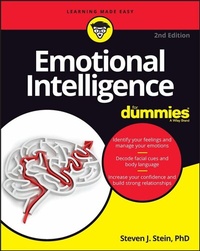
Emotional Intelligence For Dummies
Description

Emotional intelligence (also known as emotional quotient or EQ) is all about perceiving, using, understanding, managing, and handling your emotions and those of others. Develop crucial emotional skills that will help you in your career and in your personal life with Emotional Intelligence For Dummies. Learn to manage your emotions, uncover the power of empathy, and build meaningful relationships. Raise emotionally intelligent kids, become a better leader at work, and land the job you want. Let Dummies be your guide to living your best life!
* Gain emotional awareness that you can use in the workplace and at home
* Engage in practical exercises to develop your emotional intelligence skills
* Apply emotional intelligence in parenting children and teenagers
* Reduce stress and realize greater personal happiness with a higher EQ
This new edition incorporates the latest research on emotional intelligence, the new EQ-i 2.0¯® model, and updated exercises. Anyone who wants to get a grip on their emotions and seek success in life will benefit from this fun and practical guide.
More details
Other editions
Additional editions
Person
Content
Part 1: There's a New Kind of Intelligence in Town 5
Chapter 1: Feeling Smart 7
Chapter 2: Assessing Your Emotional Intelligence 21
Chapter 3: Finding Happiness 31
Part 2: The Essentials of Emotional Intelligence 41
Chapter 4: Investigating the Science Behind Emotional Intelligence 43
Chapter 5: Becoming More Aware of Your Emotions 61
Chapter 6: Managing Your Emotions 81
Chapter 7: Understanding Empathy 99
Chapter 8: Managing Other People's Emotions 115
Part 3: Taking Emotional Intelligence to Work 131
Chapter 9: Dealing with Difficult Workplace Situations 133
Chapter 10: Succeeding Through Emotional Intelligence 149
Chapter 11: Becoming an Emotionally Intelligent Leader 173
Chapter 12: Creating an Emotionally Intelligent Workplace 191
Chapter 13: Getting Through College with Emotional Intelligence 217
Part 4: Using Emotional Intelligence at Home 235
Chapter 14: Creating Emotionally Intelligent Relationships 237
Chapter 15: Parenting with Emotional Intelligence 257
Chapter 16: Raising an Emotionally Intelligent Child 275
Part 5: The Part of Tens 297
Chapter 17: Ten Ways to Improve Your Emotional Intelligence 299
Chapter 18: Ten Ways to Help Difficult People with Their Emotional Intelligence 311
Chapter 19: Ten Ways to Make the World a More Emotionally Intelligent Place 321
Index 329
Chapter 1
Feeling Smart
IN THIS CHAPTER
Getting a feel for emotional intelligence
Managing your emotions and connecting with the emotions of others
Bringing emotional intelligence into the workplace
Practicing emotional intelligence at home
When most people think about what makes a smart person, they think of the school valedictorian - someone who's a whiz at math, flies through chemistry class, masters French and German, aces English literature, and tops the debate club. Being book smart means you can compute, retain, reformulate, and regurgitate all kinds of information.
Although being smart in these ways can help you get through school with flying colors, it may not be all it's cracked up to be. Smart people do get ahead in many ways, often finding academic success and opportunities for good jobs. You need to be book smart, for example, to get into most professional schools, such as medical, law, and engineering schools. But being book smart doesn't guarantee success and happiness in life.
Being emotionally intelligent brings you much closer to achieving personal and even professional fulfillment.
Defining Emotional Intelligence
Psychologists have proposed several definitions of emotional intelligence (EI), but the original intent was to understand how some people who are so smart in some ways (who have book smarts) can be so dumb in other ways (lacking street smarts). A person can have book smarts, but not street smarts, because of a lack of emotional awareness and control, or emotional intelligence.
For example, you can probably think of a politician who was brilliant and ready to change the world. Then, out of nowhere (or so it seemed) came a sexual scandal or charges of taking bribes. The politician couldn't manage their sexual appetite or greed well enough (or long enough) to realize a successful political career.
In the opposite situation, say that a student in school has a great deal of difficulty mastering math, grammar, and literature. They find getting a grade as high as a C a real challenge. But they have this huge network of friends, get invited to every party, are the trendiest kid in class, keep up with everything and everyone, and are known as a great kid by adults, as well. They make all the right life decisions, in spite of academic challenges.
Not everyone struggles in this area, and the great news is that the right kind of practice makes you better - you always have the potential to improve. You can spot emotionally intelligent people pretty quickly. They're the people who
- Successfully manage difficult situations
- Express themselves clearly
- Gain respect from others
- Influence other people
- Convince other people to help them out
- Keep cool under pressure
- Recognize their emotional reactions to people or situations
- Know how to say the right thing to get the right result
- Manage themselves effectively when negotiating
- Manage other people effectively when negotiating
- Motivate themselves to get things done
- Know how to be positive, even during difficult situations
Although these behaviors don't fit within any formal definition of emotional intelligence, they represent typical behaviors for a person high in emotional intelligence. If the bar sounds high, don't fret - with practice, you can build on your existing skills to become more emotionally intelligent.
Getting a Handle on Your Emotions
More than most people think, people judge you based on your actions, rather than on how much you know. We value the people who care about others more than those who can memorize the periodic table. The trick is being able to control your behavior - and you can't change how you behave if you're unaware of your emotions. (For more information on how to become aware of your emotions, see Chapter 5.)
Sometimes, the easiest way to explain emotional intelligence is to use an anecdote, which I do often in this book.
- Claudio, for example, is unaware of his emotions - and therefore isn't in control of his behavior - when he ambles into his office, throws his papers on his desk, and slumps into his chair. The look on his face could read, "Beware of dog."
- His assistant, Jan, comes into his office, bringing him his usual cup of coffee.
- "Here's your coffee, Claudio," she chirps.
- Claudio just grunts and has a "get out of my hair" expression.
- "Something wrong?" she asks.
- "Not really. Could you please fix the Jackson file and get it ready?" he snorts.
- Jan's shocked. He never treats her like that. She must have done something terribly wrong to be spoken to like that. She finds it hard to pay attention to her work for the rest of the morning. She can only think about what she must have done wrong.
- Claudio is in a bad mood. He can't quite put his finger on what's wrong, and that makes him angrier. He has already alienated several people at work and two people at the coffee shop. Something's eating away at him, and he can feel it in his stomach.
Claudio really uses the wrong way of dealing with bad feelings. By wallowing in them, you don't move ahead. In the 1950s and 1960s, many psychologists felt that you had to fully experience your bad or negative feelings in order to get over them. Most psychologists and psychiatrists now know that theory isn't true. The most prominent therapies today stress using behavior modification approaches - such as cognitive-behavior therapy - as opposed to catharsis, releasing your anger.
Focusing on bad feelings tends to keep you in the same rut. Eventually, much of the pain of the bad feeling goes away, but in the long run, you can't move past the feeling without some understanding of why you're feeling the way you do.
- For Claudio, his day starts out badly when his wife tells him, first thing in the morning, that their son failed an important exam at school. Not only is Claudio angry at his son for not passing, he's also angry at himself for not having been on top of his son's schoolwork. He was too busy at work to pay attention to what was going on. The bad news leads to an argument with his wife.
- After trying to ignore his feelings, he leaves for work. Claudio has a close encounter with a red BMW that cuts him off when it enters the highway. He's enraged over the experience. Had it not been for the bad start to the morning, it probably wouldn't have bothered him so much.
- By the time he gets to the office, everything's bothering him. The office waiting room is messy, nobody's available at the front reception desk, and he drops his keys on the way to his office. His mood is one big, angry blah.
- Everyone in his path assumes that he's angry at them. Jan, for example, thinks of a number of things that she might have messed up and thus caused Claudio's anger.
If Claudio were more emotionally intelligent, he'd have the following advantages:
- He'd know what each of his negative feelings was about:
- Disappointment in his son
- Anger for not paying enough attention to his son
- Anger at arguing with his wife
- Anger at the driver who cut him off
- Anger at his office manager for not tidying up the reception area
- Anger at his receptionist for not being at her desk
- By identifying these emotions, he could contain them and keep them proportional, taking the following actions:
- Let Jan know that he was upset about something that had nothing to do with her (allowing her to focus on her work).
- Manage each emotion separately and not roll them all together into one big, undirected, angry ball.
- Use his first 20 to 30 minutes in the office more constructively by cooling off his emotions through various coping strategies (see Chapter 6).
- Be more productive the rest of the day.
- Resolve how he plans to deal with his son in a constructive way when he gets home (instead of just being angry at him).
- Be better able, in general, to deal with small frustrations around the office.
People can improve their emotional intelligence, but not everyone can be a superstar in all areas. Some people take to the skills like a duck takes to the water; and for others, changing is a struggle. Two important factors for people who can effectively change are their motivation and their willingness to practice.
BUILDING YOUR EMOTIONAL MUSCLE
Just like riding a bike, building your muscles in the gym, playing a musical instrument, or doing any other physical activity that requires synchronizing your brain and your body, you can hone your ability to manage your emotions and the emotions of others through practice.
Some people are naturals at emotional self-management and the management of other people's emotions. It's not too dissimilar from athletes, such as LeBron James, who are naturals in a certain sport. However, high levels of natural EI talent aren't widespread.
You may also identify limits to what you can accomplish through training. I know that as much as I practice my tennis, I'll never get to the level of Roger Federer. However, I'm...
