

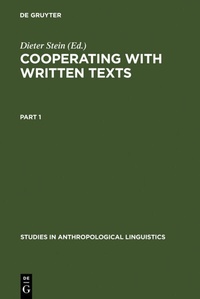
Cooperating with Written Texts
The Pragmatics and Comprehension of Written Texts
1st Edition
Published on 1. March 2011
VII, 701 pages
978-3-11-088119-6 (ISBN)
Description

No detailed description available for "Cooperating with Written Texts".
More details
Other editions
Additional editions
Book
07/1992
1st Edition
De Gruyter Mouton
€250.00
Shipment within 7-9 days
Book
01/1992
1st Edition
De Gruyter Mouton
€339.00
Article exhausted; check different version
Content
- Intro
- Cooperating with written texts: Towards a science of the text. Issues and overview
- Part I Writing, literacy, and comprehension: psycholinguistic aspects
- On the relationship between writing system, written language, and text processing
- Pause and intonation contours in written and oral discourse
- Aspects of writing development in argumentative texts
- Psycholinguistic processes in the comprehension of written texts
- Coherence and coordination in written text: Reading time studies
- Levels of language comprehension and systems of information-processing
- Part II Developmental aspects: the evolution of written texts
- The pragmatics of medieval texts
- The impact of sudden literacy on text comprehensibility: Mohawk
- Scientific texts and deictic structures
- Immediacy and displacement in consciousness and language
- Part III Literary texts: inferring meaning(s)
- Fictional conversation and its pragmatic status
- Presupposition and pragmatic inference in a literary text
- How to cope with dramatic texts including avant-garde playscripts
- The pragmatics of literary texts
- "Deep structure signals" in fiction
- The pragmatics of poetic discourse
- A pragmatic role for inserted clauses in literary texts
- Part IV Pragmatics and comprehension of individual text types
- Teaching conscientious resistance to cooperation with text: The role of pragmatics in critical thinking
- From private writing to public oration: The case of Puritan wills. Cognitive discourse analysis applied to the study of genre change
- Parallelism in advertising copy
- Notice is hereby given to hide ulterior motives
- Renarration: Oral L1 and L2 narrations as bases of written narratives
- Strategies in text production and text comprehension: A new perspective
- The axiological structure of discourse
- Part V At the interface of linguistics and pragmatics: individual linguistic structures
- On the (In)dependence of syntax and pragmatics: Evidence from the postposition -rá in Persian
- VP inversion and aspect in written texts
- Scope in discourse: Pragmatics or syntax?
- Part VI Computational modeling of text comprehension
- 'Parsing' procedures for stories
- Convergent evidence for a set of coherence relations
- Text pragmatics and computational modeling
- Integrating knowledge sources for the generation of referential expressions
- Subject index
