

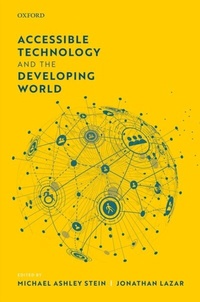
Accessible Technology and the Developing World
1st Edition
Published on 13. October 2021
240 pages
978-0-19-258541-7 (ISBN)
Description

When digital content and technologies are designed in a way that is inaccessible for persons with disabilities, they are locked out of commerce, education, employment, and access to government information. In developing areas of the world, as new technical infrastructures are being built, it is especially important to ensure that accessibility is a key design goal. Unfortunately, nearly all research on Information and Communication Technology (ICT) accessibility and innovation for persons with disabilities-whether from the legal, technical, or development fields-has focused on developed countries, with very little being written about developing world initiatives. Accessible Technology and the Developing World aims to change this, by bringing increased attention to ICT accessibility in developing areas.
This book brings together a unique combination of contributors with diverse disciplinary backgrounds, including authors from well-known non-governmental organizations, significant United Nations entities, and universities in both the developing and developed world. Together, they present a unique and much needed review of this critical and growing area of work, and primarily address three core themes - the lack of attention given to innovations taking place in the developing world, the need to ensure that infrastructures in the Global South do not present barriers to people with disabilities, and the need to exercise caution when applying techniques from the Global North to the Global South that won't transfer effectively.
This book will be of use to researchers in the fields of civil rights, development studies, disability rights, disability studies, human-computer interaction and accessibility, human rights, international law, political science, and universal design.
More details
Other editions
Additional editions
Michael Ashley Stein | Jonathan Lazar
Accessible Technology and the Developing World
Book
10/2021
Oxford University Press
€121.50
Shipment within 15-20 days
Persons
Professor Michael Ashley Stein is the co-founder and Executive Director of the Harvard Law School Project on Disability, and a Visiting Professor at Harvard Law School since 2005. Considered one of the world's leading experts on disability law and policy, Dr. Stein participated in the drafting of the UN Convention on the Rights of Persons with Disabilities; works with disabled peoples' organizations and non-governmental organizations around the world; actively consults with governments on their disability laws and policies; advises an array of UN bodies and national human rights institutions; and has brought landmark disability rights litigation globally.
Jonathan Lazar, PhD, LLM is a professor in the College of Information Studies (iSchool) at the University of Maryland. Dr Lazar joined the iSchool in 2019, after 19 years as a professor of computer and information sciences at Towson University, where he served as director of the information systems program for 14 years.
Content
- 1: Jonathan Lazar, University of Maryland, and Michael Ashley Stein, Harvard Law School: Introduction
- 2: Marianne Schulze: Development for All: How Human Rights Break Down Barriers to Technology
- 3: Charlotte McClain-Nhlapo and Deepti Samant Raja, World Bank: Addressing the Drivers of Digital Technology for Disability-Inclusive Development Funding
- 4: H.E. Luis Gallegos, Martin Gould, and Axel Leblois, Global Initiative for Inclusive Information and Communication Technologies (G3ict): Global Trends for Accessible Technologies in the Developing World: An Analysis of the Results of the Digital Accessibility Rights Evaluation Index
- 5: Francesca Cesa Bianchi, Global Initiative for Inclusive Information and Communication Technologies (G3ict): Digital Accessibility Innovation in Latin America and the Caribbean
- 6: Nirmita Narasimhan, Global Initiative for Inclusive Information and Communication Technologies (G3ict): Digital Accessibility in the Asia Pacific Region
- 7: Judy Brewer and Shadi Abou-Zahra, World Wide Web Consortium (W3C): The Role of Technical Standards in Improving Digital Accessibility in Under-Resources Regions and Communities
- 8: Betsy Beaumon, Benetech: Digital Inclusion in the Global South: Work Globally, Act Locally
- 9: G. Anthony Giannoumis and Rannveig A. Skjerve, Oslo Metropolitan University: Digital Accessibility and Intersectional Discrimination
- 10: Paul Harpur, University of Queensland (Australia) and Michael Ashley Stein, Harvard Law School: The Relevance of the CRPD and the Marrakesh Treaty to the Global South's Book Famine
- 11: Amy L. Landers, Drexel University: The Patent System, Assistive Technologies, and the Developing World
- 12: Marva Khan, Muhammad Atif Sheikh, and Abia Akram, Lahore University of Management Sciences and Special Talent Exchange Program, Pakistan: Accessible ICT as a Ray of Hope for Disability Rights in Pakistan
- 13: Minverva Chavarria, A. Mugeere, K. Schönenberger, S. Hurst, M. Rivas Velarde, University of Geneva and Makerere University: Design Approaches for Creating Person-centered, Context Sensitive, and Sustainable Assistive Technology with the Global South
- 14: Manohar Swaminathan and Joyojeet Pal, Microsoft Research India: Ludic Design for Accessibility in the Global South
- 15: Sachin Pavithran, U.S. Access Board and Utah State University: A Multi-country Comparison of ICT and Educational Accessibility for Blind Students
- 16: Vaishnav Kameswaran, University of Michigan, and Joyojeet Pal, Microsoft Research India: Ride-hailing as Accessible Transit: A Case Study of Blind Users in India
- 17: Patrick Ojok, Kyambogo University: The Role of Ugandan Public Universities in Promoting Accessible Information and Communication Technology
- 18: Raja Kushalnagar, Gallaudet University: Accessible Mobile Banking in India
