

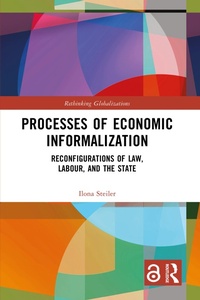
Processes of Economic Informalization
Reconfigurations of Law, Labour, and the State
Published on 25. June 2025
184 pages
978-1-040-37804-5 (ISBN)
Description

Grounded on an analysis of informalized labour in the urban economy of Dar es Salaam, Processes of Economic Informalization explores the conceptual politics involved in the political construction of the informal economy - diverse economic activities that are not regulated or protected by the state, now estimated to make up more than sixty per cent of all employment worldwide.
The author draws attention to the dynamic political, legal, and social processes shaping the formal-informal boundary. Fundamentally, the book argues that 'informal economy' presents a normative and essentially contested concept which is implicated into reconfigurations of legal institutions, labour organization and struggle, and practices of state governance. Based on interviews, ethnographic notes, and a review of policy documents and current academic literature, it illustrates how competing conceptions of the informal economy serve to normalize and justify but also contest specific forms of capitalist accumulation processes and social order. Highlighting the thorny role conceptions of the informal economy play in its construction as well as in its governance, the book makes a timely intervention that challenges conventional positions in the debate on the appropriate regulation of informalized labour.
This book will be of interest to students and scholars of global political economy, international relations, labour studies, and development studies.
The Open Access version of this book, available at http://www.taylorfrancis.com, has been made available under a Creative Commons Attribution-Non Commercial-No Derivatives (CC-BY-NC-ND) 4.0 license.
The author draws attention to the dynamic political, legal, and social processes shaping the formal-informal boundary. Fundamentally, the book argues that 'informal economy' presents a normative and essentially contested concept which is implicated into reconfigurations of legal institutions, labour organization and struggle, and practices of state governance. Based on interviews, ethnographic notes, and a review of policy documents and current academic literature, it illustrates how competing conceptions of the informal economy serve to normalize and justify but also contest specific forms of capitalist accumulation processes and social order. Highlighting the thorny role conceptions of the informal economy play in its construction as well as in its governance, the book makes a timely intervention that challenges conventional positions in the debate on the appropriate regulation of informalized labour.
This book will be of interest to students and scholars of global political economy, international relations, labour studies, and development studies.
The Open Access version of this book, available at http://www.taylorfrancis.com, has been made available under a Creative Commons Attribution-Non Commercial-No Derivatives (CC-BY-NC-ND) 4.0 license.
More details
Series
Language
English
Place of publication
London
United Kingdom
Publishing group
Taylor & Francis Ltd
Target group
College/higher education
Illustrations
2 Halftones, black and white; 2 Illustrations, black and white
File size
3,42 MB
ISBN-13
978-1-040-37804-5 (9781040378045)
Copyright in bibliographic data and cover images is held by Nielsen Book Services Limited or by the publishers or by their respective licensors: all rights reserved.
Schweitzer Classification
Other editions
Additional editions
Book
06/2025
1st Edition
Routledge
€205.90
Shipment within 10-20 days
Person
Ilona Steiler is a postdoctoral research fellow at the Tampere Peace Research Institute (TAPRI) at Tampere University, Finland.
Content
1. A Contested Concept at Work 2. 'Legitimate Lawlessness': Legal and Political Constructions of Informality 3. 'At the Fringes of the Law': Labour Relations and Intersectional (In)visibility 4. Divisions of Labour: Class, Workers' Power, and Strategies of Struggle 5. Setting Work to Rights: Legal Subjects, Rights, and Responsibilities 6. The Art of 'Eating With the Blind': the Neoliberal State and Informalized Labour 7. Concluding thoughts References Index
