

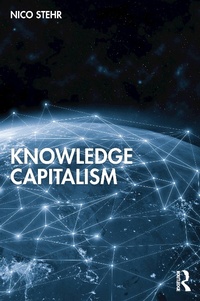
Knowledge Capitalism
1st Edition
Published on 1. June 2022
410 pages
978-1-000-60427-6 (ISBN)
Description

In his newest book, Stehr builds on his classic book Knowledge Societies (1994) to expand the concept toward one of knowledge capitalism for a now, much-changed era. It is not only because of the onset of the Covid-19 pandemic that we are living in a new epoch; it is the idea that modern societies increasingly constitute comprehensive knowledge societies under intensive capitalism, whereby the legal encoding of knowledge through national and international law is the lever that enables the transformation of the knowledge society into knowledge capitalism. The Trade Related Aspects of Intellectual Property Rights agreement, negotiated between 1986 and 1994 as part of the World Trade Organization, is the backbone of the modern society and marks a clear historical demarcation, and although knowledge capitalism is primarily an economic development, the digital giants who are in the driver's seat have significant effects on the social structure and culture of modern society.
Reviews / Votes
"Much writing and talking about 'knowledge society', I have to admit, has struck me as shallow and fashionable. In contrast, Nico Stehr's renewed treatment of the topic has convinced me of the analytical potential of the concept. This is so due to the author's compelling investigation of the sociological features of knowledge capitalism: knowledge, although intangible and reproduced with marginal costs of almost zero, is being transformed, thanks to political arrangements such as patent law, into something tradeable and profitable. Yet the radical expansion of options for strategic agency that follows from the centrality of knowledge production seems to make the future of knowledge capitalism highly contingent - virtually unknowable."-- Claus Offe, Humboldt University Emeritus
"Why is a complex society also a more fragile one? Should we always expand our action and knowledge? These questions and many others form the gist of what a modern society is. This book is a major contribution both to the question of what characterizes a modern society and how sociology should approach knowledge capitalism."
-- Eva Illouz, Directrice, Ecole des hautes etudes en sciences sociales (EHESS)
"Nico Stehr argues persuasively that the 'knowledge society' created by science and technology has been captured by 'knowledge monopoly capitalism'. Digital giants, entrenched by intellectual property rights, use their control of electronic communication to shape social behaviour for private gain. The appropriation of a free good by the platforms, in turn encounters resistance and generates alternatives. Stehr's formidable book brings into focus the permanent tensions at the heart of modernity."
-- Lord Skidelsky, Emeritus Professor of Political Economy, University of Warwick
"Knowledge Capitalism provides a brilliant analysis of the ways in which intellectual monopolies are shaping the world economy, causing increasing inequality and secular stagnation. Stehr's book gives us very useful tools for formulating political strategies which can improve our life in this last stage of capitalism. The knowledge about knowledge offered in this book should become an important reference for university courses dealing with the structure of contemporary societies."
-- Ugo Pagano, Professor of Economics, University of Siena "Much writing and talking about 'knowledge society', I have to admit, has struck me as shallow and fashionable. In contrast, Nico Stehr's renewed treatment of the topic has covinced me of the analytical potential of the concept. This is so due to the author's compelling investigation of the sociological features of knowledge capitalism: knowledge, although intangible and reproduced with marginal costs of almost zero, is being transformed, thanks to political arrangements such as patent law, into something tradeable and profitable. Yet the radical expansion of options for strategic agency that follows from the centrality of knowledge production seems to make the future of knowledge capitalism highly contingent - virtually unknowable."
-- Claus Offe, Humboldt University Emeritus
"Why is a complex society also a more fragile one? Should we always expand our action and knowledge? These questions and many others form the gist of what a modern society is. This book is a major contribution both to the question of what characterizes a modern society and how sociology should approach knowledge capitalism."
-- Eva Illouz, Directrice, Ecole des hautes etudes en sciences sociales (EHESS).
"Nico Stehr argues persuasively that the 'knowledge society' created by science and technology has been captured by 'knowledge monopoly capitalism'. Digital giants, entrenched by intellectual property rights, use their control of electronic communication to shape social behaviour for private gain. The appropriation of a free good by the platforms, in turn encounters resistance and generates alternatives. Stehr's formidable book brings into focus the permanent tensions at the heart of modernity."
-- Lord Skidelsky, Professor Emeritus of Political Economy, University of Warwick.
"Knowledge Capitalism provides a brilliant analysis of the ways in which intellectual monopolies are shaping the world economy, causing increasing inequality and secular stagnation. Stehr's book gives us very useful tools for formulating political strategies which can improve our life in this last stage of capitalism. The knowledge about knowledge offered in this book should become an important reference for university courses dealing with the structure of contemporary societies."
-- Ugo Pagano, Professor of Economics, University of Siena
More details
Edition
1. Auflage
Language
English
Place of publication
London
United Kingdom
Publishing group
Taylor & Francis Ltd
Target group
College/higher education
Product notice
Reflowable
Illustrations
2 Tables, black and white; 6 Line drawings, black and white; 6 Illustrations, black and white
ISBN-13
978-1-000-60427-6 (9781000604276)
Copyright in bibliographic data and cover images is held by Nielsen Book Services Limited or by the publishers or by their respective licensors: all rights reserved.
Schweitzer Classification
Other editions
Additional editions
Person
Nico Stehr is Karl Mannheim Professor of Cultural Studies Emeritus at the Zeppelin University, Friedrichshafen, Germany. He is a fellow of the Royal Society (Canada). He is one of the authors of the Hartwell Paper on climate policy. His recent books include The Power of Scientific Knowledge (with Reiner Grundmann, Cambridge University Press, 2012); Is Liberty a Daughter of Knowledge? (Cambridge University Press, 2016); Understanding Inequality: Social Costs and Benefits (with Amanda Machin, Springer, 2016); Knowledge: Is Knowledge Power? (with Marion Adolf, Routledge, 2017); Society & Climate (with Amanda Machin, World Scientific, 2019); Money. A Social Theory of Modernity (with Dustin Voss, Routledge, 2020).
Content
Preface
Acknowledgements
1. Theories of society
2. Knowledge about Knowledge
3. From Knowledge societies to Knowledge Capitalism
4. The politics of knowledge capitalism
5. Winds of change: Conclusions
Bibliography
Name Index
Subject Index
Acknowledgements
1. Theories of society
2. Knowledge about Knowledge
3. From Knowledge societies to Knowledge Capitalism
4. The politics of knowledge capitalism
5. Winds of change: Conclusions
Bibliography
Name Index
Subject Index
