

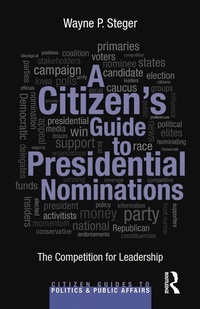
A Citizen's Guide to Presidential Nominations
The Competition for Leadership
Published on 10. April 2015
194 pages
978-1-134-06958-3 (ISBN)
Description

Presidential nominations in the United States can sometimes seem like a media circus, over-hyped and overly speculative. Even informed citizens might be tempted to tune them out. Yet understanding the process, one distinct to American politics, is crucial for civic participation. If presidential elections are about who will lead the nation, presidential nominations are about who appears on the ballot. This concise and coherent Citizen's Guide examines who has power in presidential nominations and how this affects who we as citizens choose to nominate, and ultimately to sit in the Oval Office.
Political scientist Wayne Steger defines the nominating system as a tension between an "insider game" and an "outsider game." He explains how candidates must appeal to a broad spectrum of elected and party officials, political activists, and aligned groups in order to form a winning coalition within their party, which changes over time. Either these party insiders unify early behind a candidate, effectively deciding the nominee before anyone casts a vote, or they are divided and the nomination is determined by citizens voting in the caucuses and primaries. Steger portrays how shifts in party unity and the participation of core party constituencies affect the options presented to voters. Amidst all this, the candidate still matters. Primaries with one strong candidate look much different than those with a field of weaker ones. By clearly addressing the key issues, past and present, of presidential nominations, Steger's guide will be informative, relevant, and accessible for students and general readers alike.
Political scientist Wayne Steger defines the nominating system as a tension between an "insider game" and an "outsider game." He explains how candidates must appeal to a broad spectrum of elected and party officials, political activists, and aligned groups in order to form a winning coalition within their party, which changes over time. Either these party insiders unify early behind a candidate, effectively deciding the nominee before anyone casts a vote, or they are divided and the nomination is determined by citizens voting in the caucuses and primaries. Steger portrays how shifts in party unity and the participation of core party constituencies affect the options presented to voters. Amidst all this, the candidate still matters. Primaries with one strong candidate look much different than those with a field of weaker ones. By clearly addressing the key issues, past and present, of presidential nominations, Steger's guide will be informative, relevant, and accessible for students and general readers alike.
Reviews / Votes
Using comparative data on candidate viability from 1976 to 2012, Wayne Steger demonstrates which presidential nominations are effectively won during the invisible primary stage, through the informal coordination of the party elite, and which nominations are determined by voter support in the primaries and caucuses. Through this analysis, Steger illuminates how presidential nomination politics has changed over recent decades and across the two parties.-Barbara Norrander, University of ArizonaSteger's A Citizen's Guide to Presidential Nominations: The Competition for Leadership is more about the subtitle than the title. Steger (DePaul Univ.) writes less about rules, process, and schedule than about competition within parties and control of party coalitions. Average citizens may, in fact, be somewhat confused by Steger's use of the Herfindahl-Hirschman Index for measuring competition, especially with little to no explanation of how it is derived, particularly for use in the context of presidential nominations. However, the overall discussion of different contexts for nomination races whether there is an incumbent in one party or the other or political leaders have coalesced around a single candidate contributes to the understanding of the process by average citizens. A Citizen's Guide would work well as a secondary reading in courses on the presidency or campaigns and elections, helping students gain an understanding of the dynamics of the process. --Jim Twombly, Elmira College Using comparative data on candidate viability from 1976 to 2012, Wayne Steger demonstrates which presidential nominations are effectively won during the invisible primary stage, through the informal coordination of the party elite, and which nominations are determined by voter support in the primaries and caucuses. Through this analysis, Steger illuminates how presidential nomination politics has changed over recent decades and across the two parties.-Barbara Norrander, University of Arizona
Steger's A Citizen's Guide to Presidential Nominations: The Competition for Leadership is more about the subtitle than the title. Steger (DePaul Univ.) writes less about rules, process, and schedule than about competition within parties and control of party coalitions. Average citizens may, in fact, be somewhat confused by Steger's use of the Herfindahl-Hirschman Index for measuring competition, especially with little to no explanation of how it is derived, particularly for use in the context of presidential nominations. However, the overall discussion of different contexts for nomination races whether there is an incumbent in one party or the other or political leaders have coalesced around a single candidate contributes to the understanding of the process by average citizens. A Citizen's Guide would work well as a secondary reading in courses on the presidency or campaigns and elections, helping students gain an understanding of the dynamics of the process. --Jim Twombly, Elmira College
More details
Series
Language
English
Place of publication
London
United Kingdom
Publishing group
Taylor & Francis Ltd
Target group
College/higher education
Product notice
Reflowable
Illustrations
6 s/w Abbildungen, 4 s/w Tabellen, 6 s/w Zeichnungen
4 Tables, black and white; 6 Line drawings, black and white; 6 Illustrations, black and white
File size
1,61 MB
ISBN-13
978-1-134-06958-3 (9781134069583)
Copyright in bibliographic data and cover images is held by Nielsen Book Services Limited or by the publishers or by their respective licensors: all rights reserved.
Schweitzer Classification
Other editions
Additional editions
Book
04/2015
1st Edition
Routledge
€131.70
Shipment within 15-20 days
Book
04/2015
1st Edition
Routledge
€37.20
Shipment within 15-20 days
Person
Wayne P. Steger is Professor of Political Science at DePaul University. He is a former editor of the Journal of Political Marketing and co-editor of Campaigns and Political Marketing. His work includes studies on agenda-setting, media coverage of campaigns, and marketing in political campaigns. His recent work focuses on party elites, coalition formation, and candidate decision-making.
Content
Part 1: Introduction and Rules of the Game 1. An Introduction to Presidential Nominations 2. An Evolving Nomination Process Part 2: Mechanics of the Game 3. Party Stakeholders - the Insider Game 4. The Changing Money Game 5. Mass- and Micro- Media Campaigns 6. Competition in Post-Reform Presidential Nominations 7. Collusion or Competition During the Invisible Primary Part 3: Why Some Nominations are Decided Before and Some During the Primaries 8. Political Party Unity: Long- and Short-Term Variations 9. Candidates: Opportunism, Competition, and Change 10. Before, During, and After the Primaries Index
