

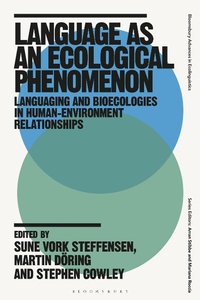
Language as an Ecological Phenomenon
Languaging and Bioecologies in Human-Environment Relationships
1st Edition
Published on 30. May 2024
260 pages
978-1-350-30449-9 (ISBN)
Description

Moving beyond a more traditional view of language as a discrete sociocultural and cognitive entity that distorts our understanding of surrounding ecologies, this book argues that the starting point for ecolinguistics is an appreciation of language as not just about nature, but of nature.
Exploring this conceptual change in the field, the book presents a process view in which language is substituted by languaging, emphasising the bioecologies that we cohabit with numerous other species. It puts forward this perspective by looking at the theoretical considerations behind the understanding of languaging as bioecological, and through examining languaging in various contexts and places. Drawing on examples from across the world, it addresses topics such as climate catastrophes, corporate narratives, questions of ecological leadership, the bioecological implications of the COVID pandemic, and relational landscapes. It also makes use of data from across multiple bioecological settings, including the dairy and agricultural industries.
Exploring this conceptual change in the field, the book presents a process view in which language is substituted by languaging, emphasising the bioecologies that we cohabit with numerous other species. It puts forward this perspective by looking at the theoretical considerations behind the understanding of languaging as bioecological, and through examining languaging in various contexts and places. Drawing on examples from across the world, it addresses topics such as climate catastrophes, corporate narratives, questions of ecological leadership, the bioecological implications of the COVID pandemic, and relational landscapes. It also makes use of data from across multiple bioecological settings, including the dairy and agricultural industries.
More details
Series
Edition
1. Auflage
Language
English
Place of publication
London
United Kingdom
Publishing group
Bloomsbury Publishing PLC
Target group
Professional and scholarly
Illustrations
20 bw illus
ISBN-13
978-1-350-30449-9 (9781350304499)
Copyright in bibliographic data and cover images is held by Nielsen Book Services Limited or by the publishers or by their respective licensors: all rights reserved.
Schweitzer Classification
Other editions
Additional editions
Sune Vork Steffensen | Stephen Cowley | Martin Doering
Language as an Ecological Phenomenon
Languaging and Bioecologies in Human-Environment Relationships
Book
approx. 01/2026
Bloomsbury Academic
€44.50
Not yet published
Sune Vork Steffensen | Stephen Cowley | Martin Doering
Language as an Ecological Phenomenon
Languaging and Bioecologies in Human-Environment Relationships
Book
06/2024
Bloomsbury Academic
€141.13
Shipment within 15-20 days
Persons
Sune Vork Steffensen is Professor of Language, Interaction, and Cognition at the University of Southern Denmark, Denmark.
Martin Döring is a senior scientist at the Institute of Geography at Hamburg University, Germany, and at the Institute for Coastal Research at the Hereon Centre Geesthacht, Germany.
Stephen Cowley is Professor of Organisational Cognition at the University of Southern Denmark, Denmark.
Martin Döring is a senior scientist at the Institute of Geography at Hamburg University, Germany, and at the Institute for Coastal Research at the Hereon Centre Geesthacht, Germany.
Stephen Cowley is Professor of Organisational Cognition at the University of Southern Denmark, Denmark.
Content
List of Figures
List of Tables
List of Contributors
Acknowledgements
1. Ecolinguistics: Living and Languaging United, Sune Vork Steffensen, Martin Döring (Hamburg University, Germany) and Stephen Cowley (University of Southern Denmark, Slagelse, Denmark)
Part I: Energising Ecolinguistics
2. How (Dairy) Cows and Human Intertwine Languaging Practices: Recurrent Vocalizations are not the same, Leonie Cornips
3. Ecolinguistics and the Cognitive Ecology of Global Warming, Sune Vork Steffensen and Ed Baggs (University of Southern Denmark, Denmark)
4. Regeneration: From Language to Languaging, Stephen Cowley (University of Southern Denmark, Denmark)
5. The Epistemological Conundrum of Language: Humans as Ecologically Special and Ecologically Destructive, Alexander Kravchenko (Baikal State University, Siberia)
6. Varieties of Expression and Enlanguaged Cognition in the Context of a Radicalized Ecolinguistics, Rasmus Gahrn-Andersen (University of Southern Denmark, Denmark)
Part II: From Discourse to Worldly Action
7. Ecolinguistics for Ethical Leadership, Arran Stibbe (University of Gloucestershire, UK)
8. Landscape Sentience, Elizabeth Oriel (University of London, UK), Deepta Sateesh (Manipal Academy of Higher Education, India), and Amal Dissanayaka (Hector Kobbekaduwa Agrarian Research and Training Institute, Sri Lanka)
9. Considering Cows in Australian Dairy Discourse, Alison Moore (University of Wollongong, Australia)
10. Learning about, Learning from, Learning with: Towards a Critical Practice and Theory of Situated Language Sciences, Chris Sinha and Vera da Silva Sinha
Index
List of Tables
List of Contributors
Acknowledgements
1. Ecolinguistics: Living and Languaging United, Sune Vork Steffensen, Martin Döring (Hamburg University, Germany) and Stephen Cowley (University of Southern Denmark, Slagelse, Denmark)
Part I: Energising Ecolinguistics
2. How (Dairy) Cows and Human Intertwine Languaging Practices: Recurrent Vocalizations are not the same, Leonie Cornips
3. Ecolinguistics and the Cognitive Ecology of Global Warming, Sune Vork Steffensen and Ed Baggs (University of Southern Denmark, Denmark)
4. Regeneration: From Language to Languaging, Stephen Cowley (University of Southern Denmark, Denmark)
5. The Epistemological Conundrum of Language: Humans as Ecologically Special and Ecologically Destructive, Alexander Kravchenko (Baikal State University, Siberia)
6. Varieties of Expression and Enlanguaged Cognition in the Context of a Radicalized Ecolinguistics, Rasmus Gahrn-Andersen (University of Southern Denmark, Denmark)
Part II: From Discourse to Worldly Action
7. Ecolinguistics for Ethical Leadership, Arran Stibbe (University of Gloucestershire, UK)
8. Landscape Sentience, Elizabeth Oriel (University of London, UK), Deepta Sateesh (Manipal Academy of Higher Education, India), and Amal Dissanayaka (Hector Kobbekaduwa Agrarian Research and Training Institute, Sri Lanka)
9. Considering Cows in Australian Dairy Discourse, Alison Moore (University of Wollongong, Australia)
10. Learning about, Learning from, Learning with: Towards a Critical Practice and Theory of Situated Language Sciences, Chris Sinha and Vera da Silva Sinha
Index
