

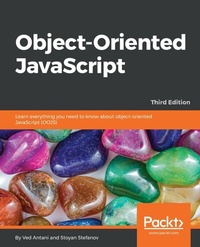
Object-Oriented JavaScript
Learn everything you need to know about object-oriented JavaScript (OOJS)
3rd Edition
Published on 8. July 2025
550 pages
978-1-78588-471-9 (ISBN)
Description

Learn everything you need to know about object-oriented JavaScript with this comprehensive guide. Enter the world of cutting-edge development!
Key Features
[*] This book has been updated to cover all the new object-oriented features introduced in ECMAScript 6
[*] It makes object-oriented programming accessible and understandable to web developers
[*] Write better and more maintainable JavaScript code while exploring interactive examples that can be used in your own scripts
Book DescriptionJavaScript is an object-oriented programming language that is used for website development. Web pages developed today currently follow a paradigm that has three clearly distinguishable parts: content (HTML), presentation (CSS), and behavior (JavaScript). JavaScript is one important pillar in this paradigm, and is responsible for the running of the web pages. This book will take your JavaScript skills to a new level of sophistication and get you prepared for your journey through professional web development. Updated for ES6, this book covers everything you will need to unleash the power of object-oriented programming in JavaScript while building professional web applications. The book begins with the basics of object-oriented programming in JavaScript and then gradually progresses to cover functions, objects, and prototypes, and how these concepts can be used to make your programs cleaner, more maintainable, faster, and compatible with other programs/libraries. By the end of the book, you will have learned how to incorporate object-oriented programming in your web development workflow to build professional JavaScript applications. What you will learn
[*] Apply the basics of object-oriented programming in the JavaScript environment
[*] Use a JavaScript Console with complete mastery
[*] Make your programs cleaner, faster, and compatible with other programs and libraries
[*] Get familiar with Iterators and Generators, the new features added in ES6
[*] Find out about ECMAScript 6's Arrow functions, and make them your own
[*] Understand objects in Google Chrome developer tools and how to use them
[*] Use a mix of prototypal inheritance and copying properties in your workflow
[*] Apply reactive programming techniques while coding in JavaScript
Who this book is forThis book is ideal for new to intermediate JavaScript developers who want to prepare themselves for web development problems solved by object-oriented JavaScript!
Key Features
[*] This book has been updated to cover all the new object-oriented features introduced in ECMAScript 6
[*] It makes object-oriented programming accessible and understandable to web developers
[*] Write better and more maintainable JavaScript code while exploring interactive examples that can be used in your own scripts
Book DescriptionJavaScript is an object-oriented programming language that is used for website development. Web pages developed today currently follow a paradigm that has three clearly distinguishable parts: content (HTML), presentation (CSS), and behavior (JavaScript). JavaScript is one important pillar in this paradigm, and is responsible for the running of the web pages. This book will take your JavaScript skills to a new level of sophistication and get you prepared for your journey through professional web development. Updated for ES6, this book covers everything you will need to unleash the power of object-oriented programming in JavaScript while building professional web applications. The book begins with the basics of object-oriented programming in JavaScript and then gradually progresses to cover functions, objects, and prototypes, and how these concepts can be used to make your programs cleaner, more maintainable, faster, and compatible with other programs/libraries. By the end of the book, you will have learned how to incorporate object-oriented programming in your web development workflow to build professional JavaScript applications. What you will learn
[*] Apply the basics of object-oriented programming in the JavaScript environment
[*] Use a JavaScript Console with complete mastery
[*] Make your programs cleaner, faster, and compatible with other programs and libraries
[*] Get familiar with Iterators and Generators, the new features added in ES6
[*] Find out about ECMAScript 6's Arrow functions, and make them your own
[*] Understand objects in Google Chrome developer tools and how to use them
[*] Use a mix of prototypal inheritance and copying properties in your workflow
[*] Apply reactive programming techniques while coding in JavaScript
Who this book is forThis book is ideal for new to intermediate JavaScript developers who want to prepare themselves for web development problems solved by object-oriented JavaScript!
All prices
More details
Edition
3rd Revised edition
Language
English
Place of publication
Birmingham
United Kingdom
Target group
Professional and scholarly
US School Grade: College Graduate Student
Edition type
Revised edition
File size
5,28 MB
ISBN-13
978-1-78588-471-9 (9781785884719)
Copyright in bibliographic data and cover images is held by Nielsen Book Services Limited or by the publishers or by their respective licensors: all rights reserved.
Schweitzer Classification
Other editions
Additional editions
Stoyan Stefanov | Ved Antani
Object-Oriented JavaScript
Learn everything you need to know about object-oriented JavaScript (OOJS)
Book
01/2017
3rd Edition
Packt Publishing
€58.00
Shipment within 3-4 weeks
Previous edition
Stoyan Stefanov
Object-Oriented JavaScript
If you've limited or no experience with JavaScript, this book will put you on the road to being an expert. A wonderfully compiled introduction to objects in JavaScript, it teaches through examples and practical play.
E-Book
01/2025
2nd Edition
Packt Publishing Limited
from
€39.59
Available for download
Persons
STEFANOV Stoyan :
Stoyan Stefanov is a Facebook engineer, author, and speaker. He talks regularly about web development topics at conferences, and his blog, www.phpied.com. He also runs a number of other sites, including JSPatterns.com - a site dedicated to exploring JavaScript patterns. Previously at Yahoo!, Stoyan was the architect of YSlow 2.0 and creator of the image optimization tool, Smush.it. A "citizen of the world", Stoyan was born and raised in Bulgaria, but is also a Canadian citizen, currently residing in Los Angeles, California. In his offline moments, he enjoys playing the guitar, taking flying lessons, and spending time at the Santa Monica beaches with his family.Antani Ved :
Ved Antani has been building scalable server and mobile platforms using JavaScript, Go, and Java since 2005. He is an associate vice president at Myntra and has previously worked at Electronic Arts and Oracle. He is an avid reader and author on several subjects. He has studied computer science and currently lives in Bangalore, India. Ved is passionate about classical music and loves to spend time with his son.
Stoyan Stefanov is a Facebook engineer, author, and speaker. He talks regularly about web development topics at conferences, and his blog, www.phpied.com. He also runs a number of other sites, including JSPatterns.com - a site dedicated to exploring JavaScript patterns. Previously at Yahoo!, Stoyan was the architect of YSlow 2.0 and creator of the image optimization tool, Smush.it. A "citizen of the world", Stoyan was born and raised in Bulgaria, but is also a Canadian citizen, currently residing in Los Angeles, California. In his offline moments, he enjoys playing the guitar, taking flying lessons, and spending time at the Santa Monica beaches with his family.Antani Ved :
Ved Antani has been building scalable server and mobile platforms using JavaScript, Go, and Java since 2005. He is an associate vice president at Myntra and has previously worked at Electronic Arts and Oracle. He is an avid reader and author on several subjects. He has studied computer science and currently lives in Bangalore, India. Ved is passionate about classical music and loves to spend time with his son.
Content
Table of Contents
Introduction to Object-oriented Programming with JavaScript
Primitive Data Types, Arrays, Loops, and Conditions
Functions
Objects
Iterators and Generators
Prototype
Inheritance
Classes and Modules
Asynchronous Programming and Promises
The Browser Environment
Reactive Programming and React
Testing and Debugging
Reactive Programming and React
Appendix A
Appendix B
Appendix C
Appendix D
Appendix E
Introduction to Object-oriented Programming with JavaScript
Primitive Data Types, Arrays, Loops, and Conditions
Functions
Objects
Iterators and Generators
Prototype
Inheritance
Classes and Modules
Asynchronous Programming and Promises
The Browser Environment
Reactive Programming and React
Testing and Debugging
Reactive Programming and React
Appendix A
Appendix B
Appendix C
Appendix D
Appendix E

