

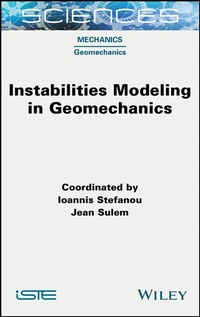
Instabilities Modeling in Geomechanics
1st Edition
Published on 12. March 2021
368 pages
978-1-119-75518-0 (ISBN)
Description

Instabilities Modeling in Geomechanics describes complex mechanisms
which are frequently met in earthquake nucleation, geothermal energy
production, nuclear waste disposal and CO2
sequestration. These
mechanisms involve systems of non-linear differential equations that
express the evolution of the geosystem (e.g. strain localization,
temperature runaway, pore pressure build-up, etc.) at different length
and time scales.
In order to study the evolution of a system and possible instabilities, it
is essential to know the mathematical properties of the governing
equations. Therefore, questions of the existence, uniqueness and
stability of solutions naturally arise.
This book particularly explores bifurcation theory and stability analysis,
which are robust and rigorous mathematical tools that allow us to study
the behavior of complex geosystems, without even explicitly solving the
governing equations. The contents are organized into 10 chapters which
illustrate the application of these methods in various fields of
geomechanics.
which are frequently met in earthquake nucleation, geothermal energy
production, nuclear waste disposal and CO2
sequestration. These
mechanisms involve systems of non-linear differential equations that
express the evolution of the geosystem (e.g. strain localization,
temperature runaway, pore pressure build-up, etc.) at different length
and time scales.
In order to study the evolution of a system and possible instabilities, it
is essential to know the mathematical properties of the governing
equations. Therefore, questions of the existence, uniqueness and
stability of solutions naturally arise.
This book particularly explores bifurcation theory and stability analysis,
which are robust and rigorous mathematical tools that allow us to study
the behavior of complex geosystems, without even explicitly solving the
governing equations. The contents are organized into 10 chapters which
illustrate the application of these methods in various fields of
geomechanics.
More details
Other editions
Additional editions
Ioannis Stefanou | Jean Sulem
Instabilities Modeling in Geomechanics
Book
06/2021
1st Edition
ISTE Ltd
€164.50
Shipment within 3-4 weeks
I. Stefanou
Instabilities Modeling in Geomechanics
Software
03/2021
Wiley
€172.39
No shipping information available
Persons
Ioannis Stefanou is Associate Professor and Researcher at Laboratoire
Navier, Ecole des Ponts Paris Tech, France.
Jean Sulem is Full Professor and Senior Researcher at Laboratoire
Navier, Ecole des Ponts Paris Tech, France.
Navier, Ecole des Ponts Paris Tech, France.
Jean Sulem is Full Professor and Senior Researcher at Laboratoire
Navier, Ecole des Ponts Paris Tech, France.
Content
- Cover
- Half-Title Page
- Title Page
- Copyright Page
- Contents
- Introduction
- 1. Multiphysics Role in Instabilities in Geomaterials: a Review
- 1.1. Introduction
- 1.2. General remarks
- 1.3. Solid phase material criteria
- 1.4. Material sample stability: experimental
- 1.5. Boundary value problems: uniqueness and stability at the field scale
- 1.5.1. Landslides
- 1.5.2. Thermal pressurization problem
- 1.5.3. Localization during drying of geomaterials
- 1.6. Conclusion
- 1.7. References
- 2. Fundamentals of Bifurcation Theory and Stability Analysis
- 2.1. Introduction
- 2.2. Bifurcation and stability of dynamical systems
- 2.2.1. Definition of stability
- 2.2.2. Linear systems of ODEs
- 2.2.3. Nonlinear systems of ODEs
- 2.2.4. An example of LSA
- 2.3. Stability of two-dimensional linear dynamical systems
- 2.3.1. Classification of fixed points
- 2.3.2. Love mechanics: Romeo and Juliet
- 2.4. Commmon types of bifurcations
- 2.4.1. Saddle-node bifurcation
- 2.4.2. Transcritical bifurcation
- 2.4.3. Supercritical and subcritical pitchfork bifurcation
- 2.4.4. From one to two dimensions - limit cycles
- 2.4.5. Bifurcations in two dimensions - supercritical and subcritical Hopf bifurcation
- 2.4.6. Mathematical bifurcations in PDEs
- 2.5. From ODEs to PDEs
- 2.5.1. Deformation bands and the acoustic tensor
- 2.5.2. Deformation bands as an instability problem
- 2.6. Summary
- 2.7. Appendix
- 2.8. References
- 3. Material Instability and Strain Localization Analysis
- 3.1. Introduction
- 3.2. Shear band model
- 3.2.1. Strain localization criterion
- 3.2.2. Strain localization, loss of ellipticity and vanishing speed of acceleration waves
- 3.3. Shear band formation in element tests on rocks
- 3.3.1. Drucker-Prager model
- 3.3.2. Non-coaxial plasticity
- 3.3.3. Cataclastic shear banding
- 3.3.4. Postlocalization behavior
- 3.4. Strain localization in fluid-saturated porous media
- 3.4.1. Strain localization criterion in fluid-saturated porous media
- 3.4.2. Stability analysis of undrained shear on a saturated layer
- 3.5. Conclusion
- 3.6. References
- 4. Experimental Investigation of the Emergence of Strain Localization in Geomaterials
- 4.1. Introduction
- 4.2. Methods
- 4.2.1. Digital image correlation
- 4.2.2. X-ray computed tomography
- 4.2.3. Experimental devices for in situ full-field measurements
- 4.3. Selected materials
- 4.3.1. Hostun sand
- 4.3.2. Caicos ooids sand
- 4.3.3. Vosges sandstone
- 4.3.4. Callovo-Oxfordian clayey rock
- 4.4. Strain localization in sands
- 4.4.1. Plane strain compression by FRS
- 4.4.2. Triaxial compression by X-ray CT and DIC
- 4.4.3. Triaxial compression by X-ray CT, the critical void ratio
- 4.5. Strain localization in porous rocks
- 4.5.1. Strain localization in Vosges sandstone
- 4.5.2. Strain localization in a clayey rock
- 4.6. Conclusion
- 4.7. References
- 5. Numerical Modeling of Strain Localization
- 5.1. Introduction
- 5.2. Cosserat continuum
- 5.2.1. Governing equations
- 5.2.2. Finite element formulation of Cosserat model
- 5.2.3. Material parameters
- 5.2.4. Failure in thick-walled cylinder test
- 5.2.5. Stability analysis of elliptical shape perforations
- 5.3. Gradient elastoplasticity
- 5.3.1. Governing equations
- 5.3.2. Finite element formulation
- 5.3.3. Material model
- 5.3.4. Modeling of the biaxial test
- 5.3.5. Modeling cavity expansion
- 5.4. Conclusion
- 5.5. Acknowledgments
- 5.6. References
- 6. Numerical Modeling of Bifurcation: Applications to Borehole Stability, Multilayer Buckling and Rock Bursting
- 6.1. Introduction
- 6.2. Borehole stability
- 6.2.1. Primary loading path
- 6.2.2. Hole failure
- 6.2.3. Simulation of hollow cylinder experiments
- 6.3. Folding of elastic media as a bifurcation problem
- 6.3.1. Buckling of a layer under initial stress
- 6.3.2. Eigen-displacements and tractions at layer boundaries
- 6.3.3. Buckling of a layer system - the transfer matrix technique
- 6.3.4. Buckling of layered half-space
- 6.4. Axial splitting and spalling
- 6.4.1. Buckling of a half-space with surface parallel cracks
- 6.5. Conclusion
- 6.6. Acknowledgments
- 6.7. References
- 7. Numerical Modeling of Multiphysics Couplings and Strain Localization
- 7.1. Introduction
- 7.2. Experimental evidences of strain localization
- 7.3. Regularization methods
- 7.3.1. Enrichment of the constitutive law
- 7.3.2. Enrichment of the kinematics
- 7.4. Coupled local second gradient model for microstructure saturated media
- 7.4.1. Balance equations for microstructure poromechanics
- 7.4.2. Coupled finite element formulation
- 7.4.3. Two-dimensional specimen under compression
- 7.5. Coupled local second gradient model for an unsaturated medium
- 7.5.1. Partial saturation conditions
- 7.5.2. Anisotropy of the intrinsic permeability
- 7.5.3. Compressibility of the solid grains
- 7.6. Modeling of a gallery excavation
- 7.6.1. Numerical model
- 7.6.2. Influence of stress and permeability anisotropies
- 7.6.3. Influence of second gradient boundary condition
- 7.6.4. Influence of Biot's coefficient
- 7.6.5. Influence of gallery ventilation
- 7.7. Conclusion
- 7.8. References
- 8. Multiphysics Couplings and Strain Localization in Geomaterials
- 8.1. Introduction
- 8.2. Thermo-chemo-chemical couplings and stability of shear zones
- 8.2.1. Problem statement
- 8.2.2. Stability of adiabatic undrained shear
- 8.2.3. Chemical weakening and earthquake nucleation
- 8.3. Dissolution weakening and compaction banding
- 8.3.1. Multiscale modeling of strong chemo-poro-mechanical coupling
- 8.3.2. Compaction banding in oedometric compression
- 8.4. Conclusion
- 8.5. References
- 9. On the Thermo-poro-mechanics of Chemically Active Faults
- 9.1. Introduction
- 9.2. Time-independent formation of shear zones from solid mechanics
- 9.2.1. Shear zone thickness at boundary temperature conditions
- 9.2.2. Shear zone thickness at elevated temperature
- 9.3. Time-dependent evolution of shear zones
- 9.3.1. Energy considerations
- 9.3.2. The Taylor-Quinney coefficient
- 9.3.3. Chemical reactions
- 9.4. Postfailure evolution of a shear zone
- 9.4.1. Analysis of the system's response
- 9.4.2. Time scales of the system
- 9.5. Comparison to field observations
- 9.6. Application to ETS sequences
- 9.6.1. Regular sequences - Cascadia ETS sequence
- 9.7. Discussion
- 9.8. Appendix: poro-chemical model
- 9.9. References
- 10. Analysis of Instabilities in Faults
- 10.1. Introduction
- 10.2. Description of the model
- 10.2.1. Cosserat continuum theory
- 10.2.2. Constitutive equations for a Cosserat continuum
- 10.2.3. Mass balance equation
- 10.2.4. Energy balance equation
- 10.3. Bifurcation analysis
- 10.3.1. LSA for a Cosserat continuum with THM couplings
- 10.3.2. Localization conditions for a fault zone
- 10.3.3. Shear band thickness evolution in a fault zone
- 10.4. Numerical analysis
- 10.4.1. Regularization of the mesh dependency
- 10.4.2. Response and shear band thickness of a fault gouge
- 10.5. Conclusion
- 10.6. Bibliography
- List of Authors
- Index
- EULA
