

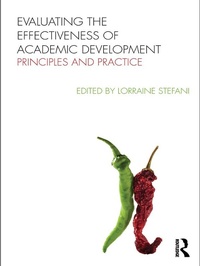
Evaluating the Effectiveness of Academic Development
Principles and Practice
Published on 4. October 2010
256 pages
978-1-136-94476-5 (ISBN)
Description

How can Academic Developers provide evidence of the effectiveness and 'added value' of their work to the key stakeholders within their institutions?
Written for Academic Developers, academic administrators and others responsible for promoting organizational change, Evaluating the Effectiveness of Academic Development is a professional guide that shares best practice advice and provides developers with useful frameworks for effective evaluation and monitoring of their work.
Through case studies and up-to-date examples from experts in the field, this collection explores the nuances of evaluative practice and the tensions inherent in claiming a causal link between academic development and organizational transformation. As higher education institutions continue to seek effective ways to determine the impact of academic development on organizational transformation in general and student learning in particular, Evaluating the Effectiveness of Academic Development is sure to be an invaluable resource.
Written for Academic Developers, academic administrators and others responsible for promoting organizational change, Evaluating the Effectiveness of Academic Development is a professional guide that shares best practice advice and provides developers with useful frameworks for effective evaluation and monitoring of their work.
Through case studies and up-to-date examples from experts in the field, this collection explores the nuances of evaluative practice and the tensions inherent in claiming a causal link between academic development and organizational transformation. As higher education institutions continue to seek effective ways to determine the impact of academic development on organizational transformation in general and student learning in particular, Evaluating the Effectiveness of Academic Development is sure to be an invaluable resource.
More details
Language
English
Place of publication
London
United Kingdom
Publishing group
Taylor & Francis Ltd
Target group
Professional and scholarly
Illustrations
8 s/w Tabellen, 8 s/w Zeichnungen
8 Tables, black and white; 8 Line drawings, black and white
File size
2,21 MB
ISBN-13
978-1-136-94476-5 (9781136944765)
Copyright in bibliographic data and cover images is held by Nielsen Book Services Limited or by the publishers or by their respective licensors: all rights reserved.
Schweitzer Classification
Other editions
Additional editions
Book
08/2010
1st Edition
Routledge
€231.80
Shipment within 15-20 days
Book
08/2010
1st Edition
Routledge
€74.50
Shipment within 15-20 days
Person
Lorraine Stefani is Director and Professor of the Centre for Academic Development (CAD) at the University of Auckland.
Content
1. Evaluating the effectiveness of academic development: an overview, Lorraine Stefani
2. Locating Academic Development: the first step in evaluation, Shelda Debowski
3. The Quality Agenda: where does academic development sit? George Gordon
4. Demonstrating Fitness for Purpose: phronesis and authenticity as overarching purposes, Carolin Kreber
5. Using Student Survey Data to Shape Priorities and Approaches, Kerri-Lee Krause
6. Innovation and Change: responding to a digital environment, Cathy Gunn
Case Study 1. Whaia te pae tawhiti: Maori Academic Development at the University of Auckland, Matiu Ratima
Case Study 2. Academic Partnership: peer mentoring with early-career academics, Barbara Kensington-Miller
Case Study 3. Tending the Secret Garden: evaluating a doctoral skills program, Frances Kelly, Ian Brailsford and Susan Carter
Case Study 4. Evaluation as Bricolage: cobbling together a strategy for appraising supervision development, Barbara Grant
Case Study 5. Archiving for the Future: a longitudinal approach to evaluating a postgraduate certificate program, Helen Sword
Case Study 6. Tracking the Invisible: an elearning group's approach to evaluation, Cathy Gunn and Claire Donald
Case Study 7. Continuous Improvement Projects: whose evaluation matters? Lorraine Stefani
Case Study 8. Leadership Programs: evaluation as a way forward, Linda McLain
7. Accrediation, Accountability and Assessment: addressing multiple agendas, Claudia Stanny and Jane Halonen
8. An Institutional Program: a national model for evaluation? Roni Bamber
9. Evaluation matters in a national, funded academic development project, Kogi Nadoo and Alison Holmes
10. Impact Evaluation and its Implications, Kathleen Gray and Alex Radloff
Endnote, Lorraine Stefani
2. Locating Academic Development: the first step in evaluation, Shelda Debowski
3. The Quality Agenda: where does academic development sit? George Gordon
4. Demonstrating Fitness for Purpose: phronesis and authenticity as overarching purposes, Carolin Kreber
5. Using Student Survey Data to Shape Priorities and Approaches, Kerri-Lee Krause
6. Innovation and Change: responding to a digital environment, Cathy Gunn
Case Study 1. Whaia te pae tawhiti: Maori Academic Development at the University of Auckland, Matiu Ratima
Case Study 2. Academic Partnership: peer mentoring with early-career academics, Barbara Kensington-Miller
Case Study 3. Tending the Secret Garden: evaluating a doctoral skills program, Frances Kelly, Ian Brailsford and Susan Carter
Case Study 4. Evaluation as Bricolage: cobbling together a strategy for appraising supervision development, Barbara Grant
Case Study 5. Archiving for the Future: a longitudinal approach to evaluating a postgraduate certificate program, Helen Sword
Case Study 6. Tracking the Invisible: an elearning group's approach to evaluation, Cathy Gunn and Claire Donald
Case Study 7. Continuous Improvement Projects: whose evaluation matters? Lorraine Stefani
Case Study 8. Leadership Programs: evaluation as a way forward, Linda McLain
7. Accrediation, Accountability and Assessment: addressing multiple agendas, Claudia Stanny and Jane Halonen
8. An Institutional Program: a national model for evaluation? Roni Bamber
9. Evaluation matters in a national, funded academic development project, Kogi Nadoo and Alison Holmes
10. Impact Evaluation and its Implications, Kathleen Gray and Alex Radloff
Endnote, Lorraine Stefani
