

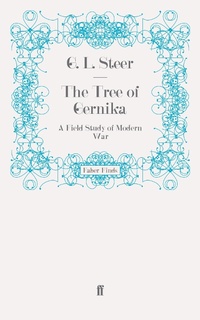
The Tree of Gernika
A Field Study of Modern War
Published on 4. October 2012
200 pages
978-0-571-28101-5 (ISBN)
Description

The Tree of Gernika: a Field Study of Modern War was published in 1938. It is G. L. Steer's masterpiece. Martha Gellhorn famously wrote to Eleanor Roosevelt:
'You must read a book by a man names Steer: it is called The Tree of Gernika. It is about the fight of the Basques - he's the London Times man - and no better book has come out of the war and he says well all the things I have tried to say to you the times I saw you, after Spain. It is beautifully written and true, and few books are like that, and fewer still deal with war. Pleas get it.'
As Paul Preston says in his We Saw Spain Die, 'Martha Gellhorn's judgement has more than stood the test of time.'
In his introduction, Nick Rankin writes.' The Tree of Gernika tells how Euzkadi, the democratic republic that the Basques created in their green homeland by the Bay of Biscay, fought for freedom and decency in an atrocious civil war. After a year of struggle, blockaded by sea, bombed from the air, fighting against overwhelming odds in their own hill, the Basques in the end lost to Franco's forces - but they lost honourably, without resorting to murder, torture and treachery.'
It was Steer who alerted the world to the destruction of Gernika (Basque spelling), Guernica (Spanish spelling). It was the most important dispatch of his life, run by both The Times and The New York Times.
Nick Rankin rightly describes The Tree of Gernika as 'a masterpiece of narrative history and eyewitness reporting by someone close to the key events . . .'
'You must read a book by a man names Steer: it is called The Tree of Gernika. It is about the fight of the Basques - he's the London Times man - and no better book has come out of the war and he says well all the things I have tried to say to you the times I saw you, after Spain. It is beautifully written and true, and few books are like that, and fewer still deal with war. Pleas get it.'
As Paul Preston says in his We Saw Spain Die, 'Martha Gellhorn's judgement has more than stood the test of time.'
In his introduction, Nick Rankin writes.' The Tree of Gernika tells how Euzkadi, the democratic republic that the Basques created in their green homeland by the Bay of Biscay, fought for freedom and decency in an atrocious civil war. After a year of struggle, blockaded by sea, bombed from the air, fighting against overwhelming odds in their own hill, the Basques in the end lost to Franco's forces - but they lost honourably, without resorting to murder, torture and treachery.'
It was Steer who alerted the world to the destruction of Gernika (Basque spelling), Guernica (Spanish spelling). It was the most important dispatch of his life, run by both The Times and The New York Times.
Nick Rankin rightly describes The Tree of Gernika as 'a masterpiece of narrative history and eyewitness reporting by someone close to the key events . . .'
More details
Edition
Main
Language
English
Place of publication
London
United Kingdom
File size
3,07 MB
ISBN-13
978-0-571-28101-5 (9780571281015)
Copyright in bibliographic data and cover images is held by Nielsen Book Services Limited or by the publishers or by their respective licensors: all rights reserved.
Schweitzer Classification
Other editions
Additional editions
Book
11/2009
Faber & Faber
€33.10
Shipment within 15-20 days
Persons
G. L. Steer (1909-1944) was one of the great war correspondents of the twentieth-century. Born in South Africa, educated at Winchester and Oxford, after an apprenticeship in journalism he went to Ethiopia in July 1935 to cover the forthcoming Italian invasion. He remained loyal to the Ethiopians and their emperor, Haile Selassie 'till the end' and helped in the latter's restoration to his throne in 1941.
Two of the three books G. L. Steer wrote about Ethiopia and the Italian occupation - Caesar in Abyssinia and Sealed and Delivered - are reissued in Faber Finds. He also wrote the official history, The Abyssinian Campaigns. His masterpiece, The Tree of Gernika, is reissued in Faber Finds as well.
The Tree of Gernika: a Field Study of Modern War is a first-hand account of the struggle of the Basque Autonomous Republic in the Spanish Civil War, from the burning of Irun to the fall of Bilbao. During this campaign Steer filed his most important dispatch about the destruction of Gernika (Guernica) by Nazi aircraft.
In the Second World War G. L. Steer worked as an army intelligence officer: he died on Christmas Day 1944 when he crashed an overloaded jeep in Bengal.
Nicholas Rankin worked 20 years for BBC World Service, winning two UN awards and ending up as Chief Producer. His previous books include biographies of Robert Louis Stevenson and the war-correspondent George Steer, Churchill's Wizards, a study of camouflage, deception and black propaganda in both world wars, and Ian Fleming's Commandos, the history of a WW2 naval intelligence unit. He is a Fellow of the Royal Society of Literature and lives in London and Kent.
Two of the three books G. L. Steer wrote about Ethiopia and the Italian occupation - Caesar in Abyssinia and Sealed and Delivered - are reissued in Faber Finds. He also wrote the official history, The Abyssinian Campaigns. His masterpiece, The Tree of Gernika, is reissued in Faber Finds as well.
The Tree of Gernika: a Field Study of Modern War is a first-hand account of the struggle of the Basque Autonomous Republic in the Spanish Civil War, from the burning of Irun to the fall of Bilbao. During this campaign Steer filed his most important dispatch about the destruction of Gernika (Guernica) by Nazi aircraft.
In the Second World War G. L. Steer worked as an army intelligence officer: he died on Christmas Day 1944 when he crashed an overloaded jeep in Bengal.
Nicholas Rankin worked 20 years for BBC World Service, winning two UN awards and ending up as Chief Producer. His previous books include biographies of Robert Louis Stevenson and the war-correspondent George Steer, Churchill's Wizards, a study of camouflage, deception and black propaganda in both world wars, and Ian Fleming's Commandos, the history of a WW2 naval intelligence unit. He is a Fellow of the Royal Society of Literature and lives in London and Kent.
