

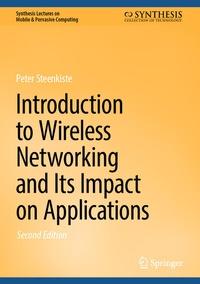
Introduction to Wireless Networking and Its Impact on Applications
Description

This book teaches readers how wireless networks work, why some of their properties impact wireless network performance at the application level, and what both network engineers and application developers can do to cope with these challenges. This Second Edition includes key updates on these topics, which have become increasingly important as internet users rely more and more on wireless access links for diverse tasks such as web browsing, video conferencing, interactive games, and data sharing. The author compares and contrasts wireless and wired networks, explaining that users expect high quality performance regardless of how they access the internet, even though wireless networks are much more difficult to build than wired networks. Structured according to the layers in the Internet protocol stack, the book discusses the challenges involved in building wireless networks and the obstacles that can affect their performance in real-world applications. The author also provides strategies for approaching these challenges and obstacles. This Second Edition incorporates new information on several topics, including WiFi and 5G cellular.
More details
Other editions
Additional editions
Person
Peter Steenkiste, Ph.D., is a Professor in the Computer Science and Electrical and Computer Engineering departments at Carnegie Mellon University. He received his B.Sc. in Electrical Engineering from the University of Gent in Belgium before earning his M.Sc. and Ph.D. in Electrical Engineering from Stanford University. His research is focused on wireless networking, novel network architectures, pervasive computing, and self-optimizing network services.
Content
Introduction.- The Physical Layer: Sending Bits.- Optimizing Throughput at the PHY Layer.- Wireless Datalink Protocols.- Layers 3 and 4: IP and TCP.- Applications in Wireless and Mobile Networks.
