

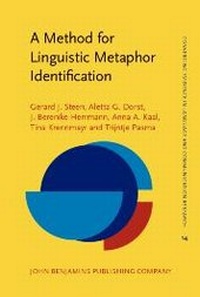
A Method for Linguistic Metaphor Identification
From MIP to MIPVU
1st Edition
Published on 23. June 2010
XI, 238 pages
978-90-272-8815-8 (ISBN)
Description

This book presents a complete method for the identification of metaphor in language at the level of word use. It is based on extensive methodological and empirical corpus-linguistic research in two languages, English and Dutch. The method is formulated as an explicit manual of instructions covering one chapter, the method being a development and refinement of the popular MIP procedure presented by the Pragglejaz Group in 2007. The extended version is called MIPVU, as it was developed at VU University Amsterdam. Its application is demonstrated in five case studies addressing metaphor in English news texts, conversations, fiction, and academic texts, and Dutch news texts and conversations. Two methodological chapters follow reporting a series of successful reliability tests and a series of post hoc troubleshooting exercises. The final chapter presents a first empirical analysis of the findings, and shows what this type of methodological attention can mean for research and theory.
More details
Other editions
Additional editions
Gerard J. Steen | Aletta G. Dorst | J. Berenike Herrmann
A Method for Linguistic Metaphor Identification
From MIP to MIPVU
Book
06/2010
John Benjamins Publishing Co
€95.40
Shipment within 10-15 days
Persons
Content
- A Method for Linguistic Metaphor Identification
- Editorial page
- Title page
- LCC data
- Table of contents
- Preface
- Acknowledgements
- Linguistic metaphor identification in usage
- 1.1. Introduction
- 1.2. Introducing MIP
- 1.3. Aspects of interpretation
- 1.4. Aspects of conceptualization
- 1.5. Aspects of operationalization
- 1.6. Data collection
- 1.7. Data analysis
- 1.8. Plan of the book
- MIPVU
- 2.1. The basic procedure
- 2.2. Deciding about words: Lexical units
- 2.2.1 General guideline
- 2.2.2 Exceptions
- 2.3. Indirect use potentially explained by cross-domain mapping
- 2.3.1 Identifying contextual meanings
- 2.3.2 Deciding about more basic meanings
- 2.3.3 Deciding about sufficient distinctness
- 2.3.4 Deciding about the role of similarity
- 2.4. Direct use potentially explained by cross-domain mapping
- 2.5. Implicit meaning potentially explained by cross-domain mapping
- 2.6. Signals of potential cross-domain mappings
- 2.7. New-formations and parts that may be potentially explained by cross-domain mapping
- Metaphor identification in news texts
- 3.1. Introduction
- 3.2. Establishing contextual meanings
- 3.2.1 Specialized terms
- 3.2.2 Novel compounds and novel metaphors
- 3.2.3 Contextual ambiguity
- 3.3. Establishing more basic meanings
- 3.4. Contrast and comparison
- 3.5. Direct metaphor
- 3.6. Conclusion
- Metaphor identification in conversation
- 4.1. The wild world of conversation
- 4.2. Illustrating MIPVU in conversation
- 4.3. Challenges to MIPVU
- 4.3.1 Problems with identifying the contextual sense
- 4.3.2 Problems with identifying the basic sense
- 4.3.3 Problems with comparing contextual and basic sense - metonymy
- 4.4. Conclusion
- Metaphor identification in fiction
- 5.1. Introduction
- 5.2. Straightforward application of MIPVU
- 5.3. Interesting issues
- 5.3.1 Directly expressed metaphors
- 5.3.2 Character descriptions
- 5.3.3 Personification
- 5.4. Conclusion
- Metaphor identification in academic discourse
- 6.1. Introduction
- 6.2. Unanimous agreement
- 6.3. Lack of agreement
- 6.3.1 Metaphor identification and specialist terms: Metaphorical to whom?
- 6.3.2 Metaphor-related words and scientific models
- 6.3.3 Metaphor-related words and text management
- 6.3.4 Metaphor-related words in extended contexts
- 6.4. Conclusion
- Metaphor identification in Dutch news and conversations
- 7.1. Introduction
- 7.2. Operational issues
- 7.2.1 The corpus: News and conversation
- 7.2.2 Van Dale dictionary and its implications
- 7.3. Linguistic issues: Complex words and fixed expressions
- 7.3.1 Separable Complex Verbs
- 7.3.2 Polywords
- 7.4. Dutch metaphor analysis: Agreement and disagreement
- 7.4.1 Dutch discourse and agreement
- 7.4.2 Dutch discourse and disagreement
- 7.5. Conclusion
- Reliability tests
- 8.1. Introduction
- 8.2. Method
- 8.3. Results and discussion: English-language research
- 8.3.1 Study 1
- 8.3.2 Study 2
- 8.3.3 Study 3
- 8.3.4 Study 4
- 8.3.5 Study 5
- 8.3.6 Study 6
- 8.3.7 General discussion of the English language tests
- 8.4. Results and discussion: Dutch-language research
- 8.5. Conclusion
- From method to research
- 9.1. Lexical units
- 9.1.1 Phrasal verbs
- 9.1.2 Polywords
- 9.1.3 Compounds
- 9.1.4 Conclusion
- 9.2. Words classified as not analyzable or borderline
- 9.2.1 DFMAs
- 9.2.2 WIDLIIs
- 9.2.3 Conclusion
- 9.3. Classes of metaphor and metaphor signals
- 9.4. Individual metaphor-related words
- 9.4.1 Rationale
- 9.4.2 Method
- 9.4.3 Results and discussion
- 9.4.4 Post hoc corrections of individual lexical items
- 9.5. Conclusion
- Metaphor in English discourse
- 10.1. Introduction
- 10.2. Method
- 10.2.1 Materials
- 10.2.2 Tools
- 10.2.3 Technique
- 10.2.4 Preparation of final database
- 10.3. Results and discussion: Initial exploration
- 10.3.1 Main metaphor categories
- 10.3.2 Simple and complex lexical units, and borderline cases
- 10.4. Results and discussion: Main analysis
- 10.4.1 Metaphor across register and word class
- 10.4.2 Metaphor across word class in four distinct registers
- 10.5. General comparison and conclusion
- 10.5.1 General comparison
- 10.5.2 Conclusion
- The quality of evidence
- Overview of annotated files from BNC-Baby
- References
- Index
