

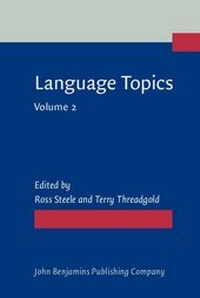
Language Topics
Essays in honour of Michael Halliday. Volume 2
1st Edition
Published on 1. January 1987
XVI, 669 pages
978-90-272-8623-9 (ISBN)
Description

This second volume in honour of Michael Halliday contains three sections: The Design of Language, Text and Discourse and Exploring Language as Social Semiotic, and concludes with a recent interview conducted by Paul Thibault in which Halliday provides further insights in his theory of language. The essential design features of language are semantic, lexico-grammatical and phonological. Text for Halliday is a semantic unit expressed by the lexico-grammatical and phonological patterns in language. The papers in the first section study aspects of these three strata of language and the relation between them. The second section deals with units higher than the clause complex and the papers there attempt to integrate the analysis of the lexico-grammatical and phonological systems into higher level discourse units. The papers in the third section develop the notion of language as social semiotic which is central to Haliday's model of language.
More details
Other editions
Additional editions
Book
01/1987
John Benjamins Publishing Co
€149.46
Shipment within 10-15 days
Content
- LANGUAGE TOPICS II
- Title page
- Copyright page
- Table of contents
- Contributors
- 1. The Design of Language
- Reproductive furniture and extinguished professors
- 1. Introduction
- 2. Affix types
- 3. Conclusion
- English intensifiers and their idiosyncrasies
- The tradition of structural analogy
- SYSPRO: a computerized method for writing system networks and deriving selection expressions
- Notes
- Appendix
- Cultural, situational and modal labels in dictionaries of English
- Morphological islands: constraint or preference?
- Notes
- Some "dia-categories
- Notes
- English quantifiers from noun sources
- Introduction
- Criteria for nouns and quantifiers
- What part of speech does Lot belong to?
- The historical source of quantifiers
- Quantifiers as a part of speech
- Conclusion
- Notes
- Two types of semantic widening and their relation to metaphor
- Trivial and nontrivial widening
- Semantic representation
- Some aspects of redundancy
- Background
- Construal
- Historical reconstruction
- Some aspects of disjunction and conjunction
- Semantic widening and metaphor
- Notes
- Note
- 2. Text and Discourse
- A comparison of process types in Poe and Melville
- Note
- Intonationand the grammar of speech
- Some preliminary evidence for phonetic adjustment strategies in communication difficulty
- Introduction
- The experiment
- Data analysis
- Sentence level
- Word level
- Segmental level
- Conclusion
- Note
- Evaluative text analysis
- Introduction
- Ideational analysis
- Interpersonal analysis
- Textual analysis
- Conclusion
- Gobbledegook: the tyranny of linguistic conceits
- Notes
- Text strategies: single, dual, multiple
- Introduction
- Definitions
- The text-strategic principle
- Two text categories
- Text strategies and rhetoric
- Text strategies and systemic functions
- Finishing other's talk: some structural and pragmatic features of completion offers
- 1. Introduction
- 2. A taxonomy of dimensions
- 3. Two illustrative cases
- Notes
- The textual basis of verbal inflections: the case of Yatzachi Zapotec
- Introduction
- Analytical procedures
- Correlations among the parameters of transitivity
- Syntactic independence and the transitivity hypothesis
- Mode, aspect and text structure
- Conclusion
- Notes
- On the concepts of "style" and "register" in sociolinguistics
- Introduction
- Style
- Register
- Conclusion
- Social constraints on grammatical variables: tense choice in English
- 1. Introduction
- 2. Description of the corpus
- 3. The grammatical variables: tense and recursion
- 4. Results
- 5. Interpretation of results
- 6. Conclusion
- Appendix
- Notes
- Some phonological constraints on grammatical formations: examples from four languages
- Introduction
- Classical Latin
- Classical Greek
- English
- Yurok
- Conclusion
- Notes
- Collocation: a progress report
- Introduction
- Two models of interpretation
- Collocation
- Collocation of back
- Upward collocates: back
- Downward collocates: back
- Conclusion
- Linguistic analysis of real estate commission agreements in a civil law suit
- 1. Introduction
- 2. Referencing analysis
- 3. Topic-comment analysis
- 4. Contrastive analysis
- 5. Conclusion
- Note
- Antithesis: astudy in clause combining and discourse structure
- 1. Introduction
- 2. The descriptive framework: a brief overview of rhetorical structure theory
- 3. The antithesis relation
- 4. The Antithesis relation and the hierarchical structure of texts
- 5. Conclusion
- Acknowledgments
- Notes
- 3. Exploring Language as Social Semiotic
- The hegemony of information
- The insatiable greediness of writing and printing
- Access to literacy as social power
- The economic specialization of literacy
- The production and consumption of information
- The rise of information monopolies
- The challenge to a global society
- Notes
- Many sentences and difficult texts
- Language, text, and human consciousness
- The rich decidability of language
- Conceptual aims in a study of difficult texts
- Text, reading, and interpretation
- Explaining moments of conflict in discourse
- 1. Introduction
- 2. Assumptions
- 3. Texts and conflicts
- 4. Intertextuality and typology
- Appendix
- Is there a literary language?
- 1. Introduction
- 2. Literary language: a brief history of definitions
- 3. Literature, literariness and discourse: some examples
- 4. Literariness, society and ideology
- 5. Integrating language and literature: pedagogical consequences
- 6. Conclusion
- Notes
- Coherence in language and culture
- Semiotics of document design
- Data, story, and texture
- Contextual configuration for statistical text
- Data reduction, sublanguage, graphics
- Verbal/visible language and semiotic structure of situation
- Notes on critical linguistics
- 1. Introduction
- 2. Participant roles
- 3. Speech as action
- 4. The uses of speakers
- 5. Other participant roles
- The structure of situations and the analysis of text
- Introduction
- Situation type as a socio-cultural knowledge system
- The structure of situation
- Theory texts and practical texts
- Conclusion
- The place of socio-semiotics in contemporary thought
- 1. Introduction
- 2. Halliday's contributions to an emerging socio-biology
- 3. MATRIX: the multimodal analytic theory and research instrument of a constructional and evolutionary socio-biology
- Notes
- Changing the subject
- 1. Introduction
- 2. The subject of history in space and time: a linguistic analysis of Pope's version of Chaucer's House of Fame
- 3. Text and context: constructing a social semiotic theory
- 4. Subjectivity and the social semiotic codes
- 5. The texts
- 6. Context as semiotic construct
- 7. Genres
- 8. "Systemic choice instantiating metagrammatical meanings" - notes on reading the grammar
- 9. Conclusion
- Notes
- Appendix
- 4. An Interview with Michael Halliday
- An Interview with Michael Halliday
- Introduction
- Note
- List of references
