

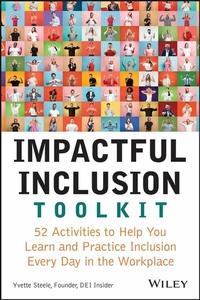
Impactful Inclusion Toolkit
Description

In Impactful Inclusion Toolkit: 52 Activities to Help You Learn and Practice Inclusion Every Day in the Workplace, accomplished diversity, equity, and inclusion (DEI) strategist and leader Yvette Steele delivers a collection of practical and hands-on exercises that encourage and promote inclusion in the workplace. The exercises emphasize the development of key inclusive behaviors, including self-knowledge, connecting with others, creating new habits, and experiencing other cultures.
In the book, you'll find:
* 52 behaviors to practice during the year that will empower you to be more inclusive in the real world
* Concrete instructions regarding how to become more inclusive, rather than just high-level information about inclusivity generally
* Actionable strategies to help drive change in your organization and manage the discomfort that sometimes exists around DEI issues
An effective and practical resource for anyone who wants to be more inclusive. Frontline and knowledge workers can empower themselves to drive change with weekly activities and resources. DEI and HR professionals, company founders, owners, managers, and other business leaders can better support staff on their inclusion journey. The Impactful Inclusion Toolkit is an essential addition to DEI strategies of any organization whether they are active or aspire to be more inclusive.
More details
Other editions
Additional editions
Person
YVETTE STEELE is a diversity, equity, and inclusion (DEI) leader whose career spans decades in sales, marketing, and DEI roles within small to mid-sized businesses to Fortune 500 organizations. Commonly the only person of color and/or the only woman at the company or on her team, the challenges faced at the beginning of her career persist today. Boldly committed to improving the lives of the millions of individuals with similar lived experiences, you'll find her calling out the issues and offering solutions on webinars, podcasts, and news articles. She has served on the DEI Advisory Committee for YMCA-USA, Tech Advisory Board Steering Committee for the National Urban League, and the DEI Task Force for Chicagoland Chamber of Commerce.
Content
Foreword xxv
Introduction xxix
Activity 1 Know Thyself 1
Actions 3
Create Mindful Interactions 3
Consider the Dynamics of Interactions 4
Enhance Your Social and Emotional Intelligence Skills 4
Action Accelerators 4
Sources Cited 5
Activity 2 Connect with Your Why, Find Your Why Now 7
Actions 10
Get Acquainted with Your Why 10
Keep Your Why Top of Mind 10
Go Beyond One-and-Done Training 11
Stay Connected to Your Why 11
Action Accelerators 11
Sources Cited 11
Activity 3 Create New Habits 13
Actions 15
Understand How Beliefs Impact Actions 15
Consider the Impact of Exclusion 15
Plan to Act on Your Inclusion Commitment Daily 16
Action Accelerators 16
Sources Cited 16
Activity 4 Make the Connection 17
Actions 19
Expose Yourself to Difference 19
Connect to the Issues 20
Facilitate Connections 20
Adjust Your Lens 20
Action Accelerators 20
Activity 5 Experience Other Cultures 23
Actions 26
Put Yourself in Spaces to Experience Various Cultures 26
Educate Yourself on the Cultures of Friends and Colleagues 26
Make Curiosity the Default 26
Action Accelerators 27
Activity 6 Remove the Labels 29
Actions 31
Expand Your View of People Beyond Race 31
Test Your Assumptions 31
Discern Whether Your Curiosity Comes from a Good Place 31
Action Accelerators 32
Sources Cited 32
Activity 7 Widen Your Perspective 33
Actions 36
Revisit Your Upbringing 36
Learn from Mistakes 36
Get Familiar with Thought Leaders of Difference 36
Action Accelerators 36
Activity 8 Slow Down Before You React 39
Actions 42
Look for Ways to Identify Your Microaggressions 42
Understand the Stereotypical Beliefs of Groups to
Which You Belong and How They Make You Feel 42
Raise Your Awareness of the Impact of Microaggressions 42
Action Accelerators 43
Sources Cited 43
Activity 9 Respect the Beliefs of Others 47
Actions 50
Find Common Ground 50
Understand the Why of Holy Day Observances 50
Break Bread Together 50
Action Accelerators 51
Sources Cited 51
Activity 10 Own Your Education 53
Actions 56
Embrace That Natural Is Natural 56
Reflect When Your Personal Space Was Violated 57
Create Your Black Hair Experience 57
Action Accelerators 57
Sources Cited 58
Activity 11 Focus on Ability 59
Actions 61
Acquire Disability Etiquette 61
Create a Lived Experience 61
Become an Advocate 61
Welcome Feedback 61
Action Accelerators 62
Sources Cited 62
Activity 12 Strive to See the Whole Person 63
Actions 65
Meet Your Biases 65
Stay Current on Inclusion Topics 66
Action Accelerators 66
Sources Cited 66
Activity 13 Aspire to Be an Ally 67
Actions 69
Educate Yourself on Allyship 69
Become an Advocate for Organizational Change 70
Create a Network of Aspiring Allies 70
Support Others in Living Company Diversity Values 70
Make an Ongoing Commitment 70
Action Accelerators 71
Sources Cited 71
Activity 14 Create an Inclusive Experience 73
Actions 76
Recognize Missed Opportunities 76
Participate in the Planning Process 76
Stop Chaos Before It Starts 76
Strengthen the Connection 77
Action Accelerators 77
Activity 15 Disrupt Power 79
Actions 82
Ensure That Everyone Can Be Heard 82
Decrease the Visibility of Power Dynamics 82
Encourage Sharing of Power 82
Action Accelerators 82
Sources Cited 83
Activity 16 Build Equality into the Day-to-Day 85
Actions 88
Create an Equitable System for Completing Menial Tasks 88
Assess Team Norms for Bias 88
Address Imbalanced Communications 89
Elevate and Amplify the Work of Women 89
Action Accelerators 89
Sources Cited 90
Activity 17 Devote Yourself to Critical Thinking 93
Actions 96
Strike a Balance 96
Collaborate with Other Inclusion Champions 96
Lead by Example 96
Develop a Framework for Critical Thinking 96
Action Accelerators 97
Sources Cited 97
Activity 18 Look Beyond Appearances 99
Actions 102
Resist the Temptation to Make a Visual Diagnosis 102
Make Support Ongoing 103
Consider a Day in the Life 103
Action Accelerators 103
Sources Cited 104
Activity 19 Invest in the Success of Others 105
Actions 108
Help Others Achieve Success 108
Reach 'Em While They're Young 109
Increase Exposure-Create Opportunity 109
Action Accelerators 109
Sources Cited 110
Activity 20 Lead Change One Word at a Time 111
Actions 115
Get to Know the Multigenerational Workforce 115
Mind Your Words 115
Action Accelerators 116
Activity 21 Practice Common Courtesy 117
Actions 119
Make Professionalism a Habit 119
Think Before You Speak 119
Express Gratitude 120
Meet and Greet with Authenticity 120
Self-Reflect 120
Action Accelerators 120
Activity 22 Amplify Voices That Aren't Being Heard 123
Actions 126
Build Inclusive Meetings 126
Empower Others to Amplify Their Own Voices 126
Explore Reasons That People Remain Silent 127
Seek Accomplices 127
Action Accelerators 127
Sources Cited 128
Activity 23 Engage Remote Colleagues with Intention 129
Actions 132
Develop Trust and Connection 132
Be Aware of Your Online Etiquette 133
Action Accelerators 133
Activity 24 Adopt Gender-Neutral Terminology 135
Actions 137
Increase Awareness of Masculine Terms 137
Help Others Not to Forget 138
Action Accelerators 139
Sources Cited 139
Activity 25 Foster an Environment of Trust 141
Actions 143
Self-Assess 143
Nurture Relationships 144
Model Consistency 144
Action Accelerators 144
Activity 26 If You See Something, Say Something 145
Actions 149
Translate Good Intent and Words into Meaningful Action 149
Learn to Recognize Acts of Exclusion 149
Action Accelerators 149
Sources Cited 150
Activity 27 Avoid Common Terms That Divide Us 153
Actions 156
Develop an Anti-racist and Anti-sexist Vocabulary 156
Resist the Temptation to Resist 156
Anticipate Feelings of Awkwardness 156
Action Accelerators 157
Sources Cited 157
Activity 28 Reframe Difficult Conversations on Polarizing Topics 159
Actions 163
Become Skilled at Having Courageous Conversations 163
Leverage Your Self-Awareness Developed in
Activity 1 and Activity 2 163
Say the Unsaid 163
Create Space to Listen to One Another 164
Action Accelerators 164
Activity 29 Embrace Gender Identities 165
Actions 168
Demonstrate Acceptance and Support 168
Recognize Impact Over Intent 168
Celebrate International Pronouns Day 169
Be a Continuous Learner 169
Action Accelerators 169
Sources Cited 170
Activity 30 Make the Workplace Safe for Everyone to Be Themselves 171
Actions 174
Get to Know What You Don't Know 174
Create Safe Havens to Connect 174
Action Accelerators 175
Activity 31 Don't Believe Your Lying Eyes-Test Assumptions 177
Actions 180
Be Aware of Occupational Stereotypes 180
Break Automatic Associations 180
Don't Credential Check 180
Action Accelerators 181
Sources Cited 181
Activity 32 Leverage Your Privilege 183
Actions 185
Know Your Privilege 185
Leverage Privilege Regularly 185
Raise Awareness Through the "Privilege Walk" 186
Action Accelerators 186
Activity 33 Support the Firsts, Fews, and Onlys 189
Actions 191
Be the Welcome Wagon 191
Course Correct Where You Can 192
Realize the Value of Being Inclusive 192
Action Accelerators 193
Activity 34 Cultivate Acceptance 195
Actions 198
Go Beyond Allyship-Be a Friend 198
Respect Identity 199
Learn the Facts 199
Observe Transgender Remembrance Day 199
Action Accelerators 199
Sources Cited 200
Activity 35 Be the Calm in the Storm 203
Actions 206
Acknowledge What's Happening 206
Remember to Check in Periodically 207
Learn the Why Behind Triggers 207
Action Accelerators 207
Activity 36 Acquire an Education on Race and Racism 209
Actions 215
Understand What CRT Is and What It Isn't 215
Observe How Race and Racism Are Reflected In Your
Workplace 215
Hold Yourself Accountable 216
Action Accelerators 216
Sources Cited 216
Activity 37 Go Beyond Performative Gestures 221
Actions 225
Be Real with Yourself 225
Learn to Recognize Personal Biases and Racist Tendencies 225
Move from a Place of Comfort to Growth 226
Action Accelerators 227
Sources Cited 227
Activity 38 Reconsider the Golden Rule 229
Actions 231
Create a Baseline 231
Honor the Signals 231
Re-evaluate an Encounter Gone Wrong 232
Action Accelerators 232
Sources Cited 232
Activity 39 Eliminate Double Standards 233
Actions 237
Hold the Privileged to the Same Standard That We Hold the Marginalized 237
Become Part of the Solution 238
Always Choose to Do the Right Thing 238
Action Accelerators 238
Activity 40 Remove the (Color) Blinders 239
Actions 243
Peel Back the Blinders to Color 243
Understand Racism Through the Lens of the
Oppressed 243
Seek Opportunities to Learn More 244
Action Accelerators 244
Sources Cited 244
Activity 41 Create a Community of Allies 247
Actions 249
Develop a Recruitment Plan 249
Look for Gaps in Expertise 249
Ensure Allyship Community Is Diverse 249
Action Accelerators 249
Activity 42 Pick a Ship and Get on It 251
Actions 257
Don't Limit Yourself to One Ship 257
Do Your Homework 257
Understand Personal Preferences 257
Action Accelerators 257
Sources Cited 258
Activity 43 Say Their Name 259
Actions 263
Create a Cheat Sheet 264
Double-Check
Before Sending 264
Prioritize the Preferred Name 264
Action Accelerators 265
Sources Cited 265
Activity 44 Master Small Talk Across Cultures 267
Actions 269
Get Curious 269
Be Agile in Your Approach 270
Create Space to Connect on a Personal Level 270
Action Accelerators 270
Sources Cited 271
Activity 45 Enable Uncovering 273
Actions 276
Develop Trust 276
Check Yourself 277
Let Vulnerability Show 277
Action Accelerators 277
Sources Cited 278
Activity 46 Diminish the Effects of Microaggressions 281
Actions 284
Facilitate Circles of Trust 284
Understand the Real Consequences of Microaggressions 285
Develop a Habit of Checking In 285
Practice Microaffirmations 285
Action Accelerators 286
Sources Cited 286
Activity 47 Affect Work-Life Balance for All 287
Actions 291
Establish New Personal Norms 291
Make a Collective Effort 292
Look for Warning Signs 292
Action Accelerators 292
Sources Cited 293
Activity 48 Value People Because of Difference-Not in Spite of 295
Actions 298
Get to Know Co-workers and the Skills They Bring 298
Be Mindful of Habits That Exclude 299
Seek Similarities 300
Action Accelerators 301
Sources Cited 301
Activity 49 Evolve from "Not Racist" to Antiracist 303
Actions 306
Reflect and Decide 306
Examine Your Beliefs About Race 307
Action Accelerators 308
Sources Cited 309
Activity 50 Create the Future by Learning from the Past 311
Actions 315
Launch a Truth Investigation 315
Revisit Your Why 315
Commit to the Process 316
Action Accelerators 316
Sources Cited 317
Activity 51 Be Willing to Learn from and Be Influenced by Others Who Are Different from You 319
Actions 322
Examine Equity and Inclusion from Multiple
Perspectives 322
Understand Your Power as an Influencer 323
Evaluate Your Influencers 323
Action Accelerators 323
Sources Cited 324
Activity 52 Honor Your Commitment to Inclusion 325
Actions 327
Lead the Way 327
Endeavor to Improve Every Day 327
Plan to Succeed Together 328
Begin Again 328
Action Accelerators 328
Index 331
Introduction
Have you ever found yourself wondering "What can I do to support diversity, equity, and inclusion (DEI) in the workplace?" I believe that at some time or other, many people ask themselves this question. Just imagine a place that you helped to create where everyone feels included and empowered to thrive in their authenticity. That's the place where everyone wants to be, and that's what we're striving for. Inclusion starts with the letter I-meaning that it starts with you. You begin by being Intentional. There's that I again. Your consistent intentional actions lead to impact or as I like to call it "Impactful Inclusion."
This book is born from my desire to help my many friends and colleagues who have approached me for guidance on how they can be a part of the solution to the inequities taking place not only in the workplace but society as a whole; and I love them for asking. Thank you for sparking this idea and creating this opportunity to share my personal experiences as well as those of family, friends, and colleagues.
There are hundreds of DEI books written for leaders and managers-people with positional authority. However, few books focus solely on the everyday person-the individual contributors who keep businesses humming. No matter their job role, everyone either experiences or perpetuates exclusion in daily interactions. We are often left without the tools or knowledge needed to recognize and address exclusive acts and replace them with acts of inclusion. My goal is to get this book in the hands of 10 million people for the good of all humanity. I believe that when we know better, we can do better. We can build a world where historically excluded people are included and valued.
Regardless of your position within an organization, you can incorporate the activities found here into your day-to-day interactions for better relationships, greater gratification, and profound business outcomes. You can be a catalyst for change. The key to success on your inclusion journey is to pack an open mind, receptivity to change, and willingness to learn. While these activities are simple, they may not always be easy. Inclusive behaviors are a skill, and like any skill, they will improve over time with practice. Lean into the discomfort. You're going to make mistakes. It's okay. It's how you learn. Stay with it. Visit my website, DEIinsider.com, for continued insights and resources. Join others on the journey by engaging in our LinkedIn group "Champions of Inclusion."
The Merriam-Webster dictionary has several definitions of inclusion. I was thrilled to see this one: "the act or practice of including and accommodating people who have historically been excluded (as because of their race, gender, sexuality, or ability)."
I remember a time when inclusion simply meant the act of being included. We've evolved into a society with an increased awareness and sense of responsibility to make the world inclusive for all. Throughout the book, I use the term "we," referring to you the reader, and me the author, as I am working to become more inclusive along with you. Thank you for joining me on this journey.
How to Use This Book
Let me begin by saying that this is not a quick read over the weekend; rather, it should be taken in weekly doses where you make time to acquire a new skill to practice every week until it becomes a habit. Journal about your reflections, what you've discovered about yourself and others. Capture successes and lessons learned. Celebrate wins.
Inclusion is everybody's job that anybody can do. Place this book somewhere where it will stay top of mind. Set weekly reminders to build your inclusion muscle. Each week, work to incorporate the actions into your day-to-day interactions and review the action accelerators to increase your understanding. My hope is that your successes and energy will lead to others joining you. Journeys are always more fun when you share them with others. There are 52 activities. Start with the first one of getting to know yourself. When you get to activity number 52, begin again at 1, and note how much you've evolved. Imagine the impact you'll make year after year.
Commit to actively changing thought processes and behaviors that ultimately create more inclusive work environments. Above all, enjoy the journey!
My Battle with Exclusion
I grew up during a time where societal norms judged and frowned upon divorcées, single motherhood, working mothers, men marrying women with children, and other ridiculous beliefs that in effect stigmatized women like my mother. Society got to decide who was acceptable and unacceptable or worthy of respect. My mother was raised in poverty in the slums of Chicago by a single mother and never met her father. A blend of German, African American, and Cherokee Indian, her green eyes, French vanilla skin, and long sandy brown hair made her stick out like a cherry in a bowl of milk. I recall the dozens of stories she shared, lamenting about the bullying at school, or the summers spent in Minot, North Dakota, with White family members, and the impact of constant reminders of the darkness of her skin. By the age of 25, she had been through two divorces and had two children. I was three years old and the youngest when she and my father went their separate ways. But I have to give it to her: Mom was a strong and determined woman. With the support of her mother and uncle, she attended nursing school while my grandmother cared for me and my brother. Looking back, I can only imagine the scars and the emotional trauma she endured and carried her entire life just trying to fit in. Those experiences definitely informed the way she cared for her children. She was determined to be accepted by society no matter the cost.
My first brush with exclusion happened when I was five. My mom took me and Tonia (not her real name), the five-year-old daughter of her best friend out for shopping and dinner. She dressed me in an outfit that made me feel like an old lady. I'll never forget that hideous blue ruffled front dress with lace-top ankle socks that kept sliding down into the back of my black patent leather Mary Jane shoes. I wore thick cat eyeglasses, and my hair was pulled into a wild, bushy ponytail. I envied Tonia. Her hair was pressed bone straight and cascaded just past her shoulders. She wore the cutest jumper and go-go boots. And my mother? Well, stunning. Her hair swept into a French roll, and she wore a knee-length sheath that not only accentuated her curves, but it was also a shade of green matching her eyes. Everywhere we went, compliments poured about the beauty of her daughter Tonia and how much she looked like her mother. Mom beamed at every flattery while I waited for her to correct them and identify me as her daughter. By the third instance, my eyes welled with tears. I could not understand why I wasn't her daughter that day. I did not realize until I was well into my 40s that it was her desire to fit in with the picture-perfect child that drove her decisions to not correct the mistaken identity.
She remarried when I was seven. Soon after, my brother started living with his paternal grandmother. I was told that he chose to leave us because his grandmother promised him a dog. Mother explained that she wanted no one who desired a dog over her, so she opened the door and allowed him to leave at only 11 years of age. I felt abandoned. How could he leave me as well for a dog? Why couldn't I go too? I don't recall him ever saying goodbye. He just left for a weekend visit with his grandmother and never returned. I now believe that the stigma of a ready-made family led to my brother's quick departure. Alone, I tried hard to be the perfect daughter for my mom and stepdad. Turns out, I was awful at being perfect and was criticized or punished for every spoken and unspoken rule I ever broke. I maintained a relationship over the phone with my brother for a few years as best I could, but eventually that wasn't enough, and we grew apart. Three years into the marriage, my sister was born. Mother blamed me for having to give birth to another child because I could not bring myself to call my stepfather "daddy," something he so desperately wanted. For me, it felt too awkward to say "daddy" to someone with whom I had no emotional connection. I knew my father, and he was daddy to me. My sister was my stepfather's first child and would ultimately become his only child. The excitement from his family members around her birth brought frequent visitors and loads of gifts. Often, these visits relegated me to another room rendering me invisible. Seemingly, no one wanted to engage with the child from the previous marriage. I remember stepping out once to see all the presents, and when I attempted to touch one, I was scolded by one of his relatives. There was one relative who visited for years every weekend bearing gifts, none of which were ever for me, and she made that clear. By the time I was 11 years old, I was made to feel unlovable regardless of how hard I tried. I could not remember the last time I saw or even spoke to my biological father. Attempts to connect with him were forbidden because he never paid child support. The photos of him that I had hidden in a drawer were discovered and destroyed. It's as if my mother wanted to wipe out his existence. Except, there I was, a constant reminder of her past. In the midst of struggles to fit in at home, I still had a privileged life. I attended private schools off and on,...
