

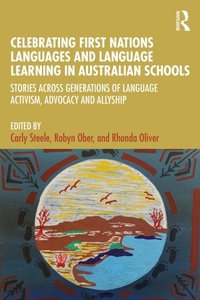
Celebrating First Nations Languages and Language Learning in Australian Schools
Stories Across Generations of Language Activism, Advocacy and Allyship
1st Edition
Published on 30. April 2025
278 pages
978-1-040-34916-8 (ISBN)
Description

This book introduces key underlying principles for teaching First Nations languages and language learners in schools across a range of contexts. It takes a comprehensive approach covering traditional languages, new languages, and English.
At a critical time for Indigenous languages across the globe, the United Nations Decade of Indigenous Languages (2022-2032) draws attention to the endangerment of these languages and advocates for the role of education to preserve and revitalise Indigenous languages. At the same time, many new language varieties spoken by Indigenous peoples often remain unrecognised in education systems, and their English language learning needs are left unaddressed. This book provides crucial information to enhance the reader's knowledge of these critical issues in language and education with a view to promote future action. The chapters showcase the advocacy, activism, and allyship for First Nations languages and language learners undertaken by educators, education systems, and researchers in Australia. With a practical focus, this book illustrates innovative and contemporary approaches to language learning for First Nations students; educators can use this text to guide and develop language-learning approaches in their respective contexts.
This is a foundational resource for both Indigenous and non-Indigenous teachers and aspiring teachers alike, and all education professionals who appreciate the fundamental importance of language in education.
At a critical time for Indigenous languages across the globe, the United Nations Decade of Indigenous Languages (2022-2032) draws attention to the endangerment of these languages and advocates for the role of education to preserve and revitalise Indigenous languages. At the same time, many new language varieties spoken by Indigenous peoples often remain unrecognised in education systems, and their English language learning needs are left unaddressed. This book provides crucial information to enhance the reader's knowledge of these critical issues in language and education with a view to promote future action. The chapters showcase the advocacy, activism, and allyship for First Nations languages and language learners undertaken by educators, education systems, and researchers in Australia. With a practical focus, this book illustrates innovative and contemporary approaches to language learning for First Nations students; educators can use this text to guide and develop language-learning approaches in their respective contexts.
This is a foundational resource for both Indigenous and non-Indigenous teachers and aspiring teachers alike, and all education professionals who appreciate the fundamental importance of language in education.
More details
Edition
1. Auflage
Language
English
Place of publication
London
United Kingdom
Publishing group
Taylor & Francis Ltd
Target group
College/higher education
Professional and scholarly
Illustrations
7 Tables, black and white; 2 Line drawings, black and white; 23 Halftones, black and white; 25 Illustrations, black and white
File size
12,84 MB
ISBN-13
978-1-040-34916-8 (9781040349168)
Copyright in bibliographic data and cover images is held by Nielsen Book Services Limited or by the publishers or by their respective licensors: all rights reserved.
Schweitzer Classification
Other editions
Additional editions

Celebrating First Nations Languages and Language Learning in Australian Schools
Stories Across Generations of Language Activism, Advocacy and Allyship
Book
05/2025
Routledge
Unfortunately, price unknown
Available (delivery time upon request)
Carly Steele | Robyn Ober | Rhonda Oliver
Celebrating First Nations Languages and Language Learning in Australian Schools
Stories Across Generations of Language Activism, Advocacy and Allyship
Book
04/2025
1st Edition
Routledge
€53.40
Shipment within 10-20 days
Carly Steele | Robyn Ober | Rhonda Oliver
Celebrating First Nations Languages and Language Learning in Australian Schools
Stories Across Generations of Language Activism, Advocacy and Allyship
Book
04/2025
1st Edition
Routledge
€207.90
Shipment within 10-20 days
Persons
Carly Steele is a non-Indigenous applied linguist and qualified teacher with experience in diverse educational contexts. She holds the position of Senior Lecturer and Master of Education course coordinator in the School of Education at Curtin University, Perth. Her research focuses on culturally and linguistically responsive pedagogies.
Robyn Ober is a Mamu/Djirribal woman from North Queensland. She is the Indigenous research practice leader at Batchelor Institute. Her research focus and expertise is on both-ways pedagogy, working to combine Indigenous and non-Indigenous ways of knowing, being and learning in teaching practice and research.
Rhonda Oliver has researched extensively in the areas of second language and dialect acquisition, and task-based language learning. Her recent work includes studies within Australian Aboriginal education settings. She co-edited the award-winning textbook Indigenous Education in Australia Learning and Teaching for Deadly Futures.
Robyn Ober is a Mamu/Djirribal woman from North Queensland. She is the Indigenous research practice leader at Batchelor Institute. Her research focus and expertise is on both-ways pedagogy, working to combine Indigenous and non-Indigenous ways of knowing, being and learning in teaching practice and research.
Rhonda Oliver has researched extensively in the areas of second language and dialect acquisition, and task-based language learning. Her recent work includes studies within Australian Aboriginal education settings. She co-edited the award-winning textbook Indigenous Education in Australia Learning and Teaching for Deadly Futures.
Content
Introduction
Part One: Contexts, Theories, Principles, Practices and Protocols for Language Learning and Teaching in Schools
1. Language Learning in Schools: Contexts, Theories and Practice
2. Consent, Copyright, Consultation, Collaboration and Co-design: Principles & Protocols for Developing School Language Programs
Part Two: Learning and Teaching Traditional Aboriginal and Torres Strait Islander Languages in Schools
3. Teaching Aboriginal Languages as First Languages in the Northern Territory: Reflections of Educators in the Warlpiri Triangle and Yol?u Communities
4. Teaching First Nations Languages in Queensland Schools
5. Western Australia Department of Education, Aboriginal Languages Teaching Training Course
6. The Journey to the Opening of Gumbaynggirr Giingana Freedom School
Part Three: Aboriginal and Torres Strait Islander Contact Languages in Education
7. The Diverse Indigenous Creole Languages and First Nations Language Repertoires in Queensland, with Information for Educators
8. Kriol in the Northern Territory
9. Aboriginal English in Education
Part Four: Learning and Teaching the Curriculum through Aboriginal and Torres Strait Islander Languages
10. Gija Curriculum at Purnululu School
11. Content Language Integrated Learning (CLIL) for Learning Aboriginal and Torres Strait Islander Languages
Part Five: Learning, Teaching and Assessing Learning in Standard Australian English for Speakers of Aboriginal and Torres Strait Islander Languages
12. Aboriginal and Torres Strait Islander Students' Language and Learning through a Both Ways Approach
13. Aboriginal and Torres Strait Islander Students' Language Learning for Literacy Development
14. Understanding the EAL/D Extra: Assessing English as an Additional Language or Dialect in First Nations Contexts
Conclusion
Part One: Contexts, Theories, Principles, Practices and Protocols for Language Learning and Teaching in Schools
1. Language Learning in Schools: Contexts, Theories and Practice
2. Consent, Copyright, Consultation, Collaboration and Co-design: Principles & Protocols for Developing School Language Programs
Part Two: Learning and Teaching Traditional Aboriginal and Torres Strait Islander Languages in Schools
3. Teaching Aboriginal Languages as First Languages in the Northern Territory: Reflections of Educators in the Warlpiri Triangle and Yol?u Communities
4. Teaching First Nations Languages in Queensland Schools
5. Western Australia Department of Education, Aboriginal Languages Teaching Training Course
6. The Journey to the Opening of Gumbaynggirr Giingana Freedom School
Part Three: Aboriginal and Torres Strait Islander Contact Languages in Education
7. The Diverse Indigenous Creole Languages and First Nations Language Repertoires in Queensland, with Information for Educators
8. Kriol in the Northern Territory
9. Aboriginal English in Education
Part Four: Learning and Teaching the Curriculum through Aboriginal and Torres Strait Islander Languages
10. Gija Curriculum at Purnululu School
11. Content Language Integrated Learning (CLIL) for Learning Aboriginal and Torres Strait Islander Languages
Part Five: Learning, Teaching and Assessing Learning in Standard Australian English for Speakers of Aboriginal and Torres Strait Islander Languages
12. Aboriginal and Torres Strait Islander Students' Language and Learning through a Both Ways Approach
13. Aboriginal and Torres Strait Islander Students' Language Learning for Literacy Development
14. Understanding the EAL/D Extra: Assessing English as an Additional Language or Dialect in First Nations Contexts
Conclusion
