

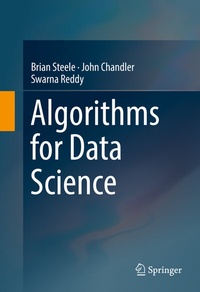
Algorithms for Data Science
Published on 25. December 2016
XXIII, 430 pages
978-3-319-45797-0 (ISBN)
Description

This textbook on practical data analytics unites fundamental principles, algorithms, and data. Algorithms are the keystone of data analytics and the focal point of this textbook. Clear and intuitive explanations of the mathematical and statistical foundations make the algorithms transparent. But practical data analytics requires more than just the foundations. Problems and data are enormously variable and only the most elementary of algorithms can be used without modification. Programming fluency and experience with real and challenging data is indispensable and so the reader is immersed in Python and R and real data analysis. By the end of the book, the reader will have gained the ability to adapt algorithms to new problems and carry out innovative analyses.
This book has three parts:(a) Data Reduction: Begins with the concepts of data reduction, data maps, and information extraction. The second chapter introduces associative statistics, themathematical foundation of scalable algorithms and distributed computing. Practical aspects of distributed computing is the subject of the Hadoop and MapReduce chapter.(b) Extracting Information from Data: Linear regression and data visualization are the principal topics of Part II. The authors dedicate a chapter to the critical domain of Healthcare Analytics for an extended example of practical data analytics. The algorithms and analytics will be of much interest to practitioners interested in utilizing the large and unwieldly data sets of the Centers for Disease Control and Prevention's Behavioral Risk Factor Surveillance System.(c) Predictive Analytics Two foundational and widely used algorithms, k-nearest neighbors and naive Bayes, are developed in detail. A chapter is dedicated to forecasting. The last chapter focuses on streaming data and uses publicly accessible data streams originating from the Twitter API and the NASDAQ stock market in the tutorials.
This book is intended for a one- or two-semester course in data analytics for upper-division undergraduate and graduate students in mathematics, statistics, and computer science. The prerequisites are kept low, and students with one or two courses in probability or statistics, an exposure to vectors and matrices, and a programming course will have no difficulty. The core material of every chapter is accessible to all with these prerequisites. The chapters often expand at the close with innovations of interest to practitioners of data science. Each chapter includes exercises of varying levels of difficulty. The text is eminently suitable for self-study and an exceptional resource for practitioners.
This book has three parts:(a) Data Reduction: Begins with the concepts of data reduction, data maps, and information extraction. The second chapter introduces associative statistics, themathematical foundation of scalable algorithms and distributed computing. Practical aspects of distributed computing is the subject of the Hadoop and MapReduce chapter.(b) Extracting Information from Data: Linear regression and data visualization are the principal topics of Part II. The authors dedicate a chapter to the critical domain of Healthcare Analytics for an extended example of practical data analytics. The algorithms and analytics will be of much interest to practitioners interested in utilizing the large and unwieldly data sets of the Centers for Disease Control and Prevention's Behavioral Risk Factor Surveillance System.(c) Predictive Analytics Two foundational and widely used algorithms, k-nearest neighbors and naive Bayes, are developed in detail. A chapter is dedicated to forecasting. The last chapter focuses on streaming data and uses publicly accessible data streams originating from the Twitter API and the NASDAQ stock market in the tutorials.
This book is intended for a one- or two-semester course in data analytics for upper-division undergraduate and graduate students in mathematics, statistics, and computer science. The prerequisites are kept low, and students with one or two courses in probability or statistics, an exposure to vectors and matrices, and a programming course will have no difficulty. The core material of every chapter is accessible to all with these prerequisites. The chapters often expand at the close with innovations of interest to practitioners of data science. Each chapter includes exercises of varying levels of difficulty. The text is eminently suitable for self-study and an exceptional resource for practitioners.
Reviews / Votes
"This 430-page book contains an excellent collection of information on the subject of practical algorithms used in data science. The discussion of each algorithm starts with some basic concepts, followed by a tutorial with real datasets and detailed code examples in Python or R. Each chapter has a set of exercise problems so readers can practice the concepts learned in the chapter. . a good reference for practitioners, or a good textbook for graduate or upper-class undergraduate students." (Xiannong Meng, Computing Reviews, September, 2017)
"This textbook on practical data analytics unites fundamental principles, algorithms, and data. . this book is devoted to upper-division undergraduate and graduate students in mathematics, statistics, and computer science. It is intended for a one- or two-semester course in data analytics and reflects the authors' research experience in data science concepts and the teaching skills in various areas. . The text is eminently suitable for self-study and an exceptional resource for practitioners." (Krzysztof J. Szajowski, zbMATH 1367.62005, 2017)More details
Series
Edition
1st ed. 2016
Language
English
Place of publication
Cham
Switzerland
Publishing group
Springer International Publishing
Target group
Primary & secondary/elementary & high school
Product notice
Reflowable
Illustrations
XXIII, 430 p. 48 illus., 30 illus. in color.
ISBN-13
978-3-319-45797-0 (9783319457970)
DOI
10.1007/978-3-319-45797-0
Schweitzer Classification
Other editions
Additional editions
Brian Steele | John Chandler | Swarna Reddy
Algorithms for Data Science
Book
12/2016
Springer
€96.29
Shipment within 10-15 days
Persons
Brian Steele is a full professor of Mathematics at the University of Montana and a Senior Data Scientist for SoftMath Consultants, LLC. Dr. Steele has published on the EM algorithm, exact bagging, the bootstrap, and numerous statistical applications. He teaches data analytics and statistics and consults on a wide variety of subjects related to data science and statistics.
John Chandler has worked at the forefront of marketing and data analysis since 1999. He has worked with Fortune 100 advertisers and scores of agencies, measuring the effectiveness of advertising and improving performance. Dr. Chandler joined the faculty at the University of Montana School of Business Administration as a Clinical Professor of Marketing in 2015 and teaches classes in advanced marketing analytics and data science. He is one of the founders and Chief Data Scientist for Ars Quanta, a Seattle-based data science consultancy.
Dr. Swarna Reddy is the founder, CEO, and a Senior Data Scientist for SoftMath Consultants, LLC and serves as a faculty affiliate with the Department of Mathematical Sciences at the University of Montana. Her area of expertise is computational mathematics and operations research. She is a published researcher and has developed computational solutions across a wide variety of areas spanning bioinformatics, cybersecurity, and business analytics.
John Chandler has worked at the forefront of marketing and data analysis since 1999. He has worked with Fortune 100 advertisers and scores of agencies, measuring the effectiveness of advertising and improving performance. Dr. Chandler joined the faculty at the University of Montana School of Business Administration as a Clinical Professor of Marketing in 2015 and teaches classes in advanced marketing analytics and data science. He is one of the founders and Chief Data Scientist for Ars Quanta, a Seattle-based data science consultancy.
Dr. Swarna Reddy is the founder, CEO, and a Senior Data Scientist for SoftMath Consultants, LLC and serves as a faculty affiliate with the Department of Mathematical Sciences at the University of Montana. Her area of expertise is computational mathematics and operations research. She is a published researcher and has developed computational solutions across a wide variety of areas spanning bioinformatics, cybersecurity, and business analytics.
Content
Introduction.- Data Mapping and Data Dictionaries.- Scalable Algorithms and Associative Statistics.- Hadoop and MapReduce.- Data Visualization.- Linear Regression Methods.- Healthcare Analytics.- Cluster Analysis.- k-Nearest Neighbor Prediction Functions.- The Multinomial Naive Bayes Prediction Function.- Forecasting.- Real-time Analytics.
