

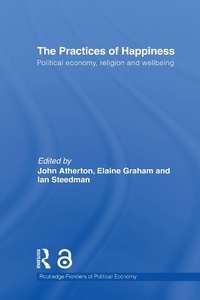
The Practices of Happiness
Political Economy, Religion and Wellbeing
Published on 3. August 2010
240 pages
978-1-136-93754-5 (ISBN)
Description

A PDF version of this book is available for free in open access via www.tandfebooks.com as well as the OAPEN Library platform, www.oapen.org. It has been made available under a Creative Commons Attribution-Non Commercial-No Derivatives 3.0 license and is part of the OAPEN-UK research project.
There is growing evidence that rising levels of prosperity in Western economies since 1945 have not been matched by greater incidences of reported well-being and happiness. Indeed, material affluence is often accompanied instead by greater social and individual distress. A growing literature within the humanities and social sciences is increasingly concerned to chart not only the underlying trends in recorded levels of happiness, but to consider what factors, if any, contribute to positive and sustainable experiences of well-being and quality of life. Increasingly, such research is focusing on the importance of values and beliefs in human satisfaction or quality of life; but the specific contribution of religion to these trends is relatively under-examined. This unique collection of essays seeks to rectify that omission, by identifying the nature and role of the religious contribution to wellbeing.
A unique collection of nineteen leading scholars from the field of economics, psychology, public theology and social policy have been brought together in this volume to explore the religious contribution to the debate about happiness and well-being. These essays explore the religious dimensions to a number of key features of well-being, including marriage, crime and rehabilitation, work, inequality, mental health, environment, participation, institutional theory, business and trade. They engage particularly closely with current trends in economics in identifying alternative models of economic growth which focus on its qualitative as well as quantitative dimensions.
This unique volume brings to public notice the nature and role of religion's contribution to wellbeing, including new ways of measurement and evaluation. As such, it represents a valuable and unprecedented resource for the development of a broad-based religious contribution to the field. It will be of particular relevance for those who are concerned about the continuing debate about personal and societal well-being, as well as those who are interested in the continuing significance of religion for the future of public policy.
There is growing evidence that rising levels of prosperity in Western economies since 1945 have not been matched by greater incidences of reported well-being and happiness. Indeed, material affluence is often accompanied instead by greater social and individual distress. A growing literature within the humanities and social sciences is increasingly concerned to chart not only the underlying trends in recorded levels of happiness, but to consider what factors, if any, contribute to positive and sustainable experiences of well-being and quality of life. Increasingly, such research is focusing on the importance of values and beliefs in human satisfaction or quality of life; but the specific contribution of religion to these trends is relatively under-examined. This unique collection of essays seeks to rectify that omission, by identifying the nature and role of the religious contribution to wellbeing.
A unique collection of nineteen leading scholars from the field of economics, psychology, public theology and social policy have been brought together in this volume to explore the religious contribution to the debate about happiness and well-being. These essays explore the religious dimensions to a number of key features of well-being, including marriage, crime and rehabilitation, work, inequality, mental health, environment, participation, institutional theory, business and trade. They engage particularly closely with current trends in economics in identifying alternative models of economic growth which focus on its qualitative as well as quantitative dimensions.
This unique volume brings to public notice the nature and role of religion's contribution to wellbeing, including new ways of measurement and evaluation. As such, it represents a valuable and unprecedented resource for the development of a broad-based religious contribution to the field. It will be of particular relevance for those who are concerned about the continuing debate about personal and societal well-being, as well as those who are interested in the continuing significance of religion for the future of public policy.
More details
Series
Language
English
Place of publication
London
United Kingdom
Publishing group
Taylor & Francis Ltd
Target group
College/higher education
File size
1,21 MB
ISBN-13
978-1-136-93754-5 (9781136937545)
Copyright in bibliographic data and cover images is held by Nielsen Book Services Limited or by the publishers or by their respective licensors: all rights reserved.
Schweitzer Classification
Other editions
Additional editions
Ian Steedman | John R. Atherton | Elaine Graham
The Practices of Happiness
Political Economy, Religion and Wellbeing
Book
11/2013
1st Edition
Routledge
€71.60
Shipment within 15-20 days
Ian Steedman | John R. Atherton | Elaine Graham
The Practices of Happiness
Political Economy, Religion and Wellbeing
Book
07/2010
1st Edition
Routledge
€206.80
Shipment within 15-20 days
Persons
John Atherton is Canon Theologian Emeritus of Manchester Cathedral and Honorary Research Fellow of the William Temple Foundation and of Manchester University, UK, with doctorates from Manchester and Uppsala Universities. His research and publishing interests have increasingly focused on the relationship between political economy and religion.
Elaine Graham is Grosvenor Research Professor of Practical Theology at the University of Chester, UK, and was until October 2009 the Samuel Ferguson Professor of Social and Pastoral Theology at the University of Manchester, UK.
Ian Steedman has been professor of economics at Manchester University and Manchester Metropolitan University, UK. He has a longstanding involvement in microeconomic theory, the history of economic thought and in the intersections among economics, ethics and social thought.
Elaine Graham is Grosvenor Research Professor of Practical Theology at the University of Chester, UK, and was until October 2009 the Samuel Ferguson Professor of Social and Pastoral Theology at the University of Manchester, UK.
Ian Steedman has been professor of economics at Manchester University and Manchester Metropolitan University, UK. He has a longstanding involvement in microeconomic theory, the history of economic thought and in the intersections among economics, ethics and social thought.
Content
Introductory essay: developing an overview as context and future John Atherton Part 1: Political Economy 1. Economic theory and happiness Ian Steedman 2. Happiness, welfare and capabilities Carl-Henric Grenholm 3. Happiness through thrift: The contribution of business to human wellbeing Peter Heslam 4. Happiness, work and Christian theology Peter Sedgwick 5. Happiness isn't working, but it should be Malcolm Brown 6. Challenging inequality in a post-scarcity era: Christian contributions to egalitarian trends John Atherton 7. Fair trade and human wellbeing Michael Northcott Part 2: Contributions to Other Social Sciences 8. Religion and happiness: perspectives from the psychology of religion, positive psychology and empirical theology Leslie Francis 9. Ethnographic insights into happiness Jonathan Miles-Watson 10. Institutions, organisations and wellbeing Tony Berry 11. Religion, family form and the question of happiness Adrian Thatcher12. Mental health, spirituality and religion Peter Gilbert 13. The 'one in the morning' knock: exploring the connections between faith, participation and wellbeing Christopher Baker 14. Crime, wellbeing and society: Reflections on social, 'anti-social' and 'restorative' capital Christopher Jones 15. Supporting offenders: A faith based initiative Charlotte Lorimer Part 3: Reflections on Foundations 16. Human happiness as a common good: clarifying the issues Patrick Riordan 17. Being well in creation John Rodwell 18.The 'virtuous circle': Religion and the practices of happiness Elaine Graham 19 Well being - or resilience? Blurred encounters between theory and practice John Reader
