

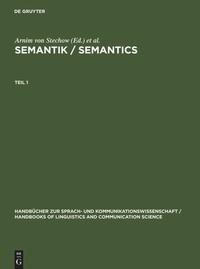
Semantik / Semantics
Description

During the past 20 years the investigation into meaning of natural languages has emerged into one of the most active disciplines in theoretical linguistics. The different traditions of linguistics, philosophy of language and philosophical logic converged in the paradigm of truth conditional semantics, which now plays a central role in the cognitive sciences. From empirical research in particular languages more principal questions arise of how the speaker succeeds in expressing particular types of meaning by use of formal combination of signs. The theories developed to cope with the question assume that for a hearer, the meaning of a complex expression must be "computable", and therefore, modern theoretical semantics uses formal algebraic methods to construct the meaning compositionally in view of syntactic structur. Furthermore, meaning need to be "anchored" in the experience available to hearer.
In order to deal with this, theoretical semantics extensivly uses the concept of truth conditions, which roughly explain how a world must be structured in order to be matched by certain linguistic expressions. Semantic analyses are complemented by context theory and the theory of speech acts. Thus, linguistic meaning must be related to human cognitive capacities, and therefore, theoretical semantics is tightly connected with philosophical logic as well as cognitive sciences in general.
The aim of this handbook is to represent the body of theoretical knowledge which has evolved in the international research of the last two decades. Some of the theories can now be termed "classical" in that they belong to the commonly accepted base of theoretical semantics. Other theories are still disputed, and there areproblems still to be solved - as normal in a more developed science. The authors, who are leading experts in the field of semantics, try to balance the accepted and the questionable results. It goes without saying that each author hold a particular position in this respect. Some articles are written in English, some in German. Since semantics is considered to be a subfield of linguistics, the articles are arranged due to linguistic points of view. In the first 5 chapters (comprising 15 articles) the common principles of semantics are presented: ontological foundations of semantics, composition of meaning, problems of use (context, speech acts, and lexical base of meaning. The next 5 chapters (comprising 25 articles) are concerned with semantic phenomena, theories and problems which are specific for a particular class of linguistic expressions. These are arranged according to parts of speech: nouns, functional categories, verbs, adjectives and so on.This division does not reflect a theoretical position by itself, however it allows one to recognize problems connected with one another. Some more general questions are discussed in more than one article, in different perspective and vicinity.
The Handbook is complemented by a service article on formal methods in semantics, followed by a comprehensive bibliography including about 1700 entries, and both a subject and a name index. This handbook is indispensable for all research in linguistics and neighboring disciplines (philosophy of language, cognitive sciences). Some of the articles can serve as basic literature for classes of advanced students.
More details
Other editions
Additional editions
Content
2 - Preface [Seite 8]
3 - Inhalt [Seite 11]
4 - I. Allgemeine Grundlagen [Seite 14]
4.1 - 1. Bedeutungstheorien [Seite 14]
4.1.1 - 1. Geschichte und Gegenstand der Semantik [Seite 14]
4.1.2 - 2. Einige Zugänge zur semantischen Theorie [Seite 20]
4.1.3 - 3. Literatur (in Kurzform) [Seite 36]
4.2 - 2. Basic Concepts of Semantics [Seite 14]
4.2.1 - 1. The Subject Matter of Semantic Theory [Seite 37]
4.2.2 - 2. Sentence Meaning [Seite 38]
4.2.3 - 3. Compositionality [Seite 38]
4.2.4 - 4. Interpretation [Seite 39]
4.2.5 - 5. Structural Ambiguity [Seite 40]
4.2.6 - 6. Wellformedness and Interpretability [Seite 40]
4.2.7 - 7. Semantics and Psychology [Seite 40]
4.2.8 - 8. Truth-Conditions and Use [Seite 41]
4.2.9 - 9. Possible World Semantics and Logic [Seite 41]
4.2.10 - 10. Bibliographical Appendix [Seite 44]
4.2.11 - 11. Short Bibliography [Seite 44]
4.3 - 3. Bedeutung und Gebrauch [Seite 14]
4.3.1 - 1. Satzbedeutung, Äußerungsbedeutung und kommunikativer Sinn [Seite verschiedene Aspekte von Bedeutung und von Gebrauch45]
4.3.2 - 2. Struktur-Repräsentation versus Prozeß [Seite 48]
4.3.3 - 3. Methodische Eingrenzung der Domäne der Semantik [Seite 50]
4.3.4 - 4. Zweistufige Semantik [Seite 54]
4.3.5 - 5. Modularität des Sprachgebrauchs: Bedeutung und Interaktionssystem [Seite 57]
4.3.6 - 6. Modularität der Bedeutung: Semantik und konzeptuelles System [Seite 61]
4.3.7 - 7. Literatur (in Kurzform) [Seite 65]
4.4 - 4. Wortsemantik [Seite 66]
4.4.1 - 1. Begriffliche Unterscheidungen [Seite 66]
4.4.2 - 2. Das Problem der logischen Wörter [Seite 68]
4.4.3 - 3. Die Semantik der Inhaltswörter: Wortbildung [Seite 71]
4.4.4 - 4. Die Semantik der Inhaltswörter: Simpliziabedeutungen [Seite 74]
4.4.5 - 5. Literatur (in Kurzform) [Seite 83]
5 - II. Probleme der ontologischen Grundlegung: Welt versus Situation [Seite 84]
5.1 - 5. Die Weltsituation [Seite 84]
5.1.1 - 1. Ziel [Seite 84]
5.1.2 - 2. Situationssemantik [Seite 84]
5.1.3 - 3. Situationen als Propositionen [Seite 85]
5.1.4 - 4. Situationen als Welten [Seite 90]
5.1.5 - 5. Situationen als Ereignisse [Seite 92]
5.1.6 - 6. Schluß [Seite 93]
5.1.7 - 7. Literatur (in Kurzform) [Seite 93]
5.2 - 6. Situationen und kleine Welten [Seite 93]
5.2.1 - 1. Vorbemerkungen [Seite 93]
5.2.2 - 2. Die Grundbegriffe der beidenTheorien [Seite 95]
5.2.3 - 3. Die wirkliche Welt und ihre Tatsachen [Seite 96]
5.2.4 - 4. Weltausschnitte [Seite 96]
5.2.5 - 5. Effizienz, Kontext und dierelationale Bedeutungstheorie [Seite 99]
5.2.6 - 6. Propositionen und Situationen [Seite 100]
5.2.7 - 7. Schluß [Seite 101]
5.2.8 - 8. Literatur (in Kurzform) [Seite 102]
6 - III. Theorie der Satzsemantik [Seite 103]
6.1 - 7. Syntax und Semantik [Seite 103]
6.1.1 - 1. Vorbemerkungen [Seite 103]
6.1.2 - 2. Allgemeine Grundlagen [Seite 104]
6.1.3 - 3. Montagues Universalgrammatik [Seite 114]
6.1.4 - 4. Kategorialgrammatik [Seite 133]
6.1.5 - 5. Generative Grammatik [Seite 144]
6.1.6 - 6. Syntaktische und semantische Stuktur [Seite 156]
6.1.7 - 7. Literatur (in Kurzform) [Seite 161]
6.2 - 8. Syntax and Semantics of Categorial Languages [Seite 161]
6.2.1 - 1. Preliminary Remarks [Seite 161]
6.2.2 - 2. Syntactic Categories [Seite 161]
6.2.3 - 3. Lambda-Abstraction [Seite 163]
6.2.4 - 4. Interpretation [Seite 165]
6.2.5 - 5. Lambda-Conversion and Transformations [Seite 166]
6.2.6 - 6. Short Bibliography [Seite 168]
7 - IV. Kontexttheorie [Seite 169]
7.1 - 9. Kontextabhängigkeit [Seite 169]
7.1.1 - 1. Die klassische Theorie [Seite 169]
7.1.2 - 2. Varianten und Alternativen [Seite 181]
7.1.3 - 3. Aspekte des Kontexts [Seite 199]
7.1.4 - 4. Probleme [Seite 214]
7.1.5 - 5. Historisch-bibliographische Anmerkungen [Seite 238]
7.1.6 - 6. Literatur (in Kurzform) [Seite 241]
7.2 - 10. Kontextveränderung [Seite 242]
7.2.1 - 1. Einleitung [Seite 242]
7.2.2 - 2. Pragmatische Folgerungen [Seite 243]
7.2.3 - 3. Redekontext und Äußerungssituation [Seite 249]
7.2.4 - 4. Anaphora [Seite 254]
7.2.5 - 5. Literatur (in Kurzform) [Seite 263]
7.3 - 11. Vagheit und Ambiguität [Seite 263]
7.3.1 - 1. Einleitung [Seite 263]
7.3.2 - 2. Die Repräsentation semantischer Unbestimmtheit [Seite 265]
7.3.3 - 3. Metrische Vagheitstheorien [Seite 270]
7.3.4 - 4. Zur Typologie der Unbestimmtheitsphänomene [Seite 275]
7.3.5 - 5. Das Grenzziehungsproblem undtopologische Vagheitstheorien [Seite 279]
7.3.6 - 6. Literatur (in Kurzform) [Seite 282]
8 - V. Semantische Grundlagen der Sprechakte [Seite 283]
8.1 - 12. Theorien der Satzmodi [Seite 283]
8.1.1 - 1. Einleitung [Seite 283]
8.1.2 - 2. Der sprachphilosophische Hintergrund [Seite 283]
8.1.3 - 3. Der Satzmodusbegriff [Seite 287]
8.1.4 - 4. Satzmodusprobleme [Seite 288]
8.1.5 - 5. Satzmodustheorien [Seite 289]
8.1.6 - 6. Offene Fragen [Seite 298]
8.1.7 - 7. Literaturempfehlungen [Seite 299]
8.1.8 - 8. Literatur (in Kurzform) [Seite 299]
8.2 - 13. Präsuppositionen [Seite 299]
8.2.1 - 1. Einleitung [Seite 299]
8.2.2 - 2. Empirische Kriterien [Seite 302]
8.2.3 - 3. Klassifikation und strukturelle Basis von Präsuppositionen [Seite 305]
8.2.4 - 4. Der logische Präsuppositionsbegriff und wie er pragmatisch wurde [Seite 308]
8.2.5 - 5. Das Projektionsproblem [Seite 314]
8.2.6 - 6. Der diskurstheoretische [Seite 324]
8.2.7 - 7. Offene Fragen [Seite 330]
8.2.8 - 8. Literatur (in Kurzform) [Seite 331]
8.3 - 14. Implikatur [Seite 332]
8.3.1 - 2. Grices Theorie der Implikatur [Seite 334]
8.3.2 - 3. Anwendungen der Theorie der Implikatur [Seite 340]
8.3.3 - 4. Kritik an der Theorie der Implikatur [Seite 344]
8.3.4 - 5. Literaturempfehlungen [Seite 345]
8.3.5 - 6. Literatur (in Kurzform) [Seite 346]
8.4 - 15. Fragesätze [Seite 346]
8.4.1 - 1. Fragemodus und Frageinhalt [Seite 346]
8.4.2 - 2. Reduktionstheorien der direkten Frage [Seite 348]
8.4.3 - 3. Frage-Antwort-Paare [Seite 352]
8.4.4 - 4. Fragen als Mengen von Deklarativen [Seite 354]
8.4.5 - 5. Deklarative und Interrogative in einer logischen Kategorie [Seite 358]
8.4.6 - 6. Literatur (in Kurzform) [Seite 361]
9 - VI. Nominalsemantik [Seite 362]
9.1 - 16. Eigennamen [Seite 362]
9.1.1 - 1. Einleitung [Seite 362]
9.1.2 - 2. Namensträger als Bedeutungen [Seite 363]
9.1.3 - 3. Namen als verkleidete Kennzeichnungen [Seite 363]
9.1.4 - 4. Eigennamen in modalen Kontexten [Seite 365]
9.1.5 - 5. Was Eigennamen bedeuten [Seite 367]
9.1.6 - 6. Eigennamen und Einstellungen [Seite 371]
9.1.7 - 7. Vermischte Bemerkungen [Seite 377]
9.1.8 - 8. Historisch-bibliographische Notizen [Seite 380]
9.1.9 - 9. Literatur (in Kurzform) [Seite 383]
9.2 - 17. Natural Kinds and Common Nouns [Seite 383]
9.2.1 - 1. Introduction [Seite 383]
9.2.2 - 2. Kind-Denoting Terms [Seite 383]
9.2.3 - 3. Kind-Level Versus Individual-LevelPredicates [Seite 386]
9.2.4 - 4. Semantic Analysis [Seite 389]
9.2.5 - 5. Stages [Seite 392]
9.2.6 - 6. Common Nouns in the HistoricalPerspective [Seite 395]
9.2.7 - 7. Proper Names, Kinds and theTheory of Reference [Seite 398]
9.2.8 - 8. Reaction to Kripke and Putnam [Seite 400]
9.2.9 - 9. Sortal Concepts [Seite 407]
9.2.10 - 10. Conclusion [Seite 408]
9.2.11 - 11. Short Bibliography [Seite 411]
9.3 - 18. Massennomina [Seite 412]
9.3.1 - 1. Einleitung [Seite 412]
9.3.2 - 2. Die Syntax von Massentermen [Seite 414]
9.3.3 - 3. Grundpositionen in der Semantikvon MN [Seite 416]
9.3.4 - 4. Die Semantik objektbezogener Massenterme [Seite 422]
9.3.5 - 5. Die Semantik generischer Massenterme [Seite 425]
9.3.6 - 6. Kumulativität bei anderensyntaktischen Kategorien [Seite 428]
9.3.7 - 7. Literatur (in Kurzform) [Seite 430]
9.4 - 19. Plural [Seite 431]
9.4.1 - 1. Einleitung [Seite 431]
9.4.2 - 2. Typen von Plural-Konstruktionen [Seite 432]
9.4.3 - 3. Ontologie [Seite 446]
9.4.4 - 4. Analyse der linguistischen Datenim Rahmen der Plural-Logik LP [Seite 450]
9.4.5 - 5. Spezielle Probleme und Ausblick [Seite 453]
9.4.6 - 6. Literatur (in Kurzform) [Seite 453]
9.5 - 20. Nominalisierungen [Seite 454]
9.5.1 - 1. Vorbemerkung [Seite 454]
9.5.2 - 2. Die Syntax von Nominalisierungen [Seite 455]
9.5.3 - 3. Die Bedeutung von Nominalisierungen [Seite 459]
9.5.4 - 4. Die formale Semantik von Nominalisierungen [Seite 466]
9.5.5 - 5. Zusammenfassung [Seite 470]
9.5.6 - 6. Literatur (in Kurzform) [Seite 470]
10 - VII. Semantik der Funktionswörter [Seite 472]
10.1 - 21. Quantification [Seite 472]
10.1.1 - 1. Introduction [Seite 472]
10.1.2 - 2. History [Seite 474]
10.1.3 - 3. The Semantics of Quantification [Seite 478]
10.1.4 - 4. Quantification and Syntax [Seite 492]
10.1.5 - 5. Conclusion [Seite 499]
10.1.6 - 6. Short Bibliography [Seite 500]
10.2 - 22. Artikel und Definitheit [Seite 500]
10.2.1 - 1. Der bestimmte Artikel [Seite 501]
10.2.2 - 2. Der unbestimmte Artikel [Seite 526]
10.2.3 - 3. Definitheit in NP-Klassifikationen [Seite 537]
10.2.4 - 4. Quellenangaben und Literaturempfehlungen [Seite 546]
10.2.5 - 5. Literatur (in Kurzform) [Seite 548]
10.3 - 23. Pronouns [Seite 548]
10.3.1 - 1. Types of Pronouns and Anaphoric Relations [Seite 548]
10.3.2 - 2. Structural Relations and Restrictions [Seite 549]
10.3.3 - 3. Bound-Variable Interpretation [Seite 551]
10.3.4 - 4. Pragmatic Coreference With Pronouns [Seite 557]
10.3.5 - 5. Semantic Approaches to Anaphora [Seite 559]
10.3.6 - 6. Short Bibliography [Seite 561]
10.4 - 24. Anaphern im Text [Seite 561]
10.4.1 - 1. Die Probleme [Seite 561]
10.4.2 - 2. Diskursrepräsentation und Diskursreferenten [Seite 563]
10.4.3 - 3. Prinzipien der Anapherninterpretation [Seite 565]
10.4.4 - 4. Literatur (in Kurzform) [Seite 572]
10.5 - 25. Negation [Seite 573]
10.5.1 - 1. Einige grundlegende Begriffe [Seite 573]
10.5.2 - 2. Erscheinungsformen dernatürlichsprachlichen Negation [Seite 575]
10.5.3 - 3. Dimensionen des Negationsbezugs [Seite 581]
10.5.4 - 4. Wieviele Negationsarten gibt es? [Seite 591]
10.5.5 - 5. Zur Distribution von Polaritätselementen [Seite 603]
10.5.6 - 6. Kompositionalitätsprobleme [Seite 606]
10.5.7 - 7. Literatur (in Kurzform) [Seite 609]
10.6 - 26. Koordinierende Konjunktionen [Seite 610]
10.6.1 - 1. Einführung: Ausgliederung, Grundbegriffe, Strukturaspekte [Seite 610]
10.6.2 - 2. Semantik der koordinativen Verknüpfung [Seite 618]
10.6.3 - 3. Semantik der koordinierenden Konjunktionen [Seite 623]
10.6.4 - 4. Probleme und Ausblick [Seite 634]
10.6.5 - 5. Literatur (in Kurzform) [Seite 635]
10.7 - 27. Causal and Purposive Clauses [Seite 636]
10.7.1 - 1. Phenomenology [Seite 636]
10.7.2 - 2. The Standard Case [Seite 638]
10.7.3 - 3. The Residue [Seite 642]
10.7.4 - 4. Short Bibliography [Seite 644]
10.8 - 28. Konzessive Konjunktionen [Seite 644]
10.8.1 - 1. Einleitende Bemerkungen [Seite 644]
10.8.2 - 2. Zur Bedeutung von konzessiven Konjunktionen [Seite 645]
10.8.3 - 3. Beziehung zu Konditionalsätzen [Seite 648]
10.8.4 - 4. Beziehung zu Kausalsätzen [Seite 649]
10.8.5 - 5. Pragmatische Aspekte [Seite 650]
10.8.6 - 6. Affinität zu anderen semantischen Bereichen [Seite 650]
10.8.7 - 7. Offene Probleme [Seite 651]
10.8.8 - 8. Literatur (in Kurzform) [Seite 652]
10.9 - 29. Modality [Seite 652]
10.9.1 - 1. Relative Modality [Seite 652]
10.9.2 - 2. The Semantics of Modal Words: A First Attempt [Seite 653]
10.9.3 - 3. Some Short comings of the Standard Analysis [Seite 655]
10.9.4 - 4. Graded Modality in the Epistemic Domain [Seite 656]
10.9.5 - 5. Two Basic Kinds of Modal Reasoning [Seite 658]
10.9.6 - 6. Ordering Sources for Circumstantial Modal Bases [Seite 659]
10.9.7 - 7. Overcoming Inconsistencies [Seite 660]
10.9.8 - 8. Conditional Modality [Seite 661]
10.9.9 - 9. The Semantic Field of Modal Expressions [Seite 662]
10.9.10 - 10. Short Bibliography [Seite 663]
10.10 - 30. Conditionals [Seite 664]
10.10.1 - 1. Grice [Seite 664]
10.10.2 - 2. Gibbard [Seite 664]
10.10.3 - 3. The Gradual Decline of Material Implication [Seite 665]
10.10.4 - 4. Indicative Conditionals as Modalized Conditionals [Seite 667]
10.10.5 - 5. Gibbard's Proof Reconsidered [Seite 668]
10.10.6 - 6. Grice Reconsidered [Seite 668]
10.10.7 - 7. Conclusion [Seite 669]
10.10.8 - 8. Short Bibliography [Seite 669]
11 - VIII. Adjektivsemantik [Seite 670]
11.1 - 31. Adjectives [Seite 670]
11.1.1 - 1. The Word Class of Adjectives [Seite 670]
11.1.2 - 2. Semantics and Adjective Classes [Seite 676]
11.1.3 - 3. More About Adjective Classes [Seite 681]
11.1.4 - 4. The Literature [Seite 685]
11.1.5 - 5. Short Bibliography [Seite 686]
11.2 - 32. Comparatives [Seite 686]
11.2.1 - 1. Linguistic Phenomenology [Seite 686]
11.2.2 - 2. Measurement [Seite 691]
11.2.3 - 3. Degree Ontologies [Seite 692]
11.2.4 - 4. The Logical Form of Comparatives [Seite 699]
11.2.5 - 5. Concluding Remarks [Seite 703]
11.2.6 - 6. Short Bibliography [Seite 704]
12 - IX. Verbalsemantik [Seite 705]
12.1 - 33. Verbklassifikation [Seite 705]
12.1.1 - 1. Verbcharakteristik. Arten von Verbklassifikationen [Seite 705]
12.1.2 - 2. Syntaktisch-semantische Valenzklassen [Seite 706]
12.1.3 - 3. Einzelne Klassifikationskriterien [Seite 713]
12.1.4 - 4. Literatur (in Kurzform) [Seite 722]
12.2 - 34. Verben der propositionalen Einstellung [Seite 722]
12.2.1 - 1. Eingrenzung des Problems [Seite 722]
12.2.2 - 2. Das semantische Problem [Seite 723]
12.2.3 - 3. Diagonalisierung [Seite 725]
12.2.4 - 4. Zur Individuierung von Bedeutungen [Seite 726]
12.2.5 - 5. Repräsentationen: Sprachliche Form und propositio mentalis [Seite 728]
12.2.6 - 6. Strukturierte Bedeutungen [Seite 730]
12.2.7 - 7. Einstellungen als Eigenschafts-zuschreibung: Glauben de se [Seite 731]
12.2.8 - 8. Glauben de re [Seite 732]
12.2.9 - 9. Technisches: Die Adaptation derstrukturierten Bedeutungen [Seite 733]
12.2.10 - 10. Iterierte Einstellungen [Seite 734]
12.2.11 - 11. Literatur (in Kurzform) [Seite 735]
12.3 - 35. Tempus [Seite 735]
12.3.1 - 1. Einleitendes [Seite 735]
12.3.2 - 2. Tempussysteme im traditionellen Sinne [Seite 736]
12.3.3 - 3. Formal definierte vs. semantische Tempora [Seite 739]
12.3.4 - 4. Stationen der Tempussemantik [Seite 742]
12.3.5 - 5. Konkretisierung: Tempora inverschiedenen Kontext typen [Seite 753]
12.3.6 - 6. Literatur (in Kurzform) [Seite 760]
12.4 - 36. Adverbial Modification in .-Categorial Languages [Seite 761]
12.4.1 - 1. Adverbials as Predicate Modifiers [Seite 761]
12.4.2 - 2. Adverbials in Possible World Semantics [Seite 762]
12.4.3 - 3. Prepositional Modifiers [Seite 764]
12.4.4 - 4. Degree Adverbs [Seite 764]
12.4.5 - 5. Causal Adverbs [Seite 765]
12.4.6 - 6. Spatio-Temporal Manifestations [Seite 767]
12.4.7 - 7. Short Bibliography [Seite 770]
13 - X. Residua: Präpositionen, Gradpartikeln, Fokus [Seite 771]
13.1 - 37. Lokale und Direktionale [Seite 771]
13.1.1 - 1. Vorbemerkungen [Seite 771]
13.1.2 - 2. Syntax der Lokalisierungsausdrücke [Seite 773]
13.1.3 - 3. Semantik der Lokalisierungsausdrücke [Seite 778]
13.1.4 - 4. Semantik der Präpositionen [Seite 789]
13.1.5 - 5. Lokalismus-Theorien [Seite 796]
13.1.6 - 6. Literatur (in Kurzform) [Seite 798]
13.2 - 38. Gradpartikeln [Seite 799]
13.2.1 - 1. Einleitung [Seite 799]
13.2.2 - 2. Syntax [Seite 800]
13.2.3 - 3. Bedeutung [Seite 802]
13.2.4 - 4. Andere Verwendungsweisen [Seite 813]
13.2.5 - 5. Offene Probleme [Seite 814]
13.2.6 - 6. Literatur (in Kurzform) [Seite 816]
13.3 - 39. Current Issues in the Theory of Focus [Seite 817]
13.3.1 - 1. Introduction [Seite 817]
13.3.2 - 2. Background [Seite 817]
13.3.3 - 3. Logical Form and Interpretation [Seite 821]
13.3.4 - 4. Short Bibliography [Seite 838]
13.4 - 40. The Representation of Focus [Seite 838]
13.4.1 - 1. Introduction [Seite 838]
13.4.2 - 2. A Version of the Movement Theory of Focus [Seite 839]
13.4.3 - 3. Rooth's In Situ Theory of Focus [Seite 841]
13.4.4 - 4. A Presupposition Skeleton Versionof the In Situ Theory [Seite 844]
14 - XI. Service-Artikel [Seite 848]
14.1 - 41. Formale Methoden in der Semantik [Seite 848]
14.1.1 - 1. Einleitung und Überblick [Seite 848]
14.1.2 - 2. Die Explikationssprache PL1 (= Prädikatenlogik 1. Stufe) [Seite 849]
14.1.3 - 3. Präsuppositionen: DreiwertigeLogik und Kontextsemantik [Seite 854]
14.1.4 - 4. Montague-Grammatik [Seite 859]
14.1.5 - 5. Die Theorie der Diskurs-repräsentationsstrukturen (DRT) [Seite 865]
14.1.6 - 6. Algebraische Semantik [Seite 867]
14.1.7 - 7. Weitere Ansätze [Seite 872]
14.1.8 - 8. Literatur (in Kurzform) [Seite 873]
15 - XII. Bibliographischer Anhang und Register [Seite 874]
15.1 - 42. Bibliographie Bibliography [Seite 874]
15.2 - 43. Personenregister [Seite 921]
15.3 - 44. Sachregister [Seite 928]
