

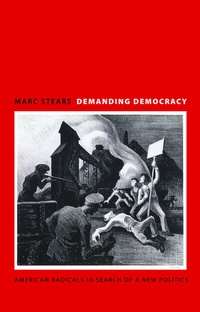
Demanding Democracy
American Radicals in Search of a New Politics
1st Edition
Published on 16. June 2015
256 pages
978-1-4008-3504-1 (ISBN)
Description

What today's political thinkers can learn from the radical democratic movements of twentieth-century America
This is a major work of history and political theory that traces radical democratic thought in America across the twentieth century, seeking to recover ideas that could reenergize democratic activism today. The question of how citizens should behave as they struggle to create a more democratic society has haunted the United States throughout its history. Should citizens restrict themselves to patient persuasion or take to the streets and seek to impose change? Marc Stears argues that anyone who continues to wrestle with these questions could learn from the radical democratic tradition that was forged in the twentieth century by political activists, including progressives, trade unionists, civil rights campaigners, and members of the student New Left.
These activists and their movements insisted that American campaigners for democratic change should be free to strike out in whatever ways they thought necessary, so long as their actions enhanced the political virtues of citizens and contributed to the eventual triumph of the democratic cause. Reevaluating the moral and strategic arguments, and the triumphs and excesses, of this radical democratic tradition, Stears contends that it still offers a compelling account of citizen behavior-one that is fairer, more inclusive, and more truly democratic than those advanced by political theorists today.
This is a major work of history and political theory that traces radical democratic thought in America across the twentieth century, seeking to recover ideas that could reenergize democratic activism today. The question of how citizens should behave as they struggle to create a more democratic society has haunted the United States throughout its history. Should citizens restrict themselves to patient persuasion or take to the streets and seek to impose change? Marc Stears argues that anyone who continues to wrestle with these questions could learn from the radical democratic tradition that was forged in the twentieth century by political activists, including progressives, trade unionists, civil rights campaigners, and members of the student New Left.
These activists and their movements insisted that American campaigners for democratic change should be free to strike out in whatever ways they thought necessary, so long as their actions enhanced the political virtues of citizens and contributed to the eventual triumph of the democratic cause. Reevaluating the moral and strategic arguments, and the triumphs and excesses, of this radical democratic tradition, Stears contends that it still offers a compelling account of citizen behavior-one that is fairer, more inclusive, and more truly democratic than those advanced by political theorists today.
All prices
More details
Other editions
Additional editions
Book
03/2013
Princeton University Press
€37.50
Available immediately
Book
01/2010
Princeton University Press
€37.14
Article exhausted; check different version
Person
Marc Stears is professor of political theory, university lecturer, and fellow at University College, Oxford. He is the author of Progressives, Pluralists and the Problems of the State and the coeditor of Political Theory: Methods and Approaches.
Content
Acknowledgments ix
Introduction 1
PART ONE 1900-1945
Chapter One: Making the Nation a Neighborhood 21
Chapter Two: After the Breach 56
Chapter Three: Radicalism Americanized 85
PART TWO: 1945-1972
Chapter Four: Doubt and the American Creed 119
Chapter Five: The Explosive Enclave 145
Chapter Six: "We Are Beginning to Move Again" 174
Conclusion: Renewing the American Radical Tradition 206
Bibliography 223
Index 243
Introduction 1
PART ONE 1900-1945
Chapter One: Making the Nation a Neighborhood 21
Chapter Two: After the Breach 56
Chapter Three: Radicalism Americanized 85
PART TWO: 1945-1972
Chapter Four: Doubt and the American Creed 119
Chapter Five: The Explosive Enclave 145
Chapter Six: "We Are Beginning to Move Again" 174
Conclusion: Renewing the American Radical Tradition 206
Bibliography 223
Index 243

