

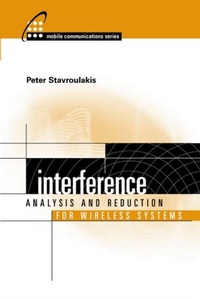
Interference Analysis and Reduction for Wireless Systems
1st Edition
Published on 1. January 2002
432 pages
978-1-58053-574-8 (ISBN)
Description

This leading-edge resource offers you a new methodology for analyzing and studying the behavior of wireless communication systems in an interference environment. It provides you with modern tools and techniques for use in real-world applications that help you guarantee optimum system performance. The book treats both additive and multiplicative interfering signals, including in-depth descriptions of how these signals behave, regardless of the source.
More details
Other editions
Additional editions
Peter Stavroulakis
Interference Analysis and Reduction for Wireless Systems
Book
12/2002
Artech House Publishers
€138.16
Shipment within 10-20 days
Content
- Interference Analysis and Reduction for Wireless Systems
- Contents vii
- Preface xv
- Acknowledgments xix
- 1 Overview of Wireless Information Systems 1
- 1.1 Introduction 1
- 1.2 Historical Perspective 4
- 1.3 First Generation Systems 4
- 1.4 Second Generation Systems 4
- 1.5 Third Generation Systems 9
- 1.6 The Cellular Concept 13
- 1.7 Satellite Systems 20
- 1.8 Wireless Local Loops 29
- 1.9 WLANs 30
- 1.10 Wireless Data Networks 39
- 1.11 Wireless Broadband Mobile Communication Systems 41
- 1.12 Millimeter Waves 43
- 1.13 Other Wireless Communications Systems 44
- References 44
- 2 Wireless Channel Characterization and Coding 47
- 2.1 Introduction 47
- 2.2 The Wireless Communication Channel 48
- 2.3 Channel Coding 72
- Refereneces 82
- 3 Transmission Systems in an Interference Environment 85
- 3.1 Introduction 85
- 3.2 Analog Transmission 86
- 3.3 Analog Modulation Methods 88
- 3.4 Noise and Interference in Analog Transmission 92
- 3.5 Comparison of Modulation Systems Based on Noise 100
- 3.6 Digital Transmission 102
- 3.7 Digital Modulation Techniques 104
- 3.8 BERs and Bandwidth Efficiency 130
- 3.9 Access Techniques 132
- References 153
- 4 Optimal Detection in Fading Channels 155
- 4.1 Introduction 155
- 4.2 Received Signal Conditional Probability Density Function 156
- 4.3 Average BER Under Fading 160
- 4.4 Flat Fading Compensation Techniques 165
- 4.5 Frequency Selective Fading 192
- References 209
- 5 Interference Analysis 213
- 5.1 Introduction 213
- 5.2 Types of Interference 214
- 5.3 Interference Analysis Methodology 241
- References 272
- 6 Interference Suppression Techniques 275
- 6.1 Introduction 275
- 6.2 Interference Reduction/Mitigation 276
- 6.3 Interference Avoidance 316
- References 324
- 7 Applications 329
- 7.1 Introduction 329
- 7.2 Interference-Canceling Equalizer for Mobile Radio Communication 331
- 7.3 A Linear Interference Canceler with a Blind Algorithm for CDMA Systems 335
- 7.4 Indirect Cochannel Interference Cancler 340
- 7.5 Adaptive Interference Canceler 342
- 7.6 Intersymbol Interference and Cochannel Interference Canceler Combining Adaptive Array Antennas and the Viterbi Equalizer in a Digital Mobile Radio 344
- 7.7 Hybrid Interference Canceler with Zero-Delay Channel Estimation for CDMA 347
- 7.8 Canellation of Adjacent Channel Signals in FDMA/TDMA Digital Mobile Radio Systems 351
- 7.9 Adaptive Multistage PIC 354
- References 359
- Appendix A: Signal and Spectra in Wireless Communications 361
- A.1 Physically Realizable Waveforms 361
- A.2 Orthogonal Series Representation of Signal and Noise 366
- A.3 Fourier Transform and Spectra 372
- References 377
- Appendix B: HMMs--Kalman Filter 379
- B.1 HMMs 379
- B.2 Parmeters of an HMM 381
- B.3 HMM--Kalman Filter Algorithm 381
- B.4 Maximum A Posteriori Channel Estimates Based on HMMs 382
- References 391
- About the Author 393
- Index 395
