

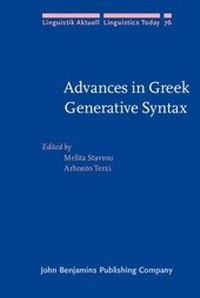
Advances in Greek Generative Syntax
In honor of Dimitra Theophanopoulou-Kontou
1st Edition
Published on 19. May 2005
VIII, 366 pages
978-90-272-9451-7 (ISBN)
Description

This collection of original research focuses on various lesser studied aspects of Greek syntax. The articles combine a sound empirical coverage within current developments of generative theory and cover a wide spectrum of areas. The syntax of sentential structure is dealt with by two articles, one is an extensive analysis of the distribution of goal and beneficiary dative DPs in Greek (and cross-linguistically) and the other addresses the relation agree in small clauses (and between adjectives and nouns). Two articles study the acquisition of the left periphery and of eventivity and one focuses on the historical evolution of participles in Greek, out of which gerunds emerged. The syntax and semantics of wh-clauses in DP positions and of the non-volitional verb ?elo are the focus of two articles situated in the syntax-semantics interface. The DP domain is approached by two theoretical articles, one on a Greek possessive adjective and another on determiner heads. The final contribution studies the acquisition of the Greek definite article.
More details
Other editions
Additional editions
Melita Stavrou | Arhonto Terzi
Advances in Greek Generative Syntax
In honor of Dimitra Theophanopoulou-Kontou
Book
05/2005
John Benjamins Publishing Co
€148.40
Shipment within 10-15 days
Persons
Content
- Advances in Greek Generative Syntax
- Editorial page
- Title page
- LCC data
- Table of contents
- Contributors
- Introduction
- The volume
- References
- Agreement and multiple case licensing in Greek
- 1. Introduction
- 2. A definition of agreement
- 3. The licensing of agreement
- 4. Agreement in small clauses
- 4.1. The issue
- 4.2. Chomsky's (2001) proposal
- 4.3. The alternative: Case agreement
- 5. Agreement between the DP-subject and the verb
- 5.1. Subject-agreement in VS(O) and nominative case
- 5.2. Agreement and case licensing
- 6. Conclusion
- Notes
- References
- Determiner heads as arguments and the Pronominal Argument (macro)parameter
- 1. Introduction
- 2. DP versus D0 arguments and parametrisation
- 3. Some conceptual difficulties with the relevance of N to argumenthood
- 3.1. Distinguishing between X0 and XP
- 3.2. Clausal arguments
- 4. Languages with both D0 and DP arguments
- 4.1. Yagua
- 4.2. Koranic Arabic8
- 4.3. Basso Polesano
- 5. Determiners as arguments
- 5.1. Only Determiners can be arguments
- 5.2. The semantics of D and argumenthood
- 5.3. Parametric variation without a Pronominal Argument parameter
- 5.4. Verbal vs. nominal D
- 5.5. A typology of arguments
- 6. Conclusion
- Notes
- References
- Cross-linguistic and cross-categorial variation of datives
- 1. Introduction
- 2. Goal ditransitives
- 2.1. Forms of goals
- 2.2. The genitive-PP alternation is a `dative alternation'
- 2.3. The syntax of genitive goals and goals introduced by `se'
- 2.4. Accounting for passives and derived nominals
- 3. Benefactive ditransitives
- 3.1. Forms of beneficiaries
- 3.2. The properties of benefactive constructions
- 3.3. The structures of benefactive constructions
- 4. Oehrle's contexts and the ambiguity of se-goals
- 5. Se-PPs vs. to-PPs
- 6. On the categories of high and low datives
- 6.1. Japanese high `ni'-datives are DPs and low `ni'-datives are PPs
- 6.2. High and low French `à'-datives
- 6.3. French `à'-datives are DPs and Greek `se'-datives are PPs
- 6.4. Cliticization and clitic doubling of datives
- 7. Concluding remarks
- Notes
- References
- A possessive adjective in the Greek DP
- 1. Introduction
- 2. The properties of the MG complex possessive construction
- 2.1. +Reflexive or -reflexive?
- 2.2. Distributional properties
- 2.3. Semantic properties
- 3. PAs in Ancient Greek
- 4. The structure of the complex possessive in Modern Greek
- 5. Possessive i&=ios
- 6. Conclusions
- Notes
- References
- Subject-object asymmetry in the acquisition of the definite article in Greek
- 1. Introduction
- 2. Factors involved in the licensing of bare nouns
- 3. Chierchia's Nominal Mapping Parameter
- 4. Predictions for the acquisition of the definite article and the licensing conditions for bare arguments
- 5. The data
- 5.1. The acquisition of definite articles: Overall use of definite articles
- 5.2. Looking for the trigger: The use of articles with proper names and kinship terms
- 5.3. Acquiring bare arguments
- 5.4. Subject-object asymmetry
- 5.5. Acquiring the licensing conditions for bare singular count nouns
- 6. Summary and conclusion
- Notes
- References
- Peripheral positions in early Greek
- 1. Introduction
- 2. The adult grammar
- 3. The theory of L1 acquisition and predictions
- 4. The data
- 4.1. Focusing, CLLD, clitic-doubling and interrogatives
- 4.2. Tense, Agreement, Modal particles and Subjects
- 4.3. Word-order
- 4.4. Modality
- 5. Implications and conclusions
- Notes
- References
- Eventivity, modality and temporal reference in child Greek
- 1. Introduction
- 2. Root infinitives in child language: Distribution and interpretation
- 2.1. Distribution
- 2.2. Interpretation
- 3. Root non-finite forms in child Greek
- 4. The aspectual, modal and temporal properties of verb forms in child Greek
- 5. A note on the functional architecture
- 6. Concluding remarks
- Notes
- References
- From participles to gerunds
- 1. Introduction
- 2. The data and the historical process of development
- 2.1. Stage 1 - Ancient Greek
- 2.2. Stage 2 - Koine (New Testament (NT) & papyri)
- 2.2. Stage 2 - Late post-classical / early medieval (4th-6th c.)
- 2.3. Stage 3 - Middle Byzantine
- 2.4. Stage 4 - Later Byzantine (12th-15th c.)
- 2.5. Stage 5 - Post-Byzantine Greek
- 2.6. Stage 6 - Modern Greek
- 2.7. Summary of evolution
- 3. Parallel evolution in other languages
- 3.1. Romance
- 3.2. Slavic and Baltic
- 4. The evolution from participle to gerund
- 4.1. Introduction
- 4.2. Previous accounts
- 4.3. Origins of the change
- 4.4. From participle to gerund
- 5. Implications for syntactic theory
- 5.1. The status and external syntax of MG gerunds
- 5.2. The internal structure of Passive Participles
- 5.3. The internal structure of gerunds
- 6. Conclusions
- Notes
- References
- Primary sources
- WH-clauses in DP-positions
- 1. Introduction
- 2. Future wh-clauses
- 3. Future wh-clauses vs. Realis Free Relatives
- 3.1. Morphological differences
- 3.2. Syntactic differences
- 3.3. Semantic differences
- 3.4. Conclusion
- 4. The anaphoric properties of FWHCs
- 5. Narrow scope in quantificational constructions
- 6. Future wh-clauses vs. Irrealis Free Relatives
- 6.1. Similarities between FWHCs and IFRs
- 6.2. Differences between FWHCs and IFRs
- 6.3. Some less comprehensible differences
- 7. The semantics of FWHCs
- 7.1. FWHCs are intensional definite DPs
- 7.2. The selecting predicates are used intensionally
- 7.3. Selection and FWHCs
- 8. The syntax of FWHCs
- 9. The selecting predicates have an unbounbed eventuality component
- 10. Irrealis Free Relatives
- 10.1. The selecting predicates
- 10.2. The semantics of IFRs
- 10.3. The syntax of IFRs
- 11. Theoretical consequences
- Notes
- References
- Appendix I
- Examples of FWHCs
- Appendix II
- Examples of IFRs
- The syntax of non-volitional thetaelo in Greek
- 1. Volitional and non-volitional thetaelo: General properties
- 2. Non-volitional thetaelo and the na-complement
- 3. Non-volitional thetaelo and the nominal complement
- 4. `Want' and `need': The two faces of thetaelo
- 5. Conclusion
- Notes
- References
- Index
- The series Linguistik Aktuell/Linguistics Today
