

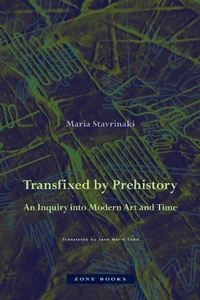
Transfixed by Prehistory
Description

An examination of how modern art was impacted by the concept of prehistory and the prehistoric
Prehistory is an invention of the late nineteenth century. In that moment of technological progress and acceleration of production and circulation, three major Western narratives about time took shape. One after another, these new fields of inquiry delved into the obscure immensity of the past: first, to surmise the age of the Earth; second, to find the point of emergence of human beings; and third, to ponder the age of art. Maria Stavrinaki considers the inseparability of these accounts of temporality from the disruptive forces of modernity. She asks what a history of modernity and its art would look like if considered through these three interwoven inventions of the longue durée. Transfixed by Prehistory attempts to articulate such a history, which turns out to be more complex than an inevitable march of progress leading up to the Anthropocene. Rather, it is a history of stupor, defamiliarization, regressive acceleration, and incessant invention, since the "new" was also found in the deep sediments of the Earth. Composed of as much speed as slowness, as much change as deep time, as much confidence as skepticism and doubt, modernity is a complex phenomenon that needs to be rethought. Stavrinaki focuses on this intrinsic tension through major artistic practices (Cézanne, Matisse, De Chirico, Ernst, Picasso, Dubuffet, Smithson, Morris, and contemporary artists such as Pierre Huyghe and Thomas Hirschhorn), philosophical discourses (Bataille, Blumenberg, and Jünger), and the human sciences. This groundbreaking book will attract readers interested in the intersections of art history, anthropology, psychoanalysis, mythology, geology, and archaeology.
More details
Other editions
Additional editions
Persons
Content
- Cover
- Contents
- Introduction
- I. "We Slip away from Ourselves": The Discovery and Internalization of the Earth's Age (Eighteenth to Twentieth Centuries)
- Earth: The Long Term
- Humankind: The Long Term
- Three Artists: Giorgio de Chirico, Max Ernst, Robert Smithson
- II. Reconstituting the Antiquity of Humankind and of Art
- The Age of Man
- The Indistinction between Man and Nature
- From the Ground to the Walls of Caves: First Fissures, First Modern Appropriations of Prehistoric Art
- Fleshing Out Fossils, Objects, and Images
- III. The Artificiality of Prehistory: A Disjunctive Genealogy of Art
- At a Distance
- Why Did Modernity Identify with Prehistory?
- Joan Miró and Jean Dubuffet
- IV. The Paradox of the Neolithic: Rupture and Permanence, Order and Disorder
- The Political Uses of the Neolithic: Revolution and Rootedness (England, ca. 1930
- Denmark, ca. 1960)
- The Neolithic of Disorder: Pablo Picasso and Robert Morris
- V. Prehistory in the Atomic Age
- The End of History
- Caves of the Atomic Age (1949-1959): Fontana, Kiesler, Pinot Gallizio
- Conclusion: Terra Incognita
- Acknowledgments
- Notes
- Bibliography
- Index
