

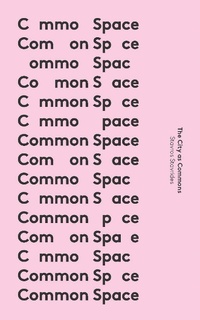
Common Space
The City as Commons
1st Edition
Published on 15. February 2016
320 pages
978-1-78360-330-5 (ISBN)
Description

Space is both a product and a prerequisite of social relations, it has the potential to block and encourage certain forms of encounter. In Common Space, activist and architect Stavros Stavrides calls for us to conceive of space-as-commons - first, to think beyond the notions of public and private space, and then to understand common space not only as space that is governed by all and remains open to all, but that explicitly expresses, encourages and exemplifies new forms of social relations and of life in common.
Through a fascinating, global examination of social housing, self-built urban settlements, street trade and art, occupied space, liberated space and graffiti, Stavrides carefully shows how spaces for commoning are created. Moreover, he explores the connections between processes of spatial transformation and the formation of politicised subjects to reveal the hidden emancipatory potential of contemporary, metropolitan life.
Through a fascinating, global examination of social housing, self-built urban settlements, street trade and art, occupied space, liberated space and graffiti, Stavrides carefully shows how spaces for commoning are created. Moreover, he explores the connections between processes of spatial transformation and the formation of politicised subjects to reveal the hidden emancipatory potential of contemporary, metropolitan life.
Reviews / Votes
How shall we understand the pulse and power of commoning, the subtle force that is constantly shaping the spaces and experiences of modern cities? Stavros Stavrides provides a rich, erudite exploration of this neglected topic and the potential for human emancipation. * David Bollier, author of Think Like a Commoner * A fascinating and path-breaking book, which can inspire activists and theoreticians alike. It enriches the academic bibliography of geography, planning, sociology, cultural studies, social anthropology, political science and more disciplines focusing on the contemporary city.' * City: Analysis of Urban Trends, Culture, Theory, Policy, Action * Stavrides escapes the Eurocentrism that often predominates in the literature on the urban commons ... The book will appeal not only to scholars across many disciplines, but also to activists who seek to engage with the significance of urban space for their political action.' * Urban Studies * The Foreword hails Common Space as "the first theoretical book of its kind, the first book to problematise space as commons". And this is precisely where the value of Stavrides' contribution is found. * 3AM Magazine * Common Space is the first of its kind ... an in-depth journey into the concept of common space ... relevant to students, academics and practitioners alike. * Environment and Urbanization * Stavrides was one of the first to open my eyes to the importance of the urban commons. His writings are exciting, a valuable reference for urban activists around the world. He is right: the city is the place where we can and should truly reinvent the commons. * Lieven De Cauter, co-editor of Art and Activism in the Age of Globalization * Stavros Stavrides has written a cutting-edge book on the commons and the city. A must read that inspires and challenges conventional thinking. Add it to your toolbox for the reinvention of the city through commoning. * Massimo De Angelis, author of Omnia Sunt Communia and The Beginning of History * Stavrides provides a wonderful guide to how we can make urban space common. He draws from the history of social housing and the successes of contemporary protest movements to formulate an exciting political project. * Michael Hardt, co-author of Empire; Multitude; and Commonwealth * The word from Athens is this: the commons is open not exclusionary; it perforates the walls of sovereignty, discipline, security, and their phantasmagoria. From Oaxaca to Nairobi, the ancient assemblies of the egalitarian agora of old rise again. Listen to the word from Athens! * Peter Linebaugh, author of The Magna Carta Manifesto * An exceptionally thoughtful study of the process and procedures of commoning, investigating the major ways by which common spaces are created in the contemporary world ... [a] remarkable and immensely rewarding text.' * Political Geography * A much-needed breath of fresh air. This is a book for all those interested in moving beyond the politics of enclosure, fear and individualism to a politics of hope, possibility and social inclusion in the contemporary city. * Sophie Watson, The Open University *More details
Series
Edition
1. Auflage
Language
English
Place of publication
United Kingdom
Publishing group
Bloomsbury Publishing PLC
ISBN-13
978-1-78360-330-5 (9781783603305)
Copyright in bibliographic data and cover images is held by Nielsen Book Services Limited or by the publishers or by their respective licensors: all rights reserved.
Schweitzer Classification
Other editions
Additional editions
Book
02/2016
Zed Books Ltd
€126.28
Shipment within 3-4 weeks
Persons
Stavros Stavrides is an architect, activist and associate professor at the School of Architecture, National Technical University of Athens, where he teaches courses on social housing design, as well as a postgraduate course on the social meaning and significations of metropolitan experience. His publications on spatial theory include The Symbolic Relation to Space (1990); Advertising and the Meaning of Space (1996); The Texture of Things (with E. Cotsou, 1996); From the City-Screen to the City-Stage (2002, National Book Award); Suspended Spaces of Alterity (2010); and Towards the City of Thresholds (2010).
Content
Foreword
Introduction
Part I: Commoning Space
1. An Urban Archipelago of Enclosures
2. Expanding Commoning: In, Against and Beyond Capitalism?
Part II: Inhabited Common Spaces
3. Shared Heterotopias: Learning From the History of a Social Housing Complex in Athens
4. Housing and Urban Commoning
5. Metropolitan Streets as Contested Spaces
6. Occupied Squares, Societies in Movement
Part III: Envisaged common spaces
7. Practices of Defacement: Thresholds to Rediscovered Commons
8. Thought-images and Representations of the City as Commons
9. Representations of Space and Representations of Emancipation
Conclusion: Reinventing the City through Commoning
Introduction
Part I: Commoning Space
1. An Urban Archipelago of Enclosures
2. Expanding Commoning: In, Against and Beyond Capitalism?
Part II: Inhabited Common Spaces
3. Shared Heterotopias: Learning From the History of a Social Housing Complex in Athens
4. Housing and Urban Commoning
5. Metropolitan Streets as Contested Spaces
6. Occupied Squares, Societies in Movement
Part III: Envisaged common spaces
7. Practices of Defacement: Thresholds to Rediscovered Commons
8. Thought-images and Representations of the City as Commons
9. Representations of Space and Representations of Emancipation
Conclusion: Reinventing the City through Commoning
