

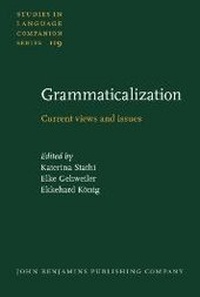
Grammaticalization
Current views and issues
1st Edition
Published on 16. September 2010
VII, 379 pages
978-90-272-8800-4 (ISBN)
Description

This volume contains a selection of papers on grammaticalization from a broad perspective. Some of the papers focus on basic concepts in grammaticalization research such as the concept of 'grammar' as the endpoint of grammaticalization processes, erosion, (uni)directionality, the relation between grammaticalization and constructions, subjectification, and the relation between grammaticalization and analogy. Other papers shed a critical light on grammaticalization as an explanatory parameter in language change. New case studies of micro-processes of grammaticalization complete the selection. The empirical evidence for (and against) grammaticalization comes from diverse domains: subject control, clitics, reciprocal markers, pronouns and agreement markers, gender markers, auxiliaries, aspectual categories, intensifying adjectives and determiners, and pragmatic markers. The languages covered include English and its varieties, German, Dutch, Italian, Spanish, French, Slavonic languages, and Turkish. The book will be valuable to scholars working on grammaticalization and language change as well as to those interested in individual languages.
More details
Other editions
Additional editions
Book
09/2010
John Benjamins Publishing Co
€104.94
Shipment within 10-15 days
Persons
Content
- Grammaticalization
- Editorial page
- Title page
- LCC data
- Table of contents
- Preface
- Introduction
- 1. Preliminary remarks
- 2. Part I: Basic questions
- 3. Part II: Grammaticalization and the explanation of language change
- 4. Part III: Case studies of micro-processes of grammaticalization
- References
- Part I: Basic questions
- On some problem areas in grammaticalization studies
- 1. Introduction
- 2. A closer look at the problem areas
- 2.1 Problem area 1
- 2.2 Problem area 2: Distinct formal expression
- 2.3 Problem area 3: A distinct set of functional domains
- 2.4 Summary of problem areas
- 3. The core of the problem and first steps to its solution
- 3.1 No explicit definition of the central concept
- 3.2 Some essential features of grammatical meaning
- References
- Issues in constructional approaches to grammaticalization in English
- 1. Introduction
- 2. A constructional framework for grammaticalization
- 2.1 Why construction grammar?
- 2.2 Constructional taxonomies
- 3. Evidence for constructional grammaticalization
- 4. Impersonal and transitive constructions in the history of English: A further case of constructional grammaticalization
- 4.1 Frequency and semantic coherence
- 4.2 Analogy and usage-based approaches to grammaticalization
- 5. Conclusions
- References
- Reconsidering erosion in grammaticalization
- 1. Introduction
- 2. The phonology of cliticization
- 2.1 Cliticization as grammaticalization
- 2.2 Clitics in prosodic phonology
- 2.3 Clitics in segmental phonology
- 2.4 Summary
- 3. Towards a rhythm-based typology
- 3.1 A rhythm-based typology of language
- 3.2 Predictions for phonology in grammaticalization
- 3.3 The cross-linguistic evidence
- 3.4 Summary
- 4. Case studies
- 4.1 The German definite article
- 4.2 Cliticization of subject pronouns in Turkish
- 4.3 Summary
- 5. Conclusions
- References
- Grammaticalization, subjectification and objectification
- 1. Introduction
- 2. Theoretical background and methodology
- 3. Case studies
- 3.1 Perfects
- 3.2 Futures
- 3.3 Progressives
- 4. Conclusion
- References
- Degrammaticalization
- 1. Introduction
- 1.1 Attitudes towards degrammaticalization, 1982 - present
- 1.2 A generic definition of degrammaticalization
- 2. Controversy I: Is degrammaticalization the 'reverse of grammaticalization'?
- 3. Controversy II: Is degrammaticalization a composite change?
- 4. Controversy III: Can degrammaticalization changes be classified?
- 5. Classifying (de)grammaticalization
- 5.1 Classifying grammaticalization
- 5.2 Classifying degrammaticalization
- 6. Selected case studies
- 6.1 Degrammation: Pennsylvania German wotte
- 6.2 Deinflectionalization: The s-genitive
- 6.3 Debonding: Northern Saami haga and English ish
- 7. Conclusion
- References
- Degrammaticalization and obsolescent morphology
- 1. Introduction
- 1.1 Characteristics of grammaticalization
- 1.2 Degrammaticalization and deflexion
- 2. Affix & clitic degrammaticalization in the conditional in some Slavonic varieties
- 2.1 Overview of the formation of the conditional in Slavonic languages
- 2.2 Reconstruction of the common Slavonic conditional
- 2.3 The role of degrammaticalization in reanalysis involving the conditional
- 2.4 The shift of byste etc. & by (e)ste etc. as degrammaticalization
- 3. Issues in degrammaticalization
- 3.1 Exaptation and adaptation
- 3.2 Degrammaticalization and reconstruction
- 4. Conclusion
- References
- Part II: Grammaticalization and the explanation of language change
- An analogical approach to grammaticalization
- 1. Introduction1
- 2. Form versus function and linguistic modeling
- 3. The principle of analogy
- 4. Language as an adaptive system
- 5. Grammaticalization and analogy-based learning: The development of pragmatic markers in English
- 6. Concluding remarks
- References
- Does grammaticalisation need analogy?
- 1. Grammaticalisation theory: Reanalysis vs. analogy
- 2. From pronoun to agreement marker: Diverging pathways
- 2.1 Subject doubling in West-Germanic and Romance
- 2.2 The emergence of subject doubling: The role of reanalysis
- 2.3 'Full' grammaticalisation in Romance but not in West-Germanic
- 2.4 Summary: Divergence
- 3. Analogical pathways
- 3.1 Inadequacies of reanalysis-based models of grammaticalisation
- 3.2 Analogy, clitics, and sentence type
- 3.3 The 'dead end' in the West-Germanic pathway
- 4. Competing explanations
- 5. Conclusions
- References
- What grammaticalisation can reveal about same-subject control
- 1. Introduction
- 2. Control in a contact situation: Colloquial Singaporean English
- 2.1 Why the CSE examples are not middles
- 2.2 Topic structure in CSE
- 3. Some semantic approaches to the definition of control
- 4. A note on the grammaticalisation of infinitives
- 5. Grammaticalisation effects
- 6. A final note
- 7. Conclusions
- References
- How the Latin neuter pronominal forms became markers of non-individuation in Spanish
- 1. Introduction: The so-called "neuter" in Modern Spanish and its origins
- 2. The "neuter" in Latin and the "neuter" in Romance
- 3. What kind of language change?
- References
- Part III: Case studies of micro-processes of grammaticalization
- The Grammaticalization of the German adjectives lauter (and eitel)
- 1. Introduction
- 2. Similarity of lauter and eitel
- 3. Synchronic analysis
- 3.1 lauter
- 3.2 eitel
- 4. Diachronic analyis
- 4.1 lauter
- 4.2 eitel
- 5. The development of lauter (and eitel)
- 5.1 The emergence of lauter and eitel 'morally good'
- 5.2 The emergence of the downtoners lauter and eitel
- 5.3 The emergence of the determiner lauter
- 6. Conclusion
- References
- Literature
- Is German gehören an auxiliary?
- 1. Introduction
- 2. The construction gehören + participle II
- 2.1 Defining the construction
- 2.2 Previous treatments
- 3. Diachronic development of gehören
- 3.1 A brief history of gehören: Semantic change
- 3.2 Structural change
- 4. Grammaticalization of gehören
- 5. The use of gehören + participle II in present-day German
- 6. Discussion
- 6.1 Target area of grammaticalization: gehören as a modal passive
- 6.2 Grammaticalization and constructionalization
- 7. Conclusion
- References
- Micro-processes of grammaticalization
- 1. Introduction
- 2. Linguistic reciprocity
- 2.1 The reciprocal system in Italian
- 3. The new reciprocal pattern
- 3.1 The results of the corpus analysis and of spontaneous tests
- 3.2 Analysis of the data: the new pattern's function
- 4. Old Italian l'un l'altro
- 5. Uninflected l'un l'altro as the final stage of a grammaticalization process?
- 6. Conclusion
- References
- List of contributors
- Index
- The Studies in Language Companion Series
