

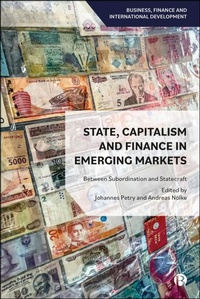
State, Capitalism, and Finance in Emerging Markets
Between Subordination and Statecraft
Bristol University Press
1st Edition
Published on 24. June 2025
292 pages
978-1-5292-4336-9 (ISBN)
Description

What role do emerging markets play in the global financial system? Are they subordinated within global financial hierarchies? Or do they have autonomy, even power, to use finance to pursue state objectives?
In this edited volume, leading scholars explore these questions, focusing on state-finance interactions globally. The book combines literatures on international financial subordination, financial statecraft and comparative capitalism to analyse state-finance relationships in emerging markets, particularly the BRICS: Brazil, Russia, India, China, and South Africa. It reveals that these states can control their domestic financial sectors despite global subordination, though their ability to do so varies significantly.
This essential volume offers profound insights into how emerging markets are reshaping global finance for scholars and policy makers.
In this edited volume, leading scholars explore these questions, focusing on state-finance interactions globally. The book combines literatures on international financial subordination, financial statecraft and comparative capitalism to analyse state-finance relationships in emerging markets, particularly the BRICS: Brazil, Russia, India, China, and South Africa. It reveals that these states can control their domestic financial sectors despite global subordination, though their ability to do so varies significantly.
This essential volume offers profound insights into how emerging markets are reshaping global finance for scholars and policy makers.
Reviews / Votes
"State, Capitalism and Finance in Emerging Markets offers a fascinating analysis of how emerging markets navigate the global financial system. Essential for scholars and policymakers, this volume unpacks the nuanced financial strategies of the BRICS and beyond." Oliver Stuenkel, Fundacao Getulio Vargas"With the rapid rise of emerging economies, it is vital for us to understand where they fit in the global finance and its geopolitical dynamics. This edited volume provides valuable insights into this topic by bridging theoretical discussions from both sides of the Atlantic and analyzing positions of the emerging economies between systemic subordination and unit-level agency through their financial statecraft in a nuanced context. A must read for those pondering the future of the world of finance in the 21st century." Saori Katada, University of Southern California
"State, Capitalism and Finance in Emerging Markets is a carefully curated volume that bridges typically siloed discussions on financial and monetary policy in emerging economies. This timely contribution is particularly significant given the growing influence of emerging markets-both within and beyond the BRICS-in global economic growth and, increasingly, in international policymaking. By integrating perspectives on international financial subordination, financial statecraft, and comparative capitalism, Johannes Petry and Andreas Noelke create a dynamic intellectual space to advance these paradigms and deepens our understanding of emerging economies' agency and policy space amid global constraints." Ewa Karwowski, Kings College London
"This volume gathers cutting-edge research on the political economy of so-called emerging markets. By combining the insights of the literatures on financial statecraft, financial subordination and comparative capitalisms, the chapters investigate the state-(international) finance nexus in countries such as Brazil, China, South Africa and more. While showing commonalities associated with "dependent" capitalism, they also stress significant institutional and policy differences that account for variegated outcomes across case studies. The overall thrust leads to a complex view that analyses state capacity and relative autonomy within a set of domestic and international constraints. A timely and original contribution to current debates about the nature and limits of policy space at the (semi)periphery of global capitalism, this book engages a stimulating conversation on how to free domestic and international finance from their neoliberal entanglements." Ndongo Samba Sylla, International Development Economics Associates
"How and why states in emerging markets, even under conditions of subordinated positions within the global financial system, can act as strategic actors exercising control over their respective domestic financial sectors and even engage in powerful financial statecraft internationally? Dealing with this important question in an interdisciplinary, comparative and multi-level analyses, this important book is a compass for students and scholars of comparative and international political economy and public policy. It is a rich resource for those who seek to navigate varieties of state activism, and state and emerging market relations in the global financial system. The leading scholars on state capitalism provide timely and thought-provoking exploration of how and why state capacity in emerging markets matter in shaping conditions of the relationship between states and finance at domestic and international levels." Caner Bakir, Koc University
More details
Series
Edition
First Edition
Language
English
Place of publication
Bristol
United Kingdom
Target group
College/higher education
Product notice
Reflowable
Illustrations
21 s/w Abbildungen, 8 s/w Tabellen
8 Tables, black and white; 21 Illustrations, black and white
File size
1,97 MB
ISBN-13
978-1-5292-4336-9 (9781529243369)
Copyright in bibliographic data and cover images is held by Nielsen Book Services Limited or by the publishers or by their respective licensors: all rights reserved.
Schweitzer Classification
Other editions
Additional editions
Johannes Petry | Andreas Nölke
State, Capitalism, and Finance in Emerging Markets
Between Subordination and Statecraft
Book
approx. 12/2026
1st Edition
Bristol University Press
€42.50
Not yet published
State, Capitalism, and Finance in Emerging Markets
Between Subordination and Statecraft
Book
06/2025
1st Edition
Bristol University Press
€105.50
Shipment within 3-4 weeks
Persons
Johannes Petry is Postdoctoral Researcher at Goethe University Frankfurt.
Andreas Noelke is Professor of Political Science at Goethe University Frankfurt.
Andreas Noelke is Professor of Political Science at Goethe University Frankfurt.
Content
Part I
1. Introduction: Subordination, Statecraft, and Comparative Capitalism - Johannes Petry and Andreas Noelke
2. Political Economy of International Financial Subordination: From Genesis to Varieties of Financial Statecraft - Ilias Alami
3. International Financial Statecraft: How, Who, and with What Expectations of Success? - Leslie Elliott Armijo
Part II
4. South African Financial System Innovation and Degradation under Conditions of Extreme Uneven Development - Patrick Bond
5. Brazil in the Global Financial Order: How Domestic Politics Trigger Ambiguous Contestation - Pedro Lange Machado, Luiz Fernando de Paula, and Eduardo Mantoan
6. Relaxing the Survival Constraint: India's Financial Statecraft in Search of Domestic Autonomy - Anush Kapadia and Fathimath Musthaq
7. Seeking Autonomy Beyond Subordination: Chinese Financial Statecraft and the e-CNY - Christopher A. McNally
Part III
8. The Role of the State in Subordinate Financialized Capitalism: Comparing Financialization of Brazilian and Turkish Firms - Annina Kaltenbrunner, Elif Karacimen, and Joel Rabinovich
9. Tools of Subordination and/or Statecraft? A Comparative Analysis of Stock Markets in Large Emerging Markets - Johannes Petry
10. Increasing State Capacity through Central Bank Digital Currencies: A Comparative Account of the Digital Yuan and the Digital Rouble - Roxana Ehlke, Tim Salzer, and Carola Westermeier
11. Afterword: The Relevance of Global Capitalism for Studying Statecraft and Financial Subordination - Ingrid Harvold Kvangraven
1. Introduction: Subordination, Statecraft, and Comparative Capitalism - Johannes Petry and Andreas Noelke
2. Political Economy of International Financial Subordination: From Genesis to Varieties of Financial Statecraft - Ilias Alami
3. International Financial Statecraft: How, Who, and with What Expectations of Success? - Leslie Elliott Armijo
Part II
4. South African Financial System Innovation and Degradation under Conditions of Extreme Uneven Development - Patrick Bond
5. Brazil in the Global Financial Order: How Domestic Politics Trigger Ambiguous Contestation - Pedro Lange Machado, Luiz Fernando de Paula, and Eduardo Mantoan
6. Relaxing the Survival Constraint: India's Financial Statecraft in Search of Domestic Autonomy - Anush Kapadia and Fathimath Musthaq
7. Seeking Autonomy Beyond Subordination: Chinese Financial Statecraft and the e-CNY - Christopher A. McNally
Part III
8. The Role of the State in Subordinate Financialized Capitalism: Comparing Financialization of Brazilian and Turkish Firms - Annina Kaltenbrunner, Elif Karacimen, and Joel Rabinovich
9. Tools of Subordination and/or Statecraft? A Comparative Analysis of Stock Markets in Large Emerging Markets - Johannes Petry
10. Increasing State Capacity through Central Bank Digital Currencies: A Comparative Account of the Digital Yuan and the Digital Rouble - Roxana Ehlke, Tim Salzer, and Carola Westermeier
11. Afterword: The Relevance of Global Capitalism for Studying Statecraft and Financial Subordination - Ingrid Harvold Kvangraven
