

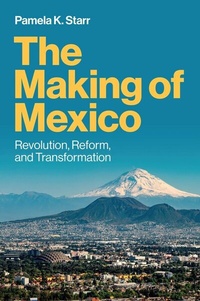
The Making of Mexico
Description

Mexico matters. It is one of the most important emerging market economies in the world and arguably the most important country in the everyday lives of Americans. Yet what do we really know about it?
By revealing the unwritten rules of behavior that drive Mexico's politics, economy, and foreign policy, leading political scientist Pamela K. Starr explores the competing forces shaping Mexican modernity. Tracing the origins of these behavioral forces in history, she shows how they characterize Mexico's foreign relations and security challenges as well as explain the strengths and weaknesses of its institutions. Amid growing pressure for reform and tumultuous US-Mexico relations, Starr gets to the heart of the forces influencing decision-making in Mexico's current regime, known as the Fourth Transformation. Her fresh and concise analysis of Mexico - its historic trajectory and contemporary political landscape - unpacks why this modern market economy behaves as it does.
The Making of Mexico offers an incisive introduction to Mexico for students of Mexican history, politics, and political economy, as well as US-Mexico relations and Latin American politics.
More details
Other editions
Additional editions
Person
Content
Acknowledgments
Abbreviations
Introduction
Part I History
1 Mexico's Pre-Revolutionary Experience
2 Revolutionary Inheritances
3 The PRI System in Action
4 The Collapse of the PRI System
Part II Reformist Mexico
5 Democracy
6 Security
7 Economy
8 Foreign Relations
Part III Mexico Today
9 The Fourth Transformation
Notes
Bibliography
Index
Introduction
Mexico is one of the least understood of the world's middle-income market democracies. Frequently it is overlooked, and when foreigners do consider Mexico, polls demonstrate that they are apt to think of a country with beautiful beaches, an enticing culture, and friendly people, but also a country characterized by poverty and crime that is a source of migrants and drugs. Although all these things are true, they create an incomplete and misleading portrait of Mexico. There is much more to the country. According to the World Bank, Mexico was the 14th largest economy in the world in 2024, bigger than Spain, Indonesia, and Turkey. Unlike many of its emerging market counterparts, Mexico boasts decades of macroeconomic stability, and it exports manufactured goods rather than commodities. It was the world's sixth largest exporter of automobiles in 2024, a leading medical device exporter, and tightly integrated into global supply chains. Mexico is also home to over three dozen billionaires, including some of the richest individuals on the planet.
Mexico transitioned peacefully from a soft authoritarian regime to a "third wave" democracy in 2000. Mexicans simply went to the polls and voted for change. Since then, the country has held regular and competitive elections at all levels of government, helping to sustain a flawed but unique democracy. Equally distinctive is Mexico's 1,954-mile border with the United States. No other middle-income country shares such a long, porous border with a global superpower. This geography unites and divides two distinct societies. Everything, it seems, crosses the US-Mexico border, including investment and trade, drugs and guns, people and diseases, arts and culture. The consequent interdependencies are deep and sometimes controversial, propelling both integration and nationalist pride over generations of bilateral interactions.
Mexico matters enormously for the United States. As of 2025, it was the United States' largest trading partner, providing nearly two-thirds of its vegetable imports and half of its fruits and nuts. About 15 percent of the cars sold in the United States are produced in Mexico. Mexico is also the number one export market for US automotive products as well as corn and pork products. (This situation is being challenged as a result of the tariff war under the new Trump administration, but remains essentially intact.) Further, the United States and Mexico do not merely trade, they produce things together. From automobiles to airplanes, medical devices, computers, and computer chips, the trilateral production platform created by the United States-Mexico-Canada Agreement (USMCA) is central to US global manufacturing competitiveness. For generations, Mexico provided the labor-short US economy with workers to harvest its agricultural products, clean its buildings, care for its children, and build much of its housing. Now this Mexican workforce includes doctors and nurses, engineers and entrepreneurs, and researchers and university presidents. And the higher birth rate of Hispanic migrants, including Mexicans, when compared with the rest of the US population has helped keep the US birth rate ahead of its advanced industrial counterparts and ward off demographic decline.
Mexico does suffer from high rates of poverty and inequality, which were driven up in the final quarter of the 20th century by a series of economic crises, albeit after a sharp decline in the preceding decades. Since 2014, however, low inflation and active anti-poverty efforts have helped improve conditions significantly while pulling millions into the middle class. In part because of poverty, Mexico historically was a large source of migrants heading to the United States looking for work. Because Mexicans migrated in such large numbers for decades, about 10 percent of the "Mexican" population now lives in the United States. Yet contrary to conventional wisdom, legal Mexican immigrants now outnumber their undocumented compatriots by over two to one.
As of 2023, less than a quarter of undocumented migrants trying to enter the United States were Mexican. In the early 21st century, the northward flow of Mexicans declined so much that for a time more Mexicans were leaving the United States than arriving. They were replaced by Central Americans, South Americans, and migrants from the rest of the world hoping to live and work in the United States. Until 2025, Mexico was consequently home to one of the world's main south-north migration routes, creating two new challenges for the country: managing transmigration through its territory and its transformation into a migrant-receiving nation.
Transnational criminal organizations that call Mexico home operate the smuggling routes that move most undocumented migrants through the country to the US border. Also known as drug cartels, these criminal operations produce and sell drugs in Mexico, the United States, and worldwide. They are involved in a wide variety of criminal activities, including robbery, extortion, and fuel theft. They also illegally import arms into Mexico, mostly from the United States, which feeds Mexico's high rates of crime and violence. The crime associated with these criminal organizations, however, is not evenly distributed throughout the country. As a result, while the murder rate in some Mexican states rivals civil war conditions, in others it is low: in Yucatán, for example, it is comparable to Canada.
Mexico is a fascinating, surprising, and significant country that is often neglected by analysts and policy-makers, and when attention is paid, there is a tendency to focus on a single issue, such as migration, security, the economy, politics, or foreign policy. Although this is a very useful approach to illuminating important aspects of modern Mexico, it offers an incomplete picture because these matters are intricately interconnected. This book focuses instead on four of these issues to paint a more comprehensive picture of the country. Analysis of Mexico also commonly focuses on contemporary events without considering the historical foundations of those developments. As a result, these works provide great detail on modern Mexico, but they leave aside how historical experience has shaped its identity and behavior. As William Faulkner said, "The past is never dead. It's not even past." Although he was speaking about the American South in the early 20th century, the sentiment is equally valid for Mexico today, a country that lives very close to its history. While Mexican attitudes and actions change over time, they consistently reflect behavioral norms shaped by generations of shared history.
Finally, there is a tendency among Mexico analysts to focus on Mexico's formal institutions: the laws, rules, and organizations that help structure a country's conduct. This valuable research has uncovered important constraints and opportunities in Mexican politics, economics, and foreign policy. Yet it can also miss what ultimately what makes the country tick. Mexico, for example, is a place where formal rules and laws are often suggestions rather than mandates. It is commonplace for foreigners to talk about the casual relationship Mexicans have with traffic laws. But a weak respect for the rule of law also informs Mexico's high rate of tax evasion, Mexicans' reliance on informal agreements rather than the law to protect their interests, and the belief among politicians that the law applies mostly to one's opponents. Former Mexican president Andrés Manuel López Obrador famously said, "Don't tell me the law is the law," arguing that his political opponents only enforced the letter of the law when it helped them block his path to the presidency. Formal organizations, meanwhile, from political parties to regulatory agencies and much of the bureaucracy and the judiciary, tend to be weak. Even the ultimate law of the land, the constitution, changes regularly.
Understanding Mexico thus requires knowledge of the informal rules and norms that shape Mexicans' behavior. This includes the unwritten rules that explain the peculiar characteristics of Mexican democracy, the normal conduct that makes the Mexican economy operate differently from other market economies, the traditional practices that underlie Mexico's security challenge, and the conventions that drive the country's often fraught relationship with the United States. This volume emphasizes these unwritten rules and norms, and how they have shaped modern Mexico.
How, then, did Mexico's peculiar customs and practices arise? Where did its unwritten rules of behavior come from? How did it become the country we observe today? Like other countries, Mexico's national norms reflect the historical experience shared by generations of its inhabitants. For everyone, the context within which we live and work creates obstacles and opportunities that promote behavioral adaptations to get ahead in life. Initially a strategic calculation is needed to succeed, a conscious decision to behave in a particular way to achieve an objective. If this behavior is iterated, however, over time it can become a normal way of operating. Whereas individuals initially think before acting, in time they act without thinking. For example, in Mexico City it is polite to greet someone when they enter an elevator. For a newcomer to the city, it takes thought to remember to offer this customary greeting. With time, however, doing so becomes automatic. More significantly, in the Mexican business world, a historically weak rule of law meant it was...
