

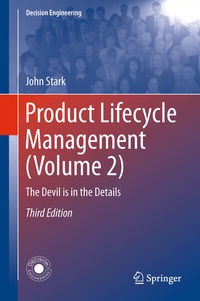
Product Lifecycle Management (Volume 2)
Description

This second volume moves beyond a general introduction to product lifecycle management (PLM) and its principal elements to provide a more in-depth analysis of the subjects introduced in Volume 1 (21st Century Paradigm for Product Realisation).
Providing insights into the emergence of PLM and the opportunities it offers, key concepts such as the PLM Grid and the PLM Paradigm are introduced along with the main components of PLM and the associated characteristics, issues and approaches.
Detailing the 10 components of PLM: objectives and metrics; management and organisation; business processes; people; product data; PDM systems; other PLM applications; facilities and equipment; methods; and products, it provides examples and best practices.
The book concludes with instructions to help readers implement and use PLM successfully, including outlining the phases of a PLM Initiative: development of PLM vision and strategy; documentation of the current situation; description of future scenarios; development of implementation strategies and plans; implementation and use. The main activities, tasks, methods, timing and tools of the different phases are also described.
More details
Other editions
New editions
Additional editions
Person
John Stark has worked in the Product Lifecycle Management sphere for more than 30 years, beginning in the 1980s and 1990s working in Computer Aided Design, Product Data Management, Business Process Improvement and Engineering Vision. He has worked as a consultant in Product Lifecycle Management since 2001 whilst in the last 15 years he has focused on helping companies implement PLM.
Content
Product Lifecycle Management.- Product Lifecycle Management.- Complex and Changing Environment.- Product Pain.- Emergence of PLM.- Opportunities and PLM.- Product.- Product Data.- Process.- PLM Applications.- The PDM System.- People.- Methods.- Facilities and Equipment.- Metrics.- Organisation.- Reasons for Implementing a PDM System.- Forewarned is Forearmed.- FAQs about PDM Implementation and Use.- Barriers to Successful Implementation of PDM.- Of PLM Vision and Strategy.- Strategies.- Getting Executive Support.- Developing PLM Vision and PLM Strategy.- Example of a PLM Vision.- The Current Situation.- Current Situation Examples.- Describing the Future Situation.- PLM Implementation Strategy and Plan.- PLM Action.
