

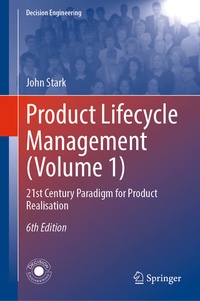
Product Lifecycle Management (Volume 1)
Description

This book explains what Product Lifecycle Management (PLM) is and why it is needed. It describes the environment in which products are ideated, developed, manufactured, supported and retired before addressing the main components of PLM and PLM Initiatives. Among the components of PLM are product-related business processes, product data, Product Data Management (PDM) systems, other PLM applications, best practices, company objectives and organisation. Key activities in PLM Initiatives include Organisational Change Management (OCM) and Project Management. The book also describes the relationships of PLM with the Internet of Things, Industry 4.0, Digital Twins, Digital Threads, Artificial Intelligence, Quality Management, Product Management and Sustainability. The final part of the book addresses the PLM Initiative, showing the typical steps and activities of a PLM project or initiative.
This sixth edition updates and adds to the successful fifth edition which, with more than 2,100 citations on Google Scholar in September 2025, is the most frequently cited PLM publication. It gives the reader a thorough explanation of PLM and provides them with a full understanding and the knowhow to implement PLM within their own business environment. This new and expanded edition is fully updated to reflect the many technological and management advances made in PLM since the release of the fifth edition in 2021. This book broadens the reader's understanding of PLM and develops the skills needed to implement PLM successfully and to achieve world-class product performance across the lifecycle.
More details
Other editions
Additional editions
Person
Dr. John Stark, a recognised PLM expert, started working in product development in 1979. In the 1980s, he worked in computer-aided design, product data management and business process improvement. He has worked as a consultant to companies in the product development and support area since the mid-1980s; first for Coopers & Lybrand, then as an independent consultant after setting up his own business in 1991. Over the last 30 years, he has helped over 100 companies implement PLM. He has written numerous highly successful books on PLM. He has also developed and delivered PLM courses for executives, people working in the product lifecycle, PLM professionals and university students.
Content
Product Lifecycle Management (PLM).- PLM and its Environment.- PLM and Products.- PLM and Business Processes.- PLM and Product Data.- PLM and PDM.- PDM and Product-related Applications.- PLM, Techniques and Methods.- PLM and the Internet of Things.- PLM, Facilities and Equipment, Industry 4.0.- PLM and Digital Twins.- PLM and Digital Threads.- PLM and Organisational Change Management.- PLM and Project Management.- Executive Activities in PLM.- PLM and the PLM Initiative.- PLM in Industry.- PLM and Artificial Intelligence.- PLM and the Triad of Regulatory Management, Compliance Management and Quality Management.- PLM and the Triad of Sustainability, ESG and Circular Economy.- PLM and Product Management.- Closing Thoughts.
