

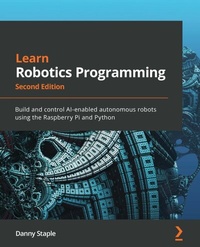
Learn Robotics Programming
Build and control AI-enabled autonomous robots using the Raspberry Pi and Python
2nd Edition
Published on 23. September 2024
602 pages
978-1-83921-786-9 (ISBN)
Description

Design, build, and program AI-driven robots from scratch using Python and Raspberry Pi while mastering real-world robotics concepts, sensor integration, and camera-based vision systems
Key Features
Learn hands-on robotics by wiring, coding, and troubleshooting real hardware
Integrate sensors, cameras, and voice agents to make your robot intelligent
Follow a structured path from Python basics to browser-based robot control
Book DescriptionWe live in an age where the most complex or repetitive tasks are automated. Smart robots have the potential to revolutionize how we perform all kinds of tasks with high accuracy and efficiency. With this second edition of Learn Robotics Programming, you'll see how a combination of the Raspberry Pi and Python can be a great starting point for robot programming. The book starts by introducing you to the basic structure of a robot and shows you how to design, build, and program it. As you make your way through the book, you'll add different outputs and sensors, learn robot building skills, and write code to add autonomous behavior using sensors and a camera. You'll also be able to upgrade your robot with Wi-Fi connectivity to control it using a smartphone. Finally, you'll understand how you can apply the skills that you've learned to visualize, lay out, build, and code your future robot building projects. By the end of this book, you'll have built an interesting robot that can perform basic artificial intelligence operations and be well versed in programming robots and creating complex robotics projects using what you've learned.What you will learn
Leverage the features of the Raspberry Pi OS
Discover how to configure a Raspberry Pi to build an AI-enabled robot
Interface motors and sensors with a Raspberry Pi
Code your robot to develop engaging and intelligent robot behavior
Explore AI behavior such as speech recognition and visual processing
Find out how you can control AI robots with a mobile phone over Wi-Fi
Understand how to choose the right parts and assemble your robot
Who this book is forThis book is intended for robotics enthusiasts, hobbyists, and aspiring programmers with a basic understanding of Python who are interested in building intelligent, AI-enabled robots using Raspberry Pi. It is ideal for learners who prefer a practical, hands-on approach.
Key Features
Learn hands-on robotics by wiring, coding, and troubleshooting real hardware
Integrate sensors, cameras, and voice agents to make your robot intelligent
Follow a structured path from Python basics to browser-based robot control
Book DescriptionWe live in an age where the most complex or repetitive tasks are automated. Smart robots have the potential to revolutionize how we perform all kinds of tasks with high accuracy and efficiency. With this second edition of Learn Robotics Programming, you'll see how a combination of the Raspberry Pi and Python can be a great starting point for robot programming. The book starts by introducing you to the basic structure of a robot and shows you how to design, build, and program it. As you make your way through the book, you'll add different outputs and sensors, learn robot building skills, and write code to add autonomous behavior using sensors and a camera. You'll also be able to upgrade your robot with Wi-Fi connectivity to control it using a smartphone. Finally, you'll understand how you can apply the skills that you've learned to visualize, lay out, build, and code your future robot building projects. By the end of this book, you'll have built an interesting robot that can perform basic artificial intelligence operations and be well versed in programming robots and creating complex robotics projects using what you've learned.What you will learn
Leverage the features of the Raspberry Pi OS
Discover how to configure a Raspberry Pi to build an AI-enabled robot
Interface motors and sensors with a Raspberry Pi
Code your robot to develop engaging and intelligent robot behavior
Explore AI behavior such as speech recognition and visual processing
Find out how you can control AI robots with a mobile phone over Wi-Fi
Understand how to choose the right parts and assemble your robot
Who this book is forThis book is intended for robotics enthusiasts, hobbyists, and aspiring programmers with a basic understanding of Python who are interested in building intelligent, AI-enabled robots using Raspberry Pi. It is ideal for learners who prefer a practical, hands-on approach.
All prices
More details
Edition
2nd Revised edition
Language
English
Place of publication
Birmingham
United Kingdom
Target group
Professional and scholarly
US School Grade: College Graduate Student
Edition type
Revised edition
Product notice
Reflowable
File size
25,02 MB
ISBN-13
978-1-83921-786-9 (9781839217869)
Copyright in bibliographic data and cover images is held by Nielsen Book Services Limited or by the publishers or by their respective licensors: all rights reserved.
Schweitzer Classification
Other editions
Additional editions
Danny Staple
Learn Robotics Programming
Build and control AI-enabled autonomous robots using the Raspberry Pi and Python
Book
02/2021
2nd Edition
Packt Publishing
€67.90
Shipment within 3-4 weeks
Previous edition
Danny Staple
Learn Robotics Programming
Build and control autonomous robots using Raspberry Pi 3 and Python
E-Book
09/2024
Packt Publishing
from
€44.59
Available for download
Person
Staple Danny :
Danny Staple builds robots and gadgets as a hobbyist, makes videos about his work with robots, and attends community events such as PiWars and Arduino Day. He has been a professional Python programmer, later moving into DevOps, since 2009, and a software engineer since 2000. He has worked with embedded systems, including embedded Linux systems, throughout the majority of his career. He has been a mentor at a local CoderDojo, where he taught how to code with Python. He has run Lego Robotics clubs with Mindstorms. He has also developed Bounce!, a visual programming language targeted at teaching code using the NodeMCU IoT platform. The robots he has built with his children include TankBot, SkittleBot (now the Pi Wars robot), ArmBot, and SpiderBot.
Danny Staple builds robots and gadgets as a hobbyist, makes videos about his work with robots, and attends community events such as PiWars and Arduino Day. He has been a professional Python programmer, later moving into DevOps, since 2009, and a software engineer since 2000. He has worked with embedded systems, including embedded Linux systems, throughout the majority of his career. He has been a mentor at a local CoderDojo, where he taught how to code with Python. He has run Lego Robotics clubs with Mindstorms. He has also developed Bounce!, a visual programming language targeted at teaching code using the NodeMCU IoT platform. The robots he has built with his children include TankBot, SkittleBot (now the Pi Wars robot), ArmBot, and SpiderBot.
Content
Table of Contents
Introduction to Robotics
Exploring Robot Building Blocks - Code and Electronics
Introducing the Raspberry Pi - Starting with Raspbian
Preparing a Raspberry Pi for a Robot - Headless by Default
Protecting Robot Code with Git and SD Card Copies
Building Robot Basics - Wheels, Power, and Wiring
Moving Motors with Python
Programming Distance Sensors with Python
Programming RGB Strips in Python
Using Python to Control Servo Motors
Programming Encoders with Python
IMU Programming with Python
Robot Vision - Using a Pi Camera and OpenCV
Line Following With A Camera with Python
Voice Communication with a Robot Using Mycroft
Diving Deeper with the IMU
Controlling the Robot With A Phone and Python
Taking Your Robot Programming Skills Further
Planning Your Next Robot Project - Putting It All Together
Introduction to Robotics
Exploring Robot Building Blocks - Code and Electronics
Introducing the Raspberry Pi - Starting with Raspbian
Preparing a Raspberry Pi for a Robot - Headless by Default
Protecting Robot Code with Git and SD Card Copies
Building Robot Basics - Wheels, Power, and Wiring
Moving Motors with Python
Programming Distance Sensors with Python
Programming RGB Strips in Python
Using Python to Control Servo Motors
Programming Encoders with Python
IMU Programming with Python
Robot Vision - Using a Pi Camera and OpenCV
Line Following With A Camera with Python
Voice Communication with a Robot Using Mycroft
Diving Deeper with the IMU
Controlling the Robot With A Phone and Python
Taking Your Robot Programming Skills Further
Planning Your Next Robot Project - Putting It All Together
