

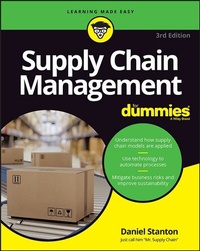
Supply Chain Management For Dummies
Description

Supply Chain Management For Dummies gives you the full rundown on what a supply chain is, how it works, how to optimize it, and the best education for a rewarding supply chain career. This new edition is fully updated for changes to the supply chain in a post-Covid world. You'll learn about the latest supply chain technologies, analytics and data-based optimization, and new strategies for delivering on your organization's promises. This approachable resource can take your supply chain management skills to the next level with step-by-step explanations, expert tips, and real-life examples.
* Gain a foundational knowledge of issues in supply chain management
* Learn about today's global supply chains, plus trends like reshoring and near-shoring
* Wrap your mind around how an organization's moving parts can be coordinated in today's high-tech world
* Discover strategies for dealing with disruptions, focusing on diversity, and increasing resilience
This For Dummies guide is great for entry-level supply chain professionals and anyone who needs an update on need-to-know concepts and recent changes in supply chain management.
More details
Other editions
Additional editions
Person
Content
Part 1: Getting Started with Supply Chain Management 5
Chapter 1: The Growing Demand for Supply Chain Management 7
Chapter 2: Seeing Supply Chains from Different Perspectives 19
Chapter 3: Evaluating Your Supply Chain Strategy 31
Part 2: Managing Supply Chain Processes 47
Chapter 4: Connecting Supply Chain Processes 49
Chapter 5: Planning the Supply Chain 57
Chapter 6: Sourcing, Purchasing, and Procurement 69
Chapter 7: Making Your Products or Services 87
Chapter 8: Delivering Your Products or Services 105
Chapter 9: Managing Product Returns and Reverse Supply Chains 131
Chapter 10: Enabling Your Supply Chain 139
Part 3: Using Technology to Manage Supply Chains 157
Chapter 11: Selecting Supply Chain Software 159
Chapter 12: Integrating Advanced Manufacturing into Your Supply Chain 181
Chapter 13: Managing Digital Transformation in Supply Chains 193
Chapter 14: Adopting Supply Chain Metrics 209
Chapter 15: Building Supply Chain Analytics 225
Part 4: Driving Value with Supply Chain Management 243
Chapter 16: Improving Your Supply Chain Processes 245
Chapter 17: Optimizing Your Supply Chain 265
Chapter 18: Improving Supply Chain Resilience 283
Chapter 19: Boosting Supply Chain Sustainability 299
Part 5: Building Your Supply Chain Management Career 311
Chapter 20: Selecting a Supply Chain Career 313
Chapter 21: Pursuing Supply Chain Education 329
Part 6: The Part of Tens 349
Chapter 22: Ten Questions to Ask about Your Supply Chain 351
Index 359
Chapter 1
The Growing Demand for Supply Chain Management
IN THIS CHAPTER
Making sense of supply chain complexity
Focusing on supply chain tasks
Adopting supply chain management principles
Building supply chain capabilities
Getting started with the New Supply Chain Agenda
These days, it's hard to find a copy of The Wall Street Journal that doesn't have the phrase supply chain somewhere on the first page. You hear about supply chains everywhere: in company reports, on the news, and even in casual conversation. But it hasn't always been that way. Only in the past 40 years has supply chain management gone from being a vague academic concept to a critical business capability. In this chapter, I cover why supply chain management has become so important and explain the process for building best-in-class supply chain management capabilities into your company.
Defining Supply Chain Management
Over the past few years, supply chains have been blamed for shortages of toilet paper, computer chips, and baby formula. Supply chains have been targeted by politicians and policy experts who were concerned about the environment and the economy. Supply chains have even become part of popular culture, with rock star Jack White naming his 2022 concert tour, "The Supply Chain Issues Tour."
In spite of the current hype, supply chains aren't really that new. Entrepreneurs have been buying things from suppliers and selling products to customers for almost as long as people have inhabited the earth. Supply chain management is new, however, and that's because the world is changing.
The basic principles of supply chain management began to take shape in the 1980s as researchers saw how interconnected the world was becoming. At that time, the world population was only about 4.5 billion, with a majority of people living in rural areas. Today the population has grown to 8 billion people, and the majority of us now live in urban areas. There are a lot more people on the planet today than there have been in the past, and we all want lots and lots of stuff.
Supply chains are the complex systems made up of people, processes, and technologies that we engineer and manage to deliver the goods and services customers value. Supply chain management is the planning and coordination of the relationships between all the people, processes, and technology involved in creating that value. Managing a supply chain effectively involves aligning all the work inside your company with the things that are happening outside your company. In other words, it means looking at each business as a single link in a long, end-to-end chain.
The word value shows up a lot when people talk about supply chain management. Basically, value means money. If a customer is willing to pay for something, it has value.
Negotiating prices, scheduling manufacturing, and managing logistics all affect the value created by a company, and they're critical to a supply chain, but because they're so interdependent, it's a bad idea to manage them separately in silos. As companies grow larger, supply chains get longer, and the pace of business gets faster, it has become more important to align the various functions in a supply chain. Ironically, many of the strategies and metrics that businesses relied on in the past, and that managers have been taught to use, can actually create serious problems for a supply chain. A sales rep might hit their quota by landing a huge deal with a customer, for example, but the deal might be unprofitable for the company because of the costs it will drive to the logistics and manufacturing functions. A buyer might negotiate a volume discount from a supplier without considering how much more it will cost to store and protect all of that extra inventory. Supply chain management helps sales, logistics, manufacturing, procurement, and all your other functions get aligned to ensure that decisions are good for the whole business.
The difference between the amount of money your company brings in (revenue) and the amount of money it spends (costs) is your profit. In other words, your profit is the value that you have captured from your supply chain.
Companies that do a good job of managing their supply chains are better able to take advantage of value-creation opportunities their competitors might miss. Implementing lean manufacturing, for example, can companies reduce inventories. Being responsive to customer needs can help them grow their sales. Collaborating with suppliers can ensure better access to materials.
Some supply chain management professionals are generalists, and others are specialists. Generalists look at the big picture; specialists focus on a particular step in the supply chain. At the end of the day, they all need to understand the effects of their decisions in order to ensure that revenue is greater than costs while meeting the needs of their customers. That's why supply chain management has become so important.
Making Tough Business Decisions
Managing a supply chain is complicated: So many moving pieces are involved, and so many things can change in an instant, that making long-term plans seems virtually impossible. How can you really plan for commodity price swings, natural disasters, and financial meltdowns, all at the same time? But you can't ignore those possibilities, either. Instead, you need to think about them and design your supply chain so that it can function well under a range of scenarios. In other words, you want your supply chain to be resilient.
A good way to start improving resilience is to practice scenario planning. Think about the many possibilities that the future holds, try to imagine each one as a series of events, and then think about how those events would affect your business. To use scenario planning to prepare for the unknown and the unknowable, you need to understand three really important things:
- Which scenarios are most important to you.
- What you'll do - and how - in each scenario. (Each scenario calls for a different plan.)
- How you can tell when a scenario is becoming reality.
It helps to have sensors that tell you what's happening, and triggers that help you decide when to implement which plan. When you use scenario planning, supply chain management becomes a process of planning ahead, sensing changes, and responding to triggers. Figure 1-1 shows how sensors help you recognize which scenario is unfolding so that you can implement the proper plan.
FIGURE 1-1: Scenario-planning model.
I can explain this concept with a few practical examples:
-
You run a manufacturing company that imports products from overseas, so you need to consider what you'd do if one of your inbound shipments is lost at sea, impounded by customs, captured by pirates, or caught in a port strike. Your sensor could be a notification system that sends alerts about your shipments. One plan might be shutting down your factory until the issue is resolved. You might also consider placing a new order with a different supplier. In an extreme case, you might declare force majeure and tell your customers that you won't be able fulfill your commitments to them.
Force majeure is a legal term that means you are free from liability if you are unable to meet obligations due to an extraordinary circumstance.
- You work for a wholesaler that has been selling a product at a steady rate for months, and one month, the company sells twice as much as normal. You don't have enough inventory to fill all your customer orders, and now you also have back orders to fill. You may even be at risk of losing sales and customers. You might decide to place bigger orders in the future and keep more inventory on hand. That means you'll be investing more working capital in inventory.
- You work for a transportation company. The company's customers pay you to deliver their products around the world, and they count on your deliveries to help them meet their commitments to their own customers. Therefore, your ability to deliver on time is essential to them. Suddenly, a volcano in a distant part of the world spews ash far into the sky, making it dangerous for airplanes to use a heavily traveled flight path. You could reroute your planes, but this is expensive because you would need to develop new flight plans, reschedule airplanes, and find available crews. Alternatively, you could tell your customers that their deliveries are on hold until normal operations can resume.
Thousands of companies have had to face every one of these scenarios in the past few years. In every case, making the right decision about how to respond required understanding supply chains and supply chain management. As you read this book, you will discover topics that can help you create more accurate scenarios and better plans for responding to them.
You can find more information about supply chain scenario planning, as well as a link to the MIT Scenario Planning Toolkit, in Chapter 15.
The next sections cover ten supply chain management principles, five supply chain tasks, six supply chain capabilities, and the five steps for implementing a new supply chain agenda. Each section provides a slightly different perspective on supply chain management, but the sections explain the same challenge in...
