

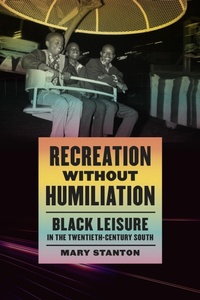
Recreation without Humiliation
Description

Recreation without Humiliation is the first comprehensive study of Black amusement venues established by Black Americans for Black Americans. Mary Stanton's extensive research on African American amusement parks in America explores not only segregation, class, and social barriers but also the notion of the 'pursuit of happiness' as an inalienable right for all races and classes of people.
Inspired by summers spent on Coney Island, where Stanton became curious about the existence of African American amusement parks in America, Stanton's research uncovered more than fifty such venues, most of which operated during the late nineteenth and early twentieth centuries. These were parks, theaters, juke joints, country clubs, summer colonies, baseball diamonds, and arenas. Although these venues provided much needed recreational services to an underserved Black population, many were threatened by whites, and some destroyed by them. Through her study of these sites of recreation, Stanton illuminates the history of African Americans who strove to create and maintain safe and satisfying entertainment despite segregation.
In her research, Stanton also found class divisions among Black American entertainment venues. At the pinnacle of Black society in this era were the upper class, who could afford exclusive Black summer cottages and country clubs. General entertainment for Black working-class families consisted of dancing and drinking in juke joints or patronizing small amusement parks, playgrounds, movie theaters, church-sponsored functions, and Black county fairs. African Americans in the twentieth century, especially in the South, transformed segregation into what historian Earl Lewis calls "congregation." Congregation implies choice, and this congregation "provided space and support for establishing new amusements, entertainments, music, and dance" without interference or oppression.
