

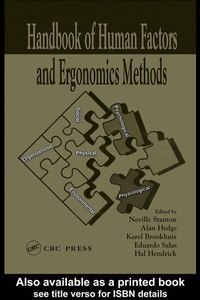
Handbook of Human Factors and Ergonomics Methods
1st Edition
Published on 30. August 2004
768 pages
978-1-134-44677-3 (ISBN)
Description

Research suggests that ergonomists tend to restrict themselves to two or three of their favorite methods in the design of systems, despite a multitude of variations in the problems that they face. Human Factors and Ergonomics Methods delivers an authoritative and practical account of methods that incorporate human capabilities and limitations, envi
Reviews / Votes
"Hanbook of Human Factors and Ergonomics Methods is one of the best resources to identify methods of tackling human factors (neck up) and ergonomics (neck down) problems encountered in greater society."-Professional Safety, Feb. 2006
More details
Edition
1. Auflage
Language
English
Place of publication
London
United Kingdom
Publishing group
Taylor & Francis Ltd
Target group
Professional and scholarly
Ergonomists, Mechanical Engineers, Safety Engineers, Industrial Hygienists, Manufacturing Engineers, Production Engineers
Product notice
Reflowable
Illustrations
144 s/w Abbildungen, 139 s/w Tabellen, 34 s/w Photographien bzw. Rasterbilder
144 b/w images, 139 tables, 34 halftones and 31 equations
ISBN-13
978-1-134-44677-3 (9781134446773)
Copyright in bibliographic data and cover images is held by Nielsen Book Services Limited or by the publishers or by their respective licensors: all rights reserved.
Schweitzer Classification
Other editions
Additional editions
Neville Anthony Stanton | Alan Hedge | Karel Brookhuis
Handbook of Human Factors and Ergonomics Methods
Book
12/2019
1st Edition
CRC Press
€95.00
Shipment within 15-20 days
Neville Anthony Stanton | Alan Hedge | Karel Brookhuis
Handbook of Human Factors and Ergonomics Methods
Book
08/2004
1st Edition
CRC Press
€230.90
Shipment within 15-20 days
Persons
Neville Anthony Stanton (University of Southampton, Highfield, Southampton, UK) (Edited by) , Alan Hedge (Cornell University, Ithaca, New York, USA) (Edited by) , Karel Brookhuis (University of Groningen, The Netherlands) (Edited by) , Eduardo Salas (University of Central Florida, Orlando, USA) (Edited by) , Hal W. Hendrick (University of Southern California (Emeritus), Los Angeles, U) (Edited by)
Content
PHYSICAL METHODS
Physical Methods
PLIBEL - The Method Assigned for Identification of Ergonomic Hazards
Musculoskeletal Discomfort Surveys Used at NIOSH
The Dutch Musculoskeletal Questionnaire (DMQ)
Quick Exposure Checklist (QEC) for the Assessment of Workplace
Risks for Work-Relate Musculoskeletal Disorders (WMSDs)
Rapid Upper Limb Assessment (RULA)Rapid Entire Body AssessmentThe Strain Index
Posture Checklist Using Personal Digital Assistant (PDA) Technology
Scaling Experiences during Work: Perceived Exertion and Difficulty
Muscle Fatigue Assessment: Functional Job Analysis Technique
Psychophysical Tables: Lifting, Lowering, Pushing, Pulling, and Carrying
Lumbar Motion Monitor
The Occupational Repetitive Action (OCRA) Methods: OCRA Index and OCRA Checklist
Assessment Of Exposure to Manual Patient Handling in Hospital Wards: MAPO INDEX (Movement and Assistance of Hospital Patients)
Psychophysiological Methods
Psycho-Physiological Methods
Electrodermal Measurement
Electromyography (EMG)
Estimating Mental Effort Using Heart Rate and Heart Rate Variability
Ambulatory EEG Methods and Sleepiness
Assessing Brain Function and Mental Chronometry with Event-Related
Potentials (ERP)
MEG and fMRI
Ambulatory Assessment of Blood Pressure to Evaluate Workload
Monitoring Alertness by Eyelid Closure
Measurement of Respiration in Applied Human Factors and Ergonomics Research
Behavioural and Cognitive Methods
Applying Interviews to Usability Assessment
Verbal Protocol Analysis
Repertory Grid for Product Evaluation
Focus Groups
Hierarchical Task Analysis (HTA)
Allocation of Functions
Critical Decision Method
Applied Cognitive Work Analysis (ACWA)
Systematic Human Error Reduction and Prediction Approach (SHERPA)
Task Analysis for Error Identification
Mental Workload
Multiple Resource Time Sharing Mode
Path Analysis for Multimodal Activity
Situation Awareness Measurement and the Situation Awareness
Global Assessment Technique
Team Methods
Team Training
Distributed Simulation Training for Teams
Synthetic Task Environments for Teams: CERTT's UAV-STE
Event-Based Approach to Training (EBAT)
Team Building
Measuring Team Knowledge
Team Communications Analysis
Questionnaires for Distributed Assessment of Team Mutual Awareness
Team Decision Requirement Exercise: Making Team Decision
Requirements Explicit
David W. Klinger and Bianka B. HahnTargeted Acceptable Responses to Generated Events or Tasks (TARGETs)
Behavioral Observation Scales (BOS)
Team Situation Assessment Training for Adaptive Coordination
Team Task Analysis
Team Workload
Social Network Analysis
Environmental Methods
Thermal Conditions Measurement
Cold Stress Indices
Heat Stress Indices
Thermal Comfort IndicesIndoor Air Quality: Chemical Exposures
Indoor Air Quality: Biological/Particulate-Phase Contaminant
Exposure Assessment Methods
Olfactometry: the Human Nose as Detection Instrument
The Context and Foundation of Lighting Practice
Photometric Characterization of the Luminous Environment
Evaluating Office Lighting
Rapid Sound-Quality Assessment of Background Noise
Noise Reaction Indices and Assessment
Noise and Human Behavior
Occupational Vibration: a Concise Perspective
Habitability Measurement in Space Vehicles and Earth Analogs
Macroergonomic Methods
Macroergonomic Organizational Questionnaire Survey (MOQS)
Interview Method
Focus Groups
Laboratory Experiment
Field Study and Field Experiment, Participatory Ergonomics (PE)
Cognitive Walk-Through Method (CWM)
Kansei Engineering
HITOP Analysis (TM)
TOP-Modeler (c) 2002The CIMOP System (c) 2002
Anthropotechnology
Systems Analysis Tool (SAT)
Macroergonomic Analysis of Structure (MAS)
MacroErgonomic Analysis and Design (MEAD)
Physical Methods
PLIBEL - The Method Assigned for Identification of Ergonomic Hazards
Musculoskeletal Discomfort Surveys Used at NIOSH
The Dutch Musculoskeletal Questionnaire (DMQ)
Quick Exposure Checklist (QEC) for the Assessment of Workplace
Risks for Work-Relate Musculoskeletal Disorders (WMSDs)
Rapid Upper Limb Assessment (RULA)Rapid Entire Body AssessmentThe Strain Index
Posture Checklist Using Personal Digital Assistant (PDA) Technology
Scaling Experiences during Work: Perceived Exertion and Difficulty
Muscle Fatigue Assessment: Functional Job Analysis Technique
Psychophysical Tables: Lifting, Lowering, Pushing, Pulling, and Carrying
Lumbar Motion Monitor
The Occupational Repetitive Action (OCRA) Methods: OCRA Index and OCRA Checklist
Assessment Of Exposure to Manual Patient Handling in Hospital Wards: MAPO INDEX (Movement and Assistance of Hospital Patients)
Psychophysiological Methods
Psycho-Physiological Methods
Electrodermal Measurement
Electromyography (EMG)
Estimating Mental Effort Using Heart Rate and Heart Rate Variability
Ambulatory EEG Methods and Sleepiness
Assessing Brain Function and Mental Chronometry with Event-Related
Potentials (ERP)
MEG and fMRI
Ambulatory Assessment of Blood Pressure to Evaluate Workload
Monitoring Alertness by Eyelid Closure
Measurement of Respiration in Applied Human Factors and Ergonomics Research
Behavioural and Cognitive Methods
Applying Interviews to Usability Assessment
Verbal Protocol Analysis
Repertory Grid for Product Evaluation
Focus Groups
Hierarchical Task Analysis (HTA)
Allocation of Functions
Critical Decision Method
Applied Cognitive Work Analysis (ACWA)
Systematic Human Error Reduction and Prediction Approach (SHERPA)
Task Analysis for Error Identification
Mental Workload
Multiple Resource Time Sharing Mode
Path Analysis for Multimodal Activity
Situation Awareness Measurement and the Situation Awareness
Global Assessment Technique
Team Methods
Team Training
Distributed Simulation Training for Teams
Synthetic Task Environments for Teams: CERTT's UAV-STE
Event-Based Approach to Training (EBAT)
Team Building
Measuring Team Knowledge
Team Communications Analysis
Questionnaires for Distributed Assessment of Team Mutual Awareness
Team Decision Requirement Exercise: Making Team Decision
Requirements Explicit
David W. Klinger and Bianka B. HahnTargeted Acceptable Responses to Generated Events or Tasks (TARGETs)
Behavioral Observation Scales (BOS)
Team Situation Assessment Training for Adaptive Coordination
Team Task Analysis
Team Workload
Social Network Analysis
Environmental Methods
Thermal Conditions Measurement
Cold Stress Indices
Heat Stress Indices
Thermal Comfort IndicesIndoor Air Quality: Chemical Exposures
Indoor Air Quality: Biological/Particulate-Phase Contaminant
Exposure Assessment Methods
Olfactometry: the Human Nose as Detection Instrument
The Context and Foundation of Lighting Practice
Photometric Characterization of the Luminous Environment
Evaluating Office Lighting
Rapid Sound-Quality Assessment of Background Noise
Noise Reaction Indices and Assessment
Noise and Human Behavior
Occupational Vibration: a Concise Perspective
Habitability Measurement in Space Vehicles and Earth Analogs
Macroergonomic Methods
Macroergonomic Organizational Questionnaire Survey (MOQS)
Interview Method
Focus Groups
Laboratory Experiment
Field Study and Field Experiment, Participatory Ergonomics (PE)
Cognitive Walk-Through Method (CWM)
Kansei Engineering
HITOP Analysis (TM)
TOP-Modeler (c) 2002The CIMOP System (c) 2002
Anthropotechnology
Systems Analysis Tool (SAT)
Macroergonomic Analysis of Structure (MAS)
MacroErgonomic Analysis and Design (MEAD)
