

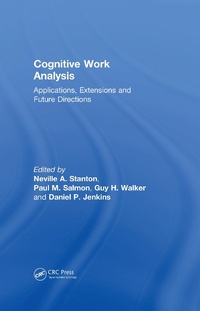
Cognitive Work Analysis
Applications, Extensions and Future Directions
Published on 14. July 2017
450 pages
978-1-317-16474-6 (ISBN)
Description

Over the past decade, Cognitive Work Analysis (CWA) has been one of the popular human factors approaches for complex systems evaluation and design applications. This is reflected by a diverse range of applications across safety critical domains. The book brings together a series of CWA applications and discussions from world-leading human factors researchers and practitioners. It begins with an overview of the CWA framework, including its theoretical underpinnings, the methodological approaches involved (including practical guidance on each phase), and previous applications of the framework. The core of the book is a series of CWA applications, undertaken in a wide range of safety critical domains for a range of purposes. These serve to demonstrate the contribution that CWA can make to real-world projects and provide readers with inspiration for how such analyses can be practically carried out. Following this, a series of applications in which new approaches or adaptations have been added to the framework are presented. These show how practical applications feedback into the theories/approaches underpinning CWA. The closing chapter then speculates on future applications of the framework and on a series of new research directions required in order to enhance its utility. In emphasising the practical realities of performing CWA, and the real-world impacts it can provide, the book tackles several common misconceptions in a constructive and persuasive way. It provides a welcome demonstration of how CWA can be a powerful ally in tackling complexity-related problems that afflict systems in all areas.
Reviews / Votes
"In this erudite and timely text, Neville Stanton and his colleagues have assembled a veritable who's who of scientists to address the crucial ergonomic challenge of cognitive work analysis. In numerous, informative chapters, we are led to a highly practical and applicable understanding of contemporary techniques and future projections for this vital perspective on evolving human work. Informative for those at the cutting edge of science as well as the sharp point of the operational spear, it is a vital resource for those who wish to comprehend and actively contribute to the future of the human condition."-Peter A. Hancock, University of Central Florida, USA
"This book contains a collection of contributions from leading scholars who specialize in the area of Cognitive Work Analysis, offering a wide range of illustrations and examples of diverse work domains. An excellent resource for researchers and practitioners, reflecting the state of the art in Cognitive work Analysis and demonstrating how this analytic framework can be applied to important problems in socio-technical design."
-Dr Gavan Lintern, Cognitive Systems Design, Australia
"Cognitive Work Analysis (CWA) reflects a shift in perspective for design thinking. This is a shift from a focus on human-machine or human-computer interaction to a focus on human-work interaction. This shift is essential for domains such as nuclear power, healthcare, and urban planning where success is no longer guaranteed by procedural compliance with a priori rules. The diverse examples provided in this volume will help readers to appreciate the nuances of CWA so that they will be better able to adapt the methods to the particulars of their own complex design challenges."
-John M. Flach, Wright State University, USA
More details
Language
English
Place of publication
London
United Kingdom
Publishing group
Taylor & Francis Ltd
Target group
Professional and scholarly
Illustrations
58 Tables, black and white; 125 Line drawings, black and white; 24 Halftones, black and white
File size
12,07 MB
ISBN-13
978-1-317-16474-6 (9781317164746)
Copyright in bibliographic data and cover images is held by Nielsen Book Services Limited or by the publishers or by their respective licensors: all rights reserved.
Schweitzer Classification
Other editions
Additional editions
Neville A. Stanton | Paul M. Salmon | Guy H. Walker
Cognitive Work Analysis
Applications, Extensions and Future Directions
Book
06/2017
1st Edition
CRC Press
€266.40
Shipment within 10-20 days
Neville A. Stanton | Paul M. Salmon | Guy H. Walker
Cognitive Work Analysis
Applications, Extensions and Future Directions
Book
06/2017
1st Edition
CRC Press
€146.60
Shipment within 10-20 days
Persons
Professor Neville Stanton, PhD, DSc, is a Chartered Psychologist, Chartered Ergonomist and a Chartered Engineer. He holds the Chair in Human Factors Engineering in the Faculty of Engineering and the Environment at the University of Southampton in the UK. He has degrees in Psychology, Applied Psychology and Human Factors and has worked at the Universities of Aston, Brunel, Cornell and MIT. His research interests include modelling, predicting, analyzing and evaluating human performance in systems as well as designing the interfaces and interaction between humans and technology. Professor Stanton has worked on design of automobiles, aircraft, ships and control rooms over the past 30 years, working on a variety of automation projects. He has published 35 books and over 270 journal papers on Ergonomics and Human Factors. In 1998 he was awarded the Institution of Electrical Engineers Divisional Premium Award for research into System Safety. The Institute of Ergonomics and Human Factors awarded him The Otto Edholm Medal in 2001, The President's Medal in 2008 and The Sir Frederic Bartlett Medal in 2012 for his contributions to basic and applied ergonomics research. The Royal Aeronautical Society awarded him and his colleagues the Hodgson Prize and Bronze Medal in 2006 for research on design-induced, flight-deck, error published in The Aeronautical Journal. The University of Southampton has awarded him a Doctor of Science in 2014 for his sustained contribution to the development and validation of Human Factors methods.
Professor Paul Salmon holds a chair in Human Factors and is creator and director of the Centre for Human Factors and Sociotechnical Systems at the University of the Sunshine Coast. He currently holds a prestigious Australian Research Council Future Fellowship and has almost 15 years experience in applied Human Factors research in a number of areas, including defence, transportation safety, sports and outdoor recreation, and disaster management. Paul currently leads major research programs in the areas of road and rail safety, identity theft and cybersecurity, and led outdoor recreation accidents. Paul has co-authored 11 books, over 140 peer reviewed journal articles, and numerous conference articles and book chapters. He has received various accolades for his contributions to research and practice, including the Australian Human Factors and Ergonomics Societies 2016 Cumming Memorial medal, the UK Ergonomics Society's Presidents Medal, the Royal Aeronautical Society's Hodgson Prize for best research and paper, and the University of the Sunshine Coast's Vice Chancellor and Presidents Medal for Research Excellence. His current research interests relate to extending Human Factors and Sociotechnical Systems theory and methods to support the optimisation of systems in many areas. Specific areas of focus include accident prediction and analysis, systems thinking in transportation safety, the development of systemic accident countermeasures, human factors in elite sports, and cybersecurity.
Dr. Guy Walker is an Associate Professor within the Institute for Infrastructure and Environment at Heriot-Watt University in Edinburgh. He lectures on human factors and is the author/co-author of over one hundred peer reviewed journal articles and thirteen books. He and his co-authors have been awarded the Institute for Ergonomics and Human Factors President's Medal for the practical application of Ergonomics theory and the Peter Vulcan prize for best research paper by the 2013 Australasian Road Safety Research Conference. In 2011 Guy also won Heriot-Watt University's Graduate's Prize for inspirational teaching. Dr. Walker has a BSc Honours degree in Psychology from the University of Southampton and a PhD in Human Factors from Brunel University. His research interests are wide ranging, spanning driver behaviour and the role of feedback in vehicles, using human factors methods to analyse black-box data recordings, the application of sociotechnical systems theory to the design and evaluation of civil engineering systems through to safety, risk and reliability. His research has featured in the popular media, from national newspapers, TV and radio through to an appearance on the Discovery Channel.
Dr. Dan Jenkins leads the research team at DCA Design International, one of the world's leading product design and development consultancies. Within multidisciplinary teams, he supports the design of a diverse range of products and services, from trains to toothbrushes. Working with clients and key stakeholders, Dan specialises in the application of human factors and systems thinking tools to ensure system performance is maximised and that products stand the greatest chance of commercial success. Notable projects include, patient administered drug delivery devices, next-generation radiotherapy equipment, personal protective equipment, airline interiors, train cabs, train passenger areas, and a wide range of fast moving consumer goods. Dan has co-authored 10 books and over 50 journal papers, he is also contributes to wide range of blogs and magazines with the aim of disseminating the role of human factors in the design process to a wider audience. Dan was received numerous awards for his work in human factors including the HFES User-Centred Design Award and the CIEHF President's Medal.
Professor Paul Salmon holds a chair in Human Factors and is creator and director of the Centre for Human Factors and Sociotechnical Systems at the University of the Sunshine Coast. He currently holds a prestigious Australian Research Council Future Fellowship and has almost 15 years experience in applied Human Factors research in a number of areas, including defence, transportation safety, sports and outdoor recreation, and disaster management. Paul currently leads major research programs in the areas of road and rail safety, identity theft and cybersecurity, and led outdoor recreation accidents. Paul has co-authored 11 books, over 140 peer reviewed journal articles, and numerous conference articles and book chapters. He has received various accolades for his contributions to research and practice, including the Australian Human Factors and Ergonomics Societies 2016 Cumming Memorial medal, the UK Ergonomics Society's Presidents Medal, the Royal Aeronautical Society's Hodgson Prize for best research and paper, and the University of the Sunshine Coast's Vice Chancellor and Presidents Medal for Research Excellence. His current research interests relate to extending Human Factors and Sociotechnical Systems theory and methods to support the optimisation of systems in many areas. Specific areas of focus include accident prediction and analysis, systems thinking in transportation safety, the development of systemic accident countermeasures, human factors in elite sports, and cybersecurity.
Dr. Guy Walker is an Associate Professor within the Institute for Infrastructure and Environment at Heriot-Watt University in Edinburgh. He lectures on human factors and is the author/co-author of over one hundred peer reviewed journal articles and thirteen books. He and his co-authors have been awarded the Institute for Ergonomics and Human Factors President's Medal for the practical application of Ergonomics theory and the Peter Vulcan prize for best research paper by the 2013 Australasian Road Safety Research Conference. In 2011 Guy also won Heriot-Watt University's Graduate's Prize for inspirational teaching. Dr. Walker has a BSc Honours degree in Psychology from the University of Southampton and a PhD in Human Factors from Brunel University. His research interests are wide ranging, spanning driver behaviour and the role of feedback in vehicles, using human factors methods to analyse black-box data recordings, the application of sociotechnical systems theory to the design and evaluation of civil engineering systems through to safety, risk and reliability. His research has featured in the popular media, from national newspapers, TV and radio through to an appearance on the Discovery Channel.
Dr. Dan Jenkins leads the research team at DCA Design International, one of the world's leading product design and development consultancies. Within multidisciplinary teams, he supports the design of a diverse range of products and services, from trains to toothbrushes. Working with clients and key stakeholders, Dan specialises in the application of human factors and systems thinking tools to ensure system performance is maximised and that products stand the greatest chance of commercial success. Notable projects include, patient administered drug delivery devices, next-generation radiotherapy equipment, personal protective equipment, airline interiors, train cabs, train passenger areas, and a wide range of fast moving consumer goods. Dan has co-authored 10 books and over 50 journal papers, he is also contributes to wide range of blogs and magazines with the aim of disseminating the role of human factors in the design process to a wider audience. Dan was received numerous awards for his work in human factors including the HFES User-Centred Design Award and the CIEHF President's Medal.
Content
Overview of CWA; Application of Cognitive Work Analysis to System Analysis and Design; Requirements Specification; Specifying system requirements using Cognitive Work Analysis; Using the abstraction hierarchy to create more innovative specifications; Using the decision ladder to reach interface requirements; From CWA to Software Engineering; Analysis of Sociotechnical Systems; Work Domain Analysis of Power Grid Operations; How a submarine returns to periscope depth; Cognitive Work Analysis - Lens on Work; Exploring the constraints of modal shift to rail transport; Conducting Cognitive Work Analysis with an Experiment in Mind; Design and Evaluation; Cognitive Work Analysis for Systems Analysis and Redesign: rail level crossings case study; Work Domain Analysis applications in urban planning: active transport infrastructure and urban corridors; Use and Refinement of CWA in an Industrial, Automotive Design, Context; Using Work Domain Analysis to design a rotary wing Head Up Display; Designing Mission Communication Planning with Rich Pictures and Cognitive Work Analysis; Risk and Resilience; CWA vs SWIFT in a Nuclear Decommissioning Case Study; Deriving and Analysing Social Networks from SOCA-CAT Diagrams; Using CWA to Understand and Enhance Infrastructure Resilience
