

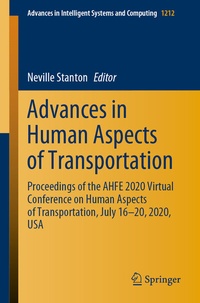
Advances in Human Aspects of Transportation
Description

This book discusses the latest advances in the research and development, design, operation, and analysis of transportation systems and their corresponding infrastructures. It presents both theories and case studies on road and rail, aviation, and maritime transportation. Further, it covers a wealth of topics, from accident analysis, intelligent vehicle control, and human-error and safety issues to next-generation transportation systems, model-based design methods, simulation and training techniques, and many more. Special emphasis is placed on smart technologies and automation in transport, as well as the user-centered, ergonomic, and sustainable design of transportation systems. The book, which is based on the AHFE 2020 Virtual Conference on Human Aspects of Transportation, held on July 16-20, 2020, mainly addresses the needs of transportation system designers, industrial designers, human-computer interaction researchers, civil and control engineers, as well as vehicle system engineers. Moreover, it represents a timely source of information for transportation policy-makers and social scientists whose work involves traffic safety, management, and sustainability issues in transport.
More details
Other editions
Additional editions
Content
- Intro
- Advances in Human Factors and Ergonomics 2020
- Preface
- Contents
- Traffic Behavior and Driver Performance
- Determining Infrastructure- and Traffic Factors that Increase the Perceived Complexity of Driving Situations
- Abstract
- 1 Introduction
- 2 Methods
- 2.1 Participants
- 2.2 Scenarios
- 2.3 Materials and Procedure
- 3 Results
- 3.1 Overall Complexity
- 3.2 Influence of Infrastructure- and Traffic Complexity on Overall Complexity
- 4 Discussion
- Funding Statement
- References
- Development of Statistical Models for Predicting Automobile Seat Fit of Drivers
- Abstract
- 1 Introduction
- 2 Data Collection
- 3 Model Development and Validation
- 4 Discussion
- Acknowledgments
- References
- How Personal Identity Influences the Driving Behavior-Correlation Analysis with Naturalistic Driving Data
- Abstract
- 1 Introduction
- 2 Related Work
- 3 Methods
- 3.1 Driver Performance
- 3.2 Naturalistic Driving Application
- 3.3 Human Factors
- 4 Results and Discussion
- 5 Conclusion
- References
- Assessment of Driver Distraction Caused by Social Networking Activities Using the Smartphone: A Driving Simulator Study
- Abstract
- 1 Background
- 2 Methodology
- 2.1 Equipment
- 2.2 Sample of Drivers
- 2.3 Driving Scenario and Events
- 2.4 Secondary Task
- 2.5 Procedure
- 2.6 Data Collection
- 3 Results
- 3.1 Crash Occurrence
- 3.2 Driving Performance
- 4 Conclusions
- References
- Personalized Driver State Profiles: A Naturalistic Data-Driven Study
- Abstract
- 1 Introduction
- 2 Related Work
- 3 Data Collection and Processing
- 4 Data Analysis
- 5 Results
- 6 Conclusion and Future Work
- References
- Human Car-Following Behavior: Parametric, Machine-Learning, and Deep-Learning Perspectives
- Abstract
- 1 Introduction
- 2 Method
- 2.1 Modeling
- 2.2 Model Assessment
- 3 Result
- 4 Discussion and Future Work
- References
- Alert! Automated Vehicle (AV) System Failure - Drivers' Reactions to a Sudden, Total Automation Disengagement
- Abstract
- 1 Introduction
- 2 Driver Transition Behaviors During AV Driving and Failures
- 3 Methodology
- 4 Results and Discussion
- 5 Conclusions
- References
- Traffic Behavior Analysis Using Mobile Base Station Data
- Abstract
- 1 Mobility Big Data
- 2 Reference Review
- 3 Existing O/D Estimation Method in Korea
- 4 New Approach Based on Mobile Base Station Data
- 5 Application and Comparison with KTDB
- 6 Conclusion
- Acknowledgments
- References
- Driver's Visual Attention Analysis in Smart Car with FHUD
- Abstract
- 1 Introduction
- 2 Method
- 2.1 Participants
- 2.2 Materials
- 2.3 Experimental Setup
- 2.4 Experimental Design
- 2.5 Dependent Variables
- 3 Result
- 3.1 Number of Fixations
- 3.2 Mean Fixation Durations
- 3.3 Areas of Interest Analysis
- 4 Discussion and Conclusion
- Acknowledgments
- References
- Human Machine Interaction
- How Important is the Plausibility of Test Scenarios Within Usability Studies for AV HMI?
- Abstract
- 1 Introduction
- 2 Method
- 2.1 Sample
- 2.2 System and HMI
- 2.3 Test Scenarios
- 2.4 Measures
- 3 Results
- 4 Summary and Conclusion
- References
- Employing Natural Finger Positioning Strategy for Improving Blind-Positioning of Steering Wheel Mounted Switches
- Abstract
- 1 Introduction
- 2 Problem Discovery
- 3 Exploring Possibilities
- 4 Idea Development of Prototyping
- 4.1 Multi-finger Pull Gesture NFP Device of Directional Entry Keys
- 4.2 Feasibility Test
- 5 Results
- 6 Employing Voice Prompt on Intermittent Key Operation
- 6.1 Visual and Auditory Prompt for Car Driver
- 6.2 Feasibility Test of Voice Prompt on Intermittent Key Operation
- 6.3 Results
- 7 Conclusions
- References
- Towards a Truly Cooperative Guidance and Control: Generic Architecture for Intuitive Human-Machine Cooperation
- Abstract
- 1 Introduction
- 1.1 Human-Machine Cooperation (Framework)
- 2 System Architecture for Adaption Based on Human Involvement
- 2.1 Intuitive Control Distribution
- 3 Intuitive Assistance in Operational Layer for Movement Control
- 4 Conclusion
- References
- Researchers and Public Views on Electronic Sideview Mirror System (ESMS) in the 21st Century Cars
- Abstract
- 1 Introduction
- 2 Methodology
- 3 Data Analysis and Results
- 4 Discussion
- 5 Conclusion
- References
- Future Transportation Service Technology Platform System Based on Internet of Vehicles
- Abstract
- 1 Introduction
- 2 Development Trend of the Autonomous Driving Industry
- 3 Blockchain in the Automotive Industry
- 3.1 Disruption of the Automotive Industry
- 3.2 The Practical Application of the Service System
- 4 Construction of Urban Travel System
- 5 Summarize
- References
- Impact of Speedometer Forms on Integration Task Performance for Train Driving
- Abstract
- 1 Introduction
- 2 Method
- 2.1 Participants
- 2.2 Apparatus
- 2.3 Procedure
- 2.4 Data Analysis
- 3 Results
- 3.1 Reaction Time
- 3.2 Correct Rate
- 3.3 Eye Movement Experiment Data Analysis and Results
- 4 Discussion
- 5 Conclusion
- References
- New Technology Implementation in High-Risk Organizations - The Application of HRO Principles in New Technology Implementation in Railroad Industry
- Abstract
- 1 Introduction
- 2 New Technology Implementation in High-Risk Organizations
- 3 Hallmarks of High Reliability Organizations
- 4 Positive Train Control
- 5 Incorporation of HRO Principles in PTC Implementation
- 6 Conclusion
- References
- Eye Movement Analysis of Interactive Interface of CRH High-Speed Train Braking Test
- Abstract
- 1 Introduction
- 2 Experiment
- 3 Data
- 3.1 Settings of TOI (Times of Intersest)
- 3.2 Visualization
- 4 Analysis
- 5 Conclusion
- References
- Research on Optimal Design of Metro Driving Interface Based on Driver's Operating Characteristics
- Abstract
- 1 Introduction
- 2 Method
- 2.1 Participant
- 2.2 Design Process
- 3 Results and Discussion
- 3.1 Optimization Design of Driving Interface
- 3.2 Satisfaction Survey
- 4 Conclusion
- References
- Effect of Intercity Train Vehicle Layout on Boarding and Alighting
- Abstract
- 1 Introduction
- 2 Passenger Boarding and Alighting Simulation Scene Developed Using LEGION
- 2.1 Simulation Model Construction and Parameter Input
- 2.2 Establishment of Analysis Area and Determination of Analysis Indicators
- 3 Influence of the Passenger Vehicle Layout Factors on the Boarding and Alighting Efficiency
- 3.1 Analysis of the Influence of the Door Width on the Boarding and Alighting Efficiency
- 3.2 Analysis of the Influence of the Hall Width on the Boarding and Alighting Efficiency
- 3.3 Analysis of the Influence of the Aisle Width on the Boarding and Alighting Efficiency
- 4 Discussion
- 5 Conclusion
- References
- Vehicle-to-Infrastructure and Human-to-Infrastructure Models for Smart Civil Infrastructure Systems
- Abstract
- 1 Introduction
- 2 Materials and Methods
- 3 Results
- 4 Discussion
- 5 Conclusion
- References
- Driving Automation
- Online Feedback Control for Driver-Vehicle Interaction in Automated Driving
- Abstract
- 1 Introduction
- 2 Structure of Feedback Control in Interaction
- 3 Exemplary Experimental Implementation
- 4 Discussion
- Acknowledgments
- References
- Automated Driving on the Motorway: A Users' Perspective on Conditional Versus High Automation
- Abstract
- 1 Introduction
- 2 Method
- 3 Results
- 4 Conclusions
- Acknowledgments
- References
- On the Road Again - Explanatory Factors for the Users' Willingness to Replace Private Cars by Autonomous on-Demand Shuttle Services
- Abstract
- 1 Introduction
- 2 State of Research and Resulting Research Questions
- 3 Methodology
- 3.1 Qualitative Preliminary Work
- 3.2 Questionnaire Design
- 3.3 Data Collection, Processing, and Analysis
- 4 Sample
- 5 Results
- 5.1 Willingness to Share Rides
- 5.2 Willingness to Replace Private Cars by Autonomous on-Demand Shuttle Services
- 6 Discussion
- 7 Limitations and Outlook
- Acknowledgements
- References
- How Visual Cues on Steering Wheel Improve Users' Trust, Experience, and Acceptance in Automated Vehicles
- Abstract
- 1 Introduction
- 2 Human Machine Interface
- 2.1 Baseline HMI Design
- 2.2 Concept A
- 2.3 Concept B
- 3 Methods
- 3.1 Procedures and Data Collection
- 4 Results
- 5 Discussion
- Acknowledgments
- References
- The Impact of a Biological Driver State Monitoring System on Visual Attention During Partially Automated Driving
- Abstract
- 1 Introduction
- 2 Method
- 2.1 Participants
- 2.2 Design and Materials
- 2.3 Measurements and Pre-processing
- 2.4 Statistical Analysis
- 3 Results
- 3.1 Eye Tracking
- 4 Discussion
- References
- Analysis of Public Transport Ridership During a Heavy Snowfall in Seoul
- Abstract
- 1 Introduction
- 2 Preceding Research
- 3 Data
- 4 Analysis and Result
- 4.1 Analysis of Public Transport Ridership
- 4.2 Changes in Public Transport Usage by Region
- 4.3 Analysis of the Main Effect of Change Public Transport
- 5 Conclusion
- Acknowledgment
- References
- The Role of Attentional Networks in Secondary Task Engagement in the Context of Partially Automated Driving
- Abstract
- 1 Introduction
- 2 Method
- 2.1 ANT
- 2.2 Dual Task
- 2.3 Apparatus and Participants
- 3 Results
- 3.1 ANT
- 3.2 Dual-Task Performance
- 3.3 Correlation Analyses
- 4 Discussion and Conclusion
- Acknowledgments
- References
- Accidents
- Analysis of Human Factors Failures in an Incident of Self-driving Car Accident
- Abstract
- 1 Introduction: Learning from Failures and Advanced Technology
- 2 Literature Review and Theorization Related to Triple Loop Learning from Major Incidents
- 3 Case Study: A Self-driving-Car Accident
- 3.1 Overview of the Accident
- 3.2 The Accident Factors and an Analysis
- 3.3 Discussion: Lessons from the Accident and the Limitations of Failures and Advanced Technology
- References
- Assessing the Effectiveness of Augmented Reality Cues in Preventing Rear-End Collisions: A Driving Simulator Study
- Abstract
- 1 Introduction
- 2 Objective
- 3 Method
- 3.1 Driving Simulator
- 3.2 Scenario and Braking Event
- 3.3 Sample of Drivers
- 3.4 Procedure
- 3.5 Data Collection
- 4 Results and Discussion
- 5 Conclusions
- References
- Operational and Geometrical Conditions of Accident Occurrence and Severity at Signalized Intersections
- Abstract
- 1 Introduction
- 2 Literature Review
- 2.1 Models of Evaluating Road Traffic Accident Occurrences
- 2.2 How Road Geometry and Traffic Volume Affect Road Traffic Accidents Occurrence
- 2.3 Accident Frequency and Severity Modeling
- 3 Data Description
- 3.1 Data Collection
- 3.2 Methodology and Data Analysis
- 4 Accident Occurrence Modelling Results and Discussion
- 4.1 Relationship Between Road Geometry and Traffic Occurrence
- 4.2 Traffic Volume and Traffic Occurrence
- 5 Accident Severity Modelling Results and Discussion
- 5.1 Modeling Approach
- 5.2 MNL Model Results and Discussion
- 6 Conclusion
- References
- Effects of a Background Arrangement on Collision-Prediction Accuracy for Approaching Objects
- Abstract
- 1 Introduction
- 2 Purpose
- 3 Method
- 3.1 Experiment 1
- 3.2 Experiment 2
- 4 Results and Discussion
- 4.1 Results of Experiment 1
- 4.2 Results of Experiment 2
- 5 Conclusion
- Acknowledgments
- References
- Influence of Passive Fatigue and Take-Over Request Lead Time on Drivers' Take-Over Performance
- Abstract
- 1 Introduction
- 2 Method
- 2.1 Experiment Design and Scenario
- 2.2 Procedure
- 3 Results and Discussion
- 3.1 Frequency of Collision
- 3.2 Degree of Drowsiness and Take-Over Performance
- 3.3 Influence of Lead Time
- 3.4 Comparison with Subjective Scores
- 4 Conclusion
- Acknowledgements
- References
- Modeling of a Vehicle Accident Prediction System Based on a Correlation of Heterogeneous Sources
- Abstract
- 1 Introduction
- 2 Related Work
- 3 Traffic Accident Prediction System
- 4 Methodology and Materials
- 5 Results
- 6 Conclusions
- References
- Comfort and Posture
- A Theoretical Framework for Occupant Comfort in Future Shared Autonomous Vehicles
- Abstract
- 1 Introduction
- 1.1 The SUaaVE Project
- 1.2 The ALFRED Concept
- 2 Definition of Comfort
- 2.1 Vehicle Comfort
- 3 Solutions to Be Investigated
- 3.1 Development of Ambient Comfort Model
- 3.2 Components of Ambient Comfort
- 3.3 ALFRED Integration
- 3.4 Ambient Comfort Concept
- 4 Continued Development and Evaluation
- 5 Conclusion
- Acknowledgments
- References
- Detection and Classification of Unconscious Movements with Body Pressure Distribution Measurement for Ride Comfort Evaluation in Vehicle Seat
- Abstract
- 1 Introduction
- 2 Detection of SFMs Using Body Pressure Measurement
- 3 Driving Simulator Experiments
- 3.1 Experimental Outline
- 3.2 Result and Discussion
- 4 Conclusion
- References
- An Ergonomic Analysis on the New E-Traysikel
- Abstract
- 1 Background of the Study
- 2 Objectives of the Study
- 3 Methodology
- 3.1 Anthropometric Analysis
- 3.2 Postural Analysis
- 3.3 Subjective Analysis
- 4 Results and Discussion
- 4.1 Results of Passenger Compartment Analysis
- 4.2 Results of Driver Compartment Analysis
- 5 Recommendations
- References
- Investigation on Driving Posture and Operating Habits of Heavy Truck Drivers
- Abstract
- 1 Introduction
- 2 Method
- 3 Results
- 3.1 The Basic Information of Respondents
- 3.2 Sitting Posture
- 3.3 Steering Wheel Gripping Mode
- 3.4 Adjustment or Using Frequency of In-Cab Device
- 4 Conclusion
- Acknowledgements
- References
- Research on the Comfortable Joint Angle for Chinese Automobile Drivers
- Abstract
- 1 Introduction
- 2 Test Device
- 3 Experimental Methods
- 4 Subject Recruitment
- 5 Experimental Process
- 6 Experimental Results and Analysis
- 6.1 Data Statistics and Analysis
- 6.2 Comparison with SAE Data
- 7 Conclusions
- Acknowledgments
- References
- Vulnerable Road Users
- Effects on Driver's Yielding Behavior of a Pedestrian Collision Warning System in Different Road Environments
- Abstract
- 1 Introduction
- 2 Methodology
- 2.1 Equipment
- 2.2 Road Simulated Scenarios
- 2.3 Warning System Design
- 2.4 Procedure
- 2.5 Participants
- 3 Data Processing
- 4 Results
- 4.1 Driver's Minimum Speed
- 4.2 Distance from the Zebra Crossing Where the Braking Maneuver Ends
- 4.3 Average Deceleration
- 5 Discussion and Conclusion
- Acknowledgments
- References
- Identified Risk Factors Among Truck Drivers Circulating in France
- Abstract
- 1 Introduction
- 2 Method
- 2.1 Participants
- 2.2 Questionnaire
- 2.3 Procedure
- 3 Results
- 4 Discussion
- Acknowledgements
- References
- Applying the Systems Theoretic Accident Model and Process to Analyze a Downgrade-Truck Collision Caused by a Brake Failure in Vietnam
- Abstract
- 1 Introduction
- 2 Method
- 3 The Accident
- 4 Results and Discussion
- 5 Conclusions
- Acknowledgements
- References
- Transport Planning and Infrastructure Design
- Effect of Perceived Contrast Enhancing Lens Technology on Traffic Signal Detection for Color-Deficient Individuals
- Abstract
- 1 Introduction
- 2 Method
- 2.1 Study Design
- 2.2 Sample
- 2.3 Apparatus
- 2.4 Experiment
- 3 Results
- 4 Discussion
- References
- Semi-charmed Life - Willingness to Use and Related Contributing Factors Regarding Semi-public Charging Infrastructure for Electric Cars
- Abstract
- 1 Introduction
- 2 State of Research and Resulting Research Questions
- 3 Methodology
- 3.1 Questionnaire Design
- 3.2 Conjoint Study
- 3.3 Data Collection, Processing and Analysis
- 4 Sample
- 5 Results
- 5.1 Relative Importances of Charging Station Attributes
- 5.2 The Levels of Charging Stations' Attributes
- 5.3 The Influence of User Factors
- 5.4 Patterns in the Stations' Attributes Influencing the Usage Decision
- 6 Discussion
- 7 Limitations and Outlook
- Acknowledgements
- References
- An Investigation of Traffic Noise Levels Around a Major Hospital in Qatar
- Abstract
- 1 Introduction
- 2 Data Collection
- 3 Analysis
- 3.1 Traffic Volumes
- 4 Conclusion
- Acknowledgements
- References
- Analysis of Driving Performance Data Considering the Characteristics of Railway Stations
- Abstract
- 1 Introduction
- 2 Methods
- 2.1 Analysis Data
- 2.2 Classification of Train Stop Position Errors
- 2.3 Evaluation Indices and Analysis Method
- 3 Results
- 3.1 Delays in Braking Manipulations
- 3.2 Misrecognitions of Stop Positions
- 4 Discussion
- 5 Conclusion
- References
- The Intersection of Spatial Fragmentation and Smart Transport Planning in Gauteng Province, South Africa: Constraints and Opportunities
- Abstract
- 1 Introduction
- 1.1 Research Objectives
- 2 Research Methods
- 3 Seeking a Conceptual Framework for Marrying Spatial Fragmentation and Smart City Solutions
- 4 Discussion of Results and Findings
- 4.1 The Smart City and Spatial Fragmentation Implementation Gaps and Inefficiencies
- 4.2 Parallel, Divided, Inadequate Smart Transport Systems and Innovations in Gauteng Province
- 5 Towards a Futuristic Framework for Anchoring Smart City and Reversing Spatial Fragmentation in Gauteng Province
- 6 Concluding Remarks
- References
- Research on the Bike-Sharing Service from the Users' Perspective and Its Impacts on Their Lifestyles
- Abstract
- 1 Background
- 2 Methods
- 2.1 Questionnaire Design
- 2.2 Interview and Investigation
- 2.3 Field Research and Extra Data Collection
- 3 Results
- 3.1 The Relationship Between the Users and the Urban Environment
- 3.2 The Relationship Between the Users and the Service System
- 3.3 The Relationship Between the Service System and the Environment
- 3.4 Impacts on the Users' Lifestyle
- 4 Discussion
- 4.1 Environmental Policy and Transportation Planning
- 4.2 Design
- 4.3 Education
- 5 Conclusions
- References
- Route Choice, Navigation and Wayfinding
- An Evaluation Index System for Wayfinding System and Its Research Applications: The Case of Beijing Subway Line 1
- Abstract
- 1 Introduction
- 1.1 Background
- 1.2 Current Standards
- 1.3 Research Status
- 2 Methods
- 2.1 Selection Principle of Evaluation Index
- 2.2 Composition of Evaluation Indexes
- 2.3 Questionnaire Constitution
- 2.4 Respondents
- 2.5 Subway Station Sampling
- 2.6 Field Test Process
- 3 Evaluation Results
- 4 Conclusion
- Acknowledgments
- References
- Empirical Study on Evaluation of Railway Wayfinding System: A Case Study of Shandong Province, China
- Abstract
- 1 Introduction
- 1.1 Research Background
- 1.2 Current Situation of Railway Wayfinding System
- 1.3 Current Situation of Railway Network in Shandong Province
- 2 Research on Evaluation Index
- 2.1 Standard Development
- 2.2 Evaluation Indexes
- 3 Methods
- 3.1 Station Sampling Method
- 3.2 Subject Sampling Method
- 3.3 Questionnaire
- 3.4 Data Quality
- 4 Conclusion
- Acknowledgments
- References
- Empirical Study on Evaluation of Subway Wayfinding System: A Case Study of Shandong Province, China
- Abstract
- 1 Introduction
- 2 Research Background
- 2.1 Standard Drafting Background
- 2.2 Evaluation Indexes
- 2.3 Functional Indexes
- 2.4 Normative Indexes
- 2.5 Safety Indexes
- 2.6 Coordination Indexes
- 3 Methods
- 3.1 Station Sampling
- 3.2 Participant Sampling
- 3.3 Questionnaire
- 4 Conclusion
- Acknowledgments
- References
- Analysis on the Redesigned Metro Safety Signs Based on Eye Tracking
- Abstract
- 1 Introduction
- 2 Experiment Design
- 2.1 Subjects and Stimulating Material
- 2.2 Equipment for Experiment
- 2.3 Experiment Procedure and Data Processing
- 3 Data Analysis
- 3.1 Subjective Data Discussion
- 3.2 Eye Movement Data Analysis
- 4 Conclusion
- Acknowledgements
- References
- TIAMBIENTA Smart Technologies for the Motor-Home Sector
- Abstract
- 1 Introduction
- 2 Tiambienta Project
- Acknowledgements
- References
- Human Factors in Transportation: Maritime
- Preventing Unruly Technologies in Maritime Navigation: A Systems Approach
- Abstract
- 1 Introduction
- 2 Technology Classification
- 3 The Case: STM Validation Project
- 4 Lessons Learned
- 4.1 The Technical Subsystem: Human-Automation Interaction and Usability
- 4.2 The Personnel Subsystem: Training, Skills and Education
- 4.3 The Work Environment Subsystem: Regulatory Considerations
- 5 Conclusions
- References
- Artificial Intelligence in Maritime Navigation: A Human Factors Perspective
- Abstract
- 1 AI: A 1960's Vision
- 2 Decision-Making, Artificial Intelligence and Automation in the Shipping Industry
- 3 Rules Governing Collision Avoidance in Navigation
- 4 Can Automation Solve COLREG Ambiguity?
- 5 Conclusions
- References
- The Anchoring Effect of Technology in Navigation Teams
- Abstract
- 1 Introduction
- 1.1 The Navigation Plan in Support of Intuition and Teamwork
- 1.2 Methodology
- 2 Preliminary Results and Discussion
- 3 Conclusions
- Acknowledgements
- References
- Validation of Virtual Command Bridge Training Environment Comparing the VR-Training with Ship Bridge Simulation
- Abstract
- 1 Introduction
- 2 Current Simulator Training Practices
- 3 Experiment Design
- 4 Findings and Results
- 5 Discussion: VR Simulation Validation and Verification Criteria
- 6 Conclusion
- References
- Addressing Gaps in Offshore Emergency Egress Training Using Virtual Environments
- Abstract
- 1 Introduction
- 2 Methods
- 3 Results and Discussion
- 4 Conclusion
- Acknowledgments
- References
- Maritime Resource Management in the Marine Engineering and Nautical Science Education - Attitudes and Implication for Training and Evaluation
- Abstract
- 1 Introduction
- 2 Background
- 2.1 Non-technical Skills Training in the Maritime Domain
- 2.2 Training NTS at Kalmar Maritime Academy
- 3 Methodological Approach
- 3.1 Participants
- 3.2 Questionnaire
- 4 Results
- 5 Discussion
- 6 Concluding Remarks
- Acknowledgments
- References
- Development of a SAGAT Query and Simulator Experiment to Measure Situation Awareness in Maritime Navigation
- Abstract
- 1 Introduction
- 2 Theory of SA and SA in Maritime
- 3 Methodology
- 4 Results
- 5 Discussion and Concluding Remarks
- Acknowledgments
- References
- Assessing Situation Awareness Across Different Submarine Control Room Layouts
- Abstract
- 1 Introduction
- 2 Method
- 2.1 Participants
- 2.2 Equipment and Materials
- 2.3 Procedure
- 2.4 Analysis of Data
- 3 Results
- 4 Discussion
- 4.1 Conclusions and Future Work
- Acknowledgments
- References
- Agent-Based Approach to Ship Officer's Navigational Behavior Modeling for Maritime Traffic Analysis
- Abstract
- 1 Introduction
- 2 Overview of Related Technologies
- 3 Agent-Based Analysis of Navigator's Cognition and Behavior
- 3.1 Navigational Cognition and Behavior Analysis Technology
- 3.2 Agent-Based Navigator Cognition and Behavior Modeling Technology
- 3.3 Analysis of Ship Officer's Behavioral Relationships and Behavioral Errors
- 4 Designing and Developing the Ship Officer Agent Model
- 5 Conclusions
- Acknowledgments
- References
- Exploiting Contemporary Technology in Flight Deck Design to Improve Flight Safety
- Envisioning Mixed Realities on the Flight Deck
- Abstract
- 1 Introduction
- 2 Methods
- 3 Results
- 3.1 Approach and Landing
- 3.2 Taxiing/Ground Operations
- 4 Discussion
- Acknowledgements
- References
- Supporting Astronaut Autonomous Operations in Future Deep Space Missions
- Abstract
- 1 Introduction
- 2 Methodology
- 2.1 Review of Standards and Guidelines
- 2.2 Technical Interchange Meeting (TIM)
- 2.3 MCC Contextual Inquiry
- 2.4 Expert Focus Group
- 3 Results
- 3.1 Review of Standards and Guidelines
- 3.2 Technical Interchange Meeting (TIM)
- 3.3 MCC Contextual Inquiry
- 3.4 Expert Focus Group
- 4 Discussion and Conclusions
- Acknowledgements
- References
- Habitability Study on Space Station Colour Design
- Abstract
- 1 Introduction
- 1.1 Space Colour Design Based on Emotional Habitability
- 1.2 Case Study: Sanitary Area of the Space Station
- 2 Method
- 2.1 Research of the Colour Perception Model Based on Emotional Habitability
- 2.2 Development of the Mockup to Test the Sanitary Area
- 2.3 Determination of Colour Specimens Based on Colour Matching Standards
- 2.4 Establishment of Test Plan and Countermeasures
- 3 Result
- 3.1 Method for Processing Physiological Signal Data
- 3.2 Data Processing Results and Analysis
- 4 Conclusion
- Acknowledgements
- References
- Human Factors in Transportation: Aviation and Space
- What-if Analysis in Total Airport Management
- Abstract
- 1 Motivation
- 2 Problem Statement
- 3 Possible What-if Solutions in Total Airport Management
- 4 Existing What-if Solutions
- 5 Conclusions
- References
- Pilot Tailored Helicopter Systems
- Abstract
- 1 Introduction
- 2 Questionnaire and Participants
- 3 Helicopter Systems
- 4 Conclusion
- References
- Operational Complexity in Performance-Based Navigation Arrival and Approach Flight Operations
- Abstract
- 1 Introduction and Background
- 2 Method
- 3 Findings
- 3.1 Results
- 3.2 Recommendations
- 4 Summary
- Acknowledgements
- References
- Towards a Glossary of Aviation Communication Factors
- Abstract
- 1 Introduction
- 2 Method
- 3 Sample Glossary Entry
- 4 Pilot Interviews
- 5 Conclusion
- Acknowledgments
- Appendix 1: Communication Factors
- References
- An Approach to Aerospace Design Integrating Crew Resource Management in Operational Environments
- Abstract
- 1 Introduction
- 2 The Role of Experts in the Design Cycle
- 3 Simulation Tools for Rapid Prototyping
- 4 Concerning Crew Resource Management
- 5 Approach to Operational CRM Training
- 6 Conclusions
- Acknowledgements
- References
- Helicopter Noise Footprint Depiction During Simulated Flight for Training
- Abstract
- 1 Introduction
- 2 Architecture
- 2.1 Flight Simulator
- 2.2 Ground Noise Footprint Display
- 3 Exhibit Feedback
- 3.1 HAI Heli-Expo 2019
- 3.2 VFS 75th Annual Forum
- 3.3 EAA AirVenture Oshkosh 2019
- 4 Further Improvements
- 5 Noise Training Aid Usefulness and Follow-on Research
- 6 Conclusion
- Acknowledgements
- References
- Predictive Safety Through Survey Interviewing - Developing a Task-Based Hazard Identification Survey Process in Offshore Helicopter Operations
- Abstract
- 1 Introduction
- 2 Process Explained
- 2.1 Select Task, Geographical Scope and Sample Sizes
- 2.2 Preliminary Hazard Identification
- 2.3 Template Development Cycle
- 2.4 Template Reassessment
- 2.5 Content Analysis
- 3 Process Implementation
- 3.1 Selection of Task, Geographical Scope and Sample Sizes
- 3.2 Preliminary Hazard Identification and Template Development Cycle
- 3.3 Content Analysis
- 4 Conclusions
- References
- Aircraft Accommodation for People Living with Obesity: A Call for a Review of Existing Seating, Safety and Emergency Regulations
- Abstract
- 1 Introduction
- 2 Seat Dimensions
- 3 Ingress and Egress
- 4 Aircraft Safety
- 5 Discussion
- 6 Conclusion
- References
- Urban Air Mobility Fleet Manager Gap Analysis and System Design
- Abstract
- 1 Introduction
- 2 Background
- 3 Gap Analysis
- 4 Functional and Information Requirements
- 5 User Interface Design
- 6 Summary
- References
- Investigation of Commercial Aircraft's Cargo Luggage Dash Impact on Passenger During Emergency Evacuating
- Abstract
- 1 Background
- 2 Airworthiness Regulations for Emergency Landing
- 3 Structure and System Damage Impact on Evacuating
- 3.1 Thin-Walled Structure Damage Impact
- 3.2 Air Control System Damage Impact
- 3.3 Fuel/Fuel Inertness System Damage Impact
- 3.4 Hydraulic System Damage Impact
- 3.5 Fire Protection System Damage Impact
- 3.6 Door Signal System Damage Impact
- 3.7 Electronic Power Supply System Damage Impact
- 4 Methods of Avoiding the Luggage's Dash Impact
- 5 Summarize
- References
- Research on the Comprehensive Evaluation System of Cabin Comfort of Civil Aircraft
- Abstract
- 1 Introduction
- 2 Current Status of Comfort Research
- 3 Composition of Comprehensive Evaluation System
- 3.1 Index System
- 3.2 Weight
- 3.3 Evaluation Method
- 4 Construction of Comprehensive Comfort Evaluation System for Civil Aircraft Cabin
- 4.1 Index System
- 4.2 Weighting System
- 4.3 Evaluation Method and Process
- 5 Case Study
- 5.1 Questionnaire
- 5.2 Evaluation Results
- 5.3 Analysis of Evaluation Results
- 6 Conclusion
- References
- The Importance of Human Factors When Designing Airport Terminals Integrating Automated Modes of Transit
- Abstract
- 1 Introduction
- 2 Landside Facilities
- 3 Changes to Landside Facilities and Operations
- 4 Human Factors
- 5 Connected and Autonomous Vehicles at Airports
- 6 Human Factors in Future Proofing Landside
- 6.1 Facilities and Services
- 7 Conclusions
- Acknowledgements
- References
- The Flight Scenarios Development Method for Cockpit Design and Evaluation of Civil Aircraft
- Abstract
- 1 Introduction
- 2 The Definition of Scenario
- 3 Cockpit Flight Scenario Development
- 3.1 Multi-dimensional Matrix of Scenario
- 3.2 Scenario Dimension Matching Method
- 3.3 Applications
- 4 Conclusion
- References
- The Effect of Anticipatory Conditions on Pilot Performance in Encountering Stall: A Flight Simulator Study
- Abstract
- 1 Introduction
- 2 Previous Research
- 3 Research Methods
- 4 The Results of Analysis
- 5 Discussion
- References
- Criteria Indicators of the Consistency of Air Traffic Controllers' Preferences on a Set of Characteristic Errors
- Abstract
- 1 Introduction
- 2 Development of the Algorithm of Personality-Oriented Simulator Training for Air Traffic Control Students
- 3 The Use of Indicators of Hazards and Frequencies to Build Systems Preferences of ATCs' on the Spectrum of Characteristic Errors
- 4 Conclusions
- References
- High-Level Review Principles for Human-Machine Interface Design of Civil Aircraft Flight Deck
- Abstract
- 1 Introduction
- 2 General Principles
- 2.1 Flight Crew Safety and Efficiency
- 2.2 Cognitive Compatibility
- 2.3 Physiological Compatibility
- 2.4 Simplicity of Design
- 2.5 Consistency
- 3 Awareness
- 3.1 Situation Awareness
- 3.2 Task Compatibility
- 3.3 Human Model Compatibility
- 3.4 Organization of HMI Elements
- 3.5 Timeliness
- 3.6 Feedback
- 4 Workload
- 4.1 Mental Workload
- 4.2 Physical Workload
- 5 Error Management
- 5.1 Error Prevention
- 5.2 Error Detection
- 5.3 Error Recovery
- 6 Summary and Conclusions
- References
- Author Index
