
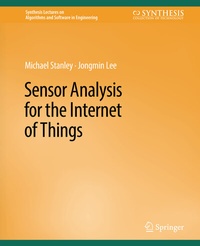
Sensor Analysis for the Internet of Things
Description
Alles über E-Books | Antworten auf Fragen rund um E-Books, Kopierschutz und Dateiformate finden Sie in unserem Info- & Hilfebereich.
While it may be attractive to view sensors as simple transducers which convert physical quantities into electrical signals, the truth of the matter is more complex. The engineer should have a proper understanding of the physics involved in the conversion process, including interactions with other measurable quantities. A deep understanding of these interactions can be leveraged to apply sensor fusion techniques to minimize noise and/or extract additional information from sensor signals.
Advances in microcontroller and MEMS manufacturing, along with improved internet connectivity, have enabled cost-effective wearable and Internet of Things sensor applications. At the same time, machine learning techniques have gone mainstream, so that those same applications can now be more intelligent than ever before. This book explores these topics in the context of a small set of sensor types.
We provide some basic understanding of sensor operation for accelerometers, magnetometers,gyroscopes, and pressure sensors. We show how information from these can be fused to provide estimates of orientation. Then we explore the topics of machine learning and sensor data analytics.
More details
Other editions
Additional editions

Persons
Content
System requirements
File format: PDF
Copy protection: Watermark-DRM (Digital Rights Management)
System requirements:
- Computer (Windows; MacOS X; Linux): Use the free software Adobe Reader, Adobe Digital Editions, or any other PDF viewer of your choice (see eBook Help).
- Tablet/Smartphone (Android; iOS): Install the free app Adobe Digital Editions or another reading app for eBooks, e.g., PocketBook (see eBook Help).
- E-reader: Bookeen, Kobo, Pocketbook, Sony, Tolino and many more (only limited: Kindle).
The file format PDF always displays a book page identically on any hardware. This makes PDF suitable for complex layouts such as those used in textbooks and reference books (images, tables, columns, footnotes). Unfortunately, on the small screens of e-readers or smartphones, PDFs are rather annoying, requiring too much scrolling.
This eBook uses Watermark-DRM, a „soft” copy protection. This means that there are no technical restrictions to prevent illegal distribution. However, there is a personalised watermark embedded in the eBook that can be used to identify the purchaser of the eBook in the event of misuse and to provide evidence for legal purposes.
For more information, see our eBook Help page.