

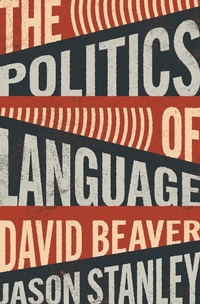
The Politics of Language
Description

A provocative case for the inherently political nature of language
In The Politics of Language, David Beaver and Jason Stanley present a radical new approach to the theory of meaning, offering an account of communication in which political and social identity, affect, and shared practices play as important a role as information. This new view of language, they argue, has dramatic consequences for free speech, democracy, and a range of other areas in which speech plays a central role.
Drawing on a wealth of disciplines, The Politics of Language argues that the function of speech-whether in dialogue, larger group interactions, or mass communication-is to attune people to something, be it a shared reality, emotion, or identity. Reconceptualizing the central ideas of pragmatics and semantics, Beaver and Stanley apply their account to a range of phenomena that defy standard frameworks in linguistics and philosophy of language-from dog whistles and covert persuasion to echo chambers and genocidal speech. The authors use their framework to show that speech is inevitably political because all communication is imbued with the resonances of particular ideologies and their normative perspectives on reality.
At a time when democracy is under attack, authoritarianism is on the rise, and diversity and equality are being demanded, The Politics of Language offers a powerful new vision of the language of politics, ideology, and protest.
More details
Other editions
Additional editions
Persons
Content
- Cover
- Contents
- Acknowledgments
- Introduction
- Harmful Speech
- Hustle
- The Path Forward
- Part I. How Words Connect People
- Chapter 1. Resonance
- 1.1. Let Freedom Ring
- 1.2. What's in a Word?
- 1.3. The Scholarship of Resonance
- 1.4. Associative Resonance
- 1.5. Revelations
- 1.6. Interactional Expressives as Moves in a Game
- 1.7. Differentiating Kaplanian Expressive Meaning from Resonance
- 1.8. Which Contexts Count?
- Chapter 2. Attunement
- 2.1. You Must Remember This
- 2.2. Individual Attunement
- 2.3. Attunement to Practice
- 2.4. Collective Attunement and Common Ground
- 2.5. Attunement to Resonance
- 2.6. Changing Ideology
- Chapter 3. Harmony
- 3.1. Comprehension in the Content-Delivery Model
- 3.2. Cognitive Dissonance
- 3.3. Nondeliberative Uptake
- 3.4. Individual Harmony
- 3.5. Narrative Harmonization
- 3.6. Priming Hate
- 3.7. Mass Coordination
- 3.8. Collective Harmony
- 3.9. What Resonates and Why
- 3.10. Conclusion
- Part II. Presupposition and Ideology
- Chapter 4. The Psychology of Presupposition
- 4.1. Common Ground and Common Enemies
- 4.2. A Collision of Language and Psychology
- 4.3. Valence Framing
- 4.4. Marking Our Common Ground
- Chapter 5. Presupposing Practice
- 5.1. What More Do We Need from a Theory of Resonance?
- 5.2. Presuppositional Resonance
- 5.3. Conventional Meaning
- 5.4. Projection
- 5.5. Categoricity
- 5.6. What Else Is Missing?
- Chapter 6. On Parole
- 6.1. Vox Populi
- 6.2. Accommodation as Harmonization
- 6.3. Beyond Scorekeeping
- 6.4. Tuning In to Others
- 6.5. Marching to Your Own Drum
- 6.6. Echo Chambers
- Part III. Idealization
- Chapter 7. Neutrality
- 7.1. A Neutral Space for Reasons?
- 7.2. Frege on Sense versus Tone
- 7.3 Evaluative Predicates and Value-Laden Concepts
- 7.4. "Dog" versus "Cur"
- 7.5. Speech Practices
- 7.6. Perspective
- 7.7. Against Neutrality as an Ideal
- Chapter 8. Straight Talk
- 8.1. Defining Hustle via Straight Talk
- 8.2. Coordination and Cooperation
- 8.3. Leading Questions
- 8.4. Plausible Deniability
- 8.5. Hustle and the Development of Speech Practice
- 8.6. Is Straight Talk Central?
- Chapter 9. Philosophy and Ideal Theory
- 9.1. Nonideal Epistemology and Beyond
- 9.2. The Content-Delivery Model
- 9.3. The Ideal/Nonideal Debate in the Theory of Meaning
- Part IV. Oppression and Freedom
- Chapter 10. Harmful Speech
- 10.1. Oppressive Language and the Ideal of Neutrality
- 10.2. Slurring
- 10.3. Genocidal Speech
- 10.4. Bureaucratic Speech
- Chapter 11. Free Speech
- 11.1. On the Benefits of Free Speech
- 11.2. On Speaker Autonomy
- 11.3. Let Equality Ring
- Glossary of Technical Terms
- Bibliography
- Index
