

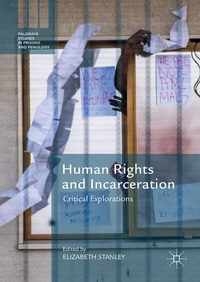
Human Rights and Incarceration
Description

This collection considers human rights and incarceration in relation to the liberal-democratic states of Australia, New Zealand and the UK. It presents original case-study material on groups that are disproportionately affected by incarceration, including indigenous populations, children, women, those with disabilities, and refugees or 'non-citizens'. The book considers how and why human rights are eroded, but also how they can be built and sustained through social, creative, cultural, legal, political and personal acts. It establishes the need for pragmatic reforms as well as the abolition of incarceration.
Contributors consider what has, or might, work to secure rights for incarcerated populations, and they critically analyse human rights in their legal, socio-cultural, economic and political contexts. In covering this ground, the book presents a re-invigorated vision of human rights in relation to incarceration. After all, human rights are not static principles; they have to be developed, fought over and engaged with.
More details
Other editions
Additional editions
Person
Elizabeth Stanley is Reader in Criminology, and Rutherford Discovery Fellow, at the Institute of Criminology, Victoria University of Wellington, New Zealand. She is an established, internationally recognised scholar in the areas of human rights and state crime. She was included in the recent substantive
Handbook on Human Rights
, and contributed the 'guiding' introductory chapter to the section of 'Human Rights and Penality' (Weber et al, 2016). She is an Associate Editor of the
Australian and New Zealand Journal of Criminology
and a Board Member on several other journals (
Criminology and Criminal Justice
;
State Crime
;
Justice, Power and Resistance
). Her work is highly regarded for its originality and quality.
Content
Chapter 1. Human Rights and Incarceration; Elizabeth Stanley.- Chapter 2. Children Deprived of their Liberty on 'Welfare' Grounds: A Critical Perspective; Deena Haydon.- Chapter 3. Rights of Persons with Disability not to be Criminalised; Eileen Baldry.- Chapter 4. Challenging Maori Imprisonment and Human Rights Ritualism; Elizabeth Stanley and Riki Mihaere.- Chapter 5. Immigration Detention and the Limits of Human Rights; Michael Grewcock.- Chapter 6. Haunted by the Presence of Death: Prisons, Abolitionism and the Right to Life; David Scott.- Chapter 7. Human Rights for 'Hard Cases': Alternatives to Imprisonment for Serious Offending by Children and Youth; Nessa Lynch.- Chapter 8. Entrenching Women's Imprisonment: An Anti-Carceral Critique of Rights Based Advocacy and Reform; Bree Carlton and Emma K. Russell.- Chapter 9. From Conflict to 'Peace': The Persistent Impact of Human Rights Violations in Northern Ireland's Prisons; Phil Scraton.- Chapter 10. Reconceptualising Custody: Rights, Responsibilities and 'Imagined Communities'; Margaret S. Malloch.- Chapter 11. 'Stone Walls Do Not a Prison Make': Bare Life and the Carceral Archipelago in Colonial and Postcolonial Societies; Harry Blagg and Thalia Anthony.- Chapter 12. Indigenous Rights, Poetry and Decarceration; Tracey McIntosh.
