

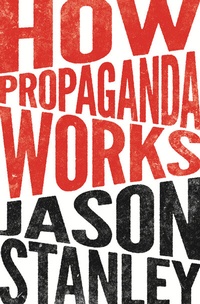
How Propaganda Works
1st Edition
Published on 28. July 2015
376 pages
978-1-4008-6580-2 (ISBN)
Description

How propaganda undermines democracy and why we need to pay attention
Our democracy today is fraught with political campaigns, lobbyists, liberal media, and Fox News commentators, all using language to influence the way we think and reason about public issues. Even so, many of us believe that propaganda and manipulation aren't problems for us-not in the way they were for the totalitarian societies of the mid-twentieth century. In How Propaganda Works, Jason Stanley demonstrates that more attention needs to be paid. He examines how propaganda operates subtly, how it undermines democracy-particularly the ideals of democratic deliberation and equality-and how it has damaged democracies of the past.
Focusing on the shortcomings of liberal democratic states, Stanley provides a historically grounded introduction to democratic political theory as a window into the misuse of democratic vocabulary for propaganda's selfish purposes. He lays out historical examples, such as the restructuring of the US public school system at the turn of the twentieth century, to explore how the language of democracy is sometimes used to mask an undemocratic reality. Drawing from a range of sources, including feminist theory, critical race theory, epistemology, formal semantics, educational theory, and social and cognitive psychology, he explains how the manipulative and hypocritical declaration of flawed beliefs and ideologies arises from and perpetuates inequalities in society, such as the racial injustices that commonly occur in the United States.
How Propaganda Works shows that an understanding of propaganda and its mechanisms is essential for the preservation and protection of liberal democracies everywhere.
Our democracy today is fraught with political campaigns, lobbyists, liberal media, and Fox News commentators, all using language to influence the way we think and reason about public issues. Even so, many of us believe that propaganda and manipulation aren't problems for us-not in the way they were for the totalitarian societies of the mid-twentieth century. In How Propaganda Works, Jason Stanley demonstrates that more attention needs to be paid. He examines how propaganda operates subtly, how it undermines democracy-particularly the ideals of democratic deliberation and equality-and how it has damaged democracies of the past.
Focusing on the shortcomings of liberal democratic states, Stanley provides a historically grounded introduction to democratic political theory as a window into the misuse of democratic vocabulary for propaganda's selfish purposes. He lays out historical examples, such as the restructuring of the US public school system at the turn of the twentieth century, to explore how the language of democracy is sometimes used to mask an undemocratic reality. Drawing from a range of sources, including feminist theory, critical race theory, epistemology, formal semantics, educational theory, and social and cognitive psychology, he explains how the manipulative and hypocritical declaration of flawed beliefs and ideologies arises from and perpetuates inequalities in society, such as the racial injustices that commonly occur in the United States.
How Propaganda Works shows that an understanding of propaganda and its mechanisms is essential for the preservation and protection of liberal democracies everywhere.
More details
Other editions
Additional editions
Jason Stanley
How Propaganda Works
Book
12/2016
Princeton University Press
€21.50
Available immediately
Jason Stanley
How Propaganda Works
Book
05/2015
Princeton University Press
€47.04
Article exhausted; check different version
Person
Jason Stanley is the Jacob Urowsky Professor of Philosophy at Yale University. He is the author of Knowledge and Practical Interests, Language in Context, and Know How.
Content
Preface IX
Introduction: The Problem of Propaganda 1
1 Propaganda in the History of Political Thought 27
2 Propaganda Defined 39
3 Propaganda in Liberal Democracy 81
4 Language as a Mechanism of Control 125
5 Ideology 178
6 Political Ideologies 223
7 The Ideology of Elites: A Case Study 269
Conclusion 292
Acknowledgments 295
Notes 305
Bibliography 335
Index 347
Introduction: The Problem of Propaganda 1
1 Propaganda in the History of Political Thought 27
2 Propaganda Defined 39
3 Propaganda in Liberal Democracy 81
4 Language as a Mechanism of Control 125
5 Ideology 178
6 Political Ideologies 223
7 The Ideology of Elites: A Case Study 269
Conclusion 292
Acknowledgments 295
Notes 305
Bibliography 335
Index 347
