

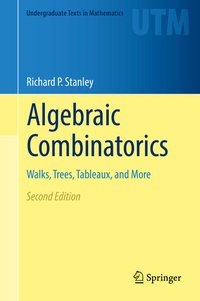
Algebraic Combinatorics
Description

Written by one of the foremost experts in the field, Algebraic Combinatorics is a unique undergraduate textbook that will prepare the next generation of pure and applied mathematicians. The combination of the author's extensive knowledge of combinatorics and classical and practical tools from algebra will inspire motivated students to delve deeply into the fascinating interplay between algebra and combinatorics. Readers will be able to apply their newfound understanding to mathematical, engineering, and business models. Prerequisites include a basic knowledge of linear algebra over a field, existence of finite fields, and rudiments of group theory. The topics in each chapter build on one another and include extensive problem sets as well as hints to selected exercises. Key topics include walks on graphs, cubes and the Radon transform, the Matrix-Tree Theorem, de Bruijn sequences, the Erdos-Moser conjecture, electrical networks, the Sperner property, shellability of simplicialcomplexes and face rings. There are also three appendices on purely enumerative aspects of combinatorics related to the chapter material: the RSK algorithm, plane partitions, and the enumeration of labeled trees.
The new edition contains a bit more content than intended for a one-semester advanced undergraduate course in algebraic combinatorics, enumerative combinatorics, or graph theory. Instructors may pick and choose chapters/sections for course inclusion and students can immerse themselves in exploring additional gems once the course has ended. A chapter on combinatorial commutative algebra (Chapter 12) is the heart of added material in this new edition. The author gives substantial application without requisites needed for algebraic topology and homological algebra. A sprinkling of additional exercises and a new section (13.8) involving commutative algebra, have been added.
From reviews of the first edition:
"This gentle book provides the perfect stepping-stone up. The various chapters treat diverse topics . . Stanley's emphasis on 'gems' unites all this -he chooses his material to excite students and draw them into further study. . Summing Up: Highly recommended. Upper-division undergraduates and above."
-D. V. Feldman, Choice, Vol.
51
(8), April, 2014
More details
Other editions
Additional editions
Person
Richard P. Stanley is one of the most well-known algebraic combinatorists in the world. He is currently professor of Applied Mathematics at the Massachusetts Institute of Technology. Amongst his several visiting professorships, Stanley has received numerous awards including the George Polya Prize in Applied Combinatorics, Guggenheim Fellowship, admission to both the American Academy and National Academies of Sciences, Leroy P. Steele Prize for Mathematical Exposition, Rolf Schock Prize in Mathematics, Senior Scholar at Clay Mathematics Institute, Aisenstadt Chair, Honorary Doctor of Mathematics from the University of Waterloo, and an honorary professorship at the Nankai University. Professor Stanley has had over 50 doctoral students and is well known for his excellent teaching skills.
