

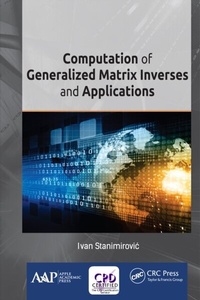
Computation of Generalized Matrix Inverses and Applications
1st Edition
Published on 14. December 2017
292 pages
978-1-351-63005-4 (ISBN)
Description

This volume offers a gradual exposition to matrix theory as a subject of linear algebra. It presents both the theoretical results in generalized matrix inverses and the applications. The book is as self-contained as possible, assuming no prior knowledge of matrix theory and linear algebra.
The book first addresses the basic definitions and concepts of an arbitrary generalized matrix inverse with special reference to the calculation of {i,j,...,k} inverse and the Moore-Penrose inverse. Then, the results of LDL* decomposition of the full rank polynomial matrix are introduced, along with numerical examples. Methods for calculating the Moore-Penrose's inverse of rational matrix are presented, which are based on LDL* and QDR decompositions of the matrix. A method for calculating the A(2)T;S inverse using LDL* decomposition using methods is derived as well as the symbolic calculation of A(2)T;S inverses using QDR factorization.
The text then offers several ways on how the introduced theoretical concepts can be applied in restoring blurred images and linear regression methods, along with the well-known application in linear systems. The book also explains how the computation of generalized inverses of matrices with constant values is performed. It covers several methods, such as methods based on full-rank factorization, Leverrier-Faddeev method, method of Zhukovski, and variations of the partitioning method.
The book first addresses the basic definitions and concepts of an arbitrary generalized matrix inverse with special reference to the calculation of {i,j,...,k} inverse and the Moore-Penrose inverse. Then, the results of LDL* decomposition of the full rank polynomial matrix are introduced, along with numerical examples. Methods for calculating the Moore-Penrose's inverse of rational matrix are presented, which are based on LDL* and QDR decompositions of the matrix. A method for calculating the A(2)T;S inverse using LDL* decomposition using methods is derived as well as the symbolic calculation of A(2)T;S inverses using QDR factorization.
The text then offers several ways on how the introduced theoretical concepts can be applied in restoring blurred images and linear regression methods, along with the well-known application in linear systems. The book also explains how the computation of generalized inverses of matrices with constant values is performed. It covers several methods, such as methods based on full-rank factorization, Leverrier-Faddeev method, method of Zhukovski, and variations of the partitioning method.
Reviews / Votes
"This book explores the computation of various kinds of generalized inverses of constant matrices, matrix polynomials, and rational functions, from the point of view of symbolic computation. The matter of stability is not considered.After setting basic de?nitions and properties in Chapter 1, in Chapter 2 the author reviews various methods for constructing generalized inverses of constant matrices.
In the third chapter, techniques based on classical matrix factorizations are applied to "polynomial and rational matrices", i.e., matrix polynomials and rational matrix functions.
The discussion focuses mainly on theoretical properties and algorithms, rather than on the role of generalized inverses in solving particular problems, e.g., least squares problems. Some applications are brie?y described in the last chapter.
Many examples involving matrices of small size are given, in order to illustrate the peculiarities of the algorithms. The implementation of some of the methods described is reported in the form of Mathematica programs. Due to the size of the font used, it is not always easy to read the program listings. It would have been preferable to attach to the volume a CD containing the code.
The English language used in the book is sometimes convoluted or incorrect, but on average it is rather comprehensible."
- Giuseppe Rodriguez - Mathematical Reviews Clippings - March 2019
More details
Language
English
Place of publication
London
United Kingdom
Publishing group
Taylor & Francis Ltd
Target group
College/higher education
Professional and scholarly
Product notice
Reflowable
Illustrations
2 s/w Abbildungen
2 Illustrations, black and white
File size
6,49 MB
ISBN-13
978-1-351-63005-4 (9781351630054)
Copyright in bibliographic data and cover images is held by Nielsen Book Services Limited or by the publishers or by their respective licensors: all rights reserved.
Schweitzer Classification
Other editions
Additional editions
Ivan Stanimirovic
Computation of Generalized Matrix Inverses and Applications
Book
03/2021
1st Edition
Apple Academic Press Inc.
€107.50
Shipment within 3-4 weeks
Ivan Stanimirovic
Computation of Generalized Matrix Inverses and Applications
Book
12/2017
1st Edition
Apple Academic Press Inc.
€178.27
Shipment within 3-4 weeks
Person
Ivan Stanimirovic, PhD, is currently with the Department of Computer Science, Faculty of Sciences and Mathematics at the University of Nis, Serbia, where he is an Assistant Professor. He formerly was with the Faculty of Management at Megatrend University, Belgrade, as a Lecturer. His work spans from multi-objective optimization methods to applications of generalized matrix inverses in areas such as image processing and restoration and computer graphics. His current research interests include computing generalized matrix inverses and its applications, applied multi-objective optimization and decision making, as well as deep learning neural networks. Dr. Stanimirovic was the Chairman of a workshop held at 13th Serbian Mathematical Congress, Vrnjacka banja, Serbia, in 2014.
Content
Introduction. Computing Generalized Inverses of Matrices with Numerical Values. Generalized Inverses of Polynomial and Rational Matrices. Applications. Conclusion. Literature.
