

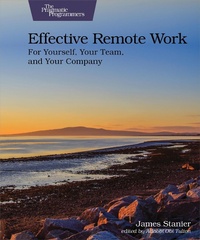
Effective Remote Work
Description

The office isn''t as essential as it used to be. Flexible working hours and distributed teams are replacing decades of on-site, open-plan office culture. Wherever you work from nowadays, your colleagues are likely to be somewhere else. No more whiteboards. No more water coolers. And certainly no Ping-Pong. So how can you organize yourself, ship software, communicate, and be impactful as part of a globally distributed workforce? We''ll show you how. It''s time to adopt a brand new mindset. Remote working is here to stay. Come and join us.
Remote working is on the rise. Whether or not we are remote workers, it is likely we are all part of a global workforce. We need to learn to interact remotely, because we are all remote from someone in some way. Rather than simply simulating the way we''d usually work together via digital means, we have to learn new communication skills and adopt a different mindset in order to work remotely effectively, efficiently, and, most importantly, healthily.
We''ll start by getting you set up with the right equipment and habits. Then, we''ll learn the mindset of treating everyone as remote, and conquer both synchronous and asynchronous communication. You''ll learn how to produce amazing artifacts, how to communicate clearly, and how to manage yourself and your teams. Then we''ll look at the bigger picture: from measuring the remote readiness of your workplace, to creating a handbook for your team, to exploring remote-first culture and tackling burnout and mental well-being.
Fundamentally we''ll see that adopting a remote-working mindset can do wonders for our organization, our effectiveness, and our impact in our careers. It can even create a more diverse and inclusive industry for us all to work in.
So what are you waiting for? The remote future is now. Be a part of it.
What You Need:
There are no prerequisites to reading this book, other than having had some experience of working in the software industry and a healthy curiosity.
More details
Other editions
Additional editions
Person
Dr. James Stanier is a computer science Ph.D who made the jump from software engineer to manager and has never looked back. He works remotely in Cumbria, UK, and has over a decade of experience with building people and software.
Content
- Cover
- Table of Contents
- Acknowledgments
- Introduction
- The Biggest Remote-Working Experiment in History
- Where You're Headed
- The Outline of This Book
- What's Next?
- Part I-Getting Oriented for Remote Work
- 1. A Remote Future
- A Brief History of the Future
- Lockdown
- Remote Is Here to Stay
- Time to Get Set Up
- 2. Getting Set Up
- The Office: What We Want and What We Don't
- The Basics, Briefly
- In the Real World
- Installing Mental Scaffolding
- The Golden Rule
- Part II-Building Effective Remote Teams
- 3. Treat Everyone as Remote
- Out of Sight, Out of Mind
- A Principle for Cultural Change
- Taking Practical Action
- Let's Build a Model!
- 4. The Spectrum of Synchronousness
- Synchronousness
- Permanence
- Restoring Your Humanity
- Onward to Hyrule
- 5. The Same but Different
- A Normal Day in the Office
- Through the Magic Mirror
- Conquering the Dark World
- Let's Discover Some Artifacts
- 6. Artifacts for a Better Future
- Comparing Artifacts
- Written Artifacts
- Codebase Artifacts
- Recorded Artifacts
- Getting on Board with Onboarding
- 7. Onboarding and Orientation
- The Contribution Curve
- The Onboarding Equation
- And Here's the Trick
- Coming Up: Considering Communication
- 8. Effective Communication Techniques
- Why Humans Communicate
- Principles for Better Remote Communication
- Techniques to Improve Interactions
- The Right Tools and When to Use Them
- Turning Inward
- 9. Managing Yourself
- An Organizational Bedrock
- On Being Unobserved
- Riding Peaks and Troughs
- From Yourself to Teams
- 10. Managing Teams
- The Output Equation Revisited
- Shrinking the Scale Factor
- Supercharging the Scale Factor
- Time to Take It up a Level
- Part III-Creating a World-Class Remote Culture
- 11. The Remote Working Test
- The Joel Test
- Twelve Questions about Remote Working
- Making Changes in Your Company
- Something to Guide Us
- 12. Creating a Handbook
- The GitLab Handbook
- Creating a Handbook for Your Team
- A Handbook for the Company
- Fully Making the Shift
- 13. Becoming Fully Remote
- The Spectrum of Remoteness
- The Challenge of Retrofitting Fully Remote Culture
- The Triangle of Transition
- Learning from Trailblazers
- Now the Difficult Stuff
- 14. The Hard Parts
- Walking the Curves
- The Physical and Mental Impact of Working Remotely
- Supporting Others Remotely
- And Breathe .
- 15. The Path to Equality Is Remote
- Diversity and Inclusion
- Remote: The Great Leveler
- This Is Just the Beginning
- And That's It
- Bibliography
- Index
- - DIGITS -
- - A -
- - B -
- - C -
- - D -
- - E -
- - F -
- - G -
- - H -
- - I -
- - J -
- - K -
- - L -
- - M -
- - N -
- - O -
- - P -
- - Q -
- - R -
- - S -
- - T -
- - U -
- - V -
- - W -
- - Y -
- - Z -
