

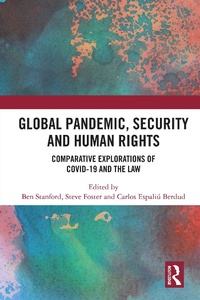
Global Pandemic, Security and Human Rights
Comparative Explorations of COVID-19 and the Law
1st Edition
Published on 29. December 2021
256 pages
978-1-000-51512-1 (ISBN)
Description

This book presents an international and comparative exploration of how the COVID-19 global pandemic has affected and impacted on issues of human rights, security, and law.
Throughout the world, the COVID-19 global pandemic has fundamentally impacted and altered our way of life. As this book sets out, all states have had to contend with similar challenges as well as competing interests and obligations affecting human rights and security. These challenges present very few simple choices but nonetheless carry enormous consequences. Organised into two thematic and distinct yet interrelated parts, first on theoretical and practical challenges for human rights and second on threats to personal, collective, and global security, the book examines how the ability of states to safeguard our fundamental rights and security, broadly defined, has been challenged. Questions about the legality and legal impact of recent responses to COVID-19 will persist for some time. It is often said that global problems require coordinated global solutions, but the various responses to the pandemic by states suggest a notable lack of a consensus amongst the international community.
The book will be of interest to academics and researchers working in the areas of human rights law and security law. It will also appeal to constitutional lawyers, given the nature of law-making and the challenge of ensuring adequate scrutiny in emergency situations as well as the impact of COVID-19 upon the legal framework more generally. It will provide a valuable resource for policymakers, practitioners, and public servants.
Throughout the world, the COVID-19 global pandemic has fundamentally impacted and altered our way of life. As this book sets out, all states have had to contend with similar challenges as well as competing interests and obligations affecting human rights and security. These challenges present very few simple choices but nonetheless carry enormous consequences. Organised into two thematic and distinct yet interrelated parts, first on theoretical and practical challenges for human rights and second on threats to personal, collective, and global security, the book examines how the ability of states to safeguard our fundamental rights and security, broadly defined, has been challenged. Questions about the legality and legal impact of recent responses to COVID-19 will persist for some time. It is often said that global problems require coordinated global solutions, but the various responses to the pandemic by states suggest a notable lack of a consensus amongst the international community.
The book will be of interest to academics and researchers working in the areas of human rights law and security law. It will also appeal to constitutional lawyers, given the nature of law-making and the challenge of ensuring adequate scrutiny in emergency situations as well as the impact of COVID-19 upon the legal framework more generally. It will provide a valuable resource for policymakers, practitioners, and public servants.
More details
Edition
1. Auflage
Language
English
Place of publication
London
United Kingdom
Publishing group
Taylor & Francis Ltd
Target group
College/higher education
Product notice
Reflowable
Illustrations
6 Tables, black and white; 6 Line drawings, black and white; 6 Illustrations, black and white
ISBN-13
978-1-000-51512-1 (9781000515121)
Copyright in bibliographic data and cover images is held by Nielsen Book Services Limited or by the publishers or by their respective licensors: all rights reserved.
Schweitzer Classification
Other editions
Additional editions
Ben Stanford | Steve Foster | Carlos Espaliu Berdud
Global Pandemic, Security and Human Rights
Comparative Explorations of COVID-19 and the Law
Book
09/2023
1st Edition
Routledge
€65.40
Shipment within 10-20 days
Ben Stanford | Steve Foster | Carlos Espaliu Berdud
Global Pandemic, Security and Human Rights
Comparative Explorations of COVID-19 and the Law
Book
12/2021
1st Edition
Routledge
€206.50
Shipment within 10-20 days
Persons
Ben Stanford is a Senior Lecturer at Liverpool John Moores University. He is also an Editor for the Asian Yearbook of Human Rights and Humanitarian Law and a Fellow of the Higher Education Academy. Ben was recently appointed as Lay Observer to monitor the welfare and access to justice of people held in court custody. He has previously worked for Rights Watch (UK), Peace Brigades International (UK), and the Human Rights Lawyers Association.
Steve Foster has taught law at Coventry for over 40 years and was Head of Coventry Law School until 2017. He is currently the editor-in-chief of the Coventry Law Journal.
Carlos Espaliu Berdud is Main Researcher of the Research Group on Security, Risks Management, and Conflicts at the University of Nebrija and is Full Professor. He has been Lecturer in the University of Navarre, Legal Officer of the International Court of Justice, Ramon y Cajal Researcher in the University of Cordoba, Associate Professor in Public International Law and European Union Law, and Director of the Charlemagne Institute of European Studies and Vice-Dean for Academic Affairs at the Faculty of Law at the International University of Catalonia (UIC).
Steve Foster has taught law at Coventry for over 40 years and was Head of Coventry Law School until 2017. He is currently the editor-in-chief of the Coventry Law Journal.
Carlos Espaliu Berdud is Main Researcher of the Research Group on Security, Risks Management, and Conflicts at the University of Nebrija and is Full Professor. He has been Lecturer in the University of Navarre, Legal Officer of the International Court of Justice, Ramon y Cajal Researcher in the University of Cordoba, Associate Professor in Public International Law and European Union Law, and Director of the Charlemagne Institute of European Studies and Vice-Dean for Academic Affairs at the Faculty of Law at the International University of Catalonia (UIC).
Content
Introduction
1. Human rights and security in the COVID-19 era
Part 1 - Theoretical and Practical Challenges for Human Rights
2. COVID-19 and constitutional tensions: Conflicts between the state and the governed
3. Human rights in times of emergency: COVID-19 taking the United Kingdom into uncharted territory
4. 2020: Human rights in Spain or the end of a legal guarantee? A constitutional crisis
5. Managing a pandemic: The securitisation of health and the challenge for fundamental freedoms
6. Guaranteeing migrants' rights in a time of pandemics: The Portuguese exception
Part 2 - Threats to Personal, Collective and Global Security
7. Tax in reverse: Financial support and social security during COVID-19
8. Subjects of surveillance: Human security and law in the wake of COVID-19
9. The future of the European Strategy for Data: Impact analysis from the COVID-19 pandemic
10. Analysing the use of technology in the fight against COVID-19: A look at China, Taiwan, South Korea, Iceland and Israel from the perspective of 'Technologies for Freedom'
11. Virus-laden ships: International rights and obligations of coastal states regarding foreign cruise ships feared to be carrying an infectious disease
12. The New Cold War and the (uneven) implications of COVID-19 for international security: The cases of Italy and the UK
1. Human rights and security in the COVID-19 era
Part 1 - Theoretical and Practical Challenges for Human Rights
2. COVID-19 and constitutional tensions: Conflicts between the state and the governed
3. Human rights in times of emergency: COVID-19 taking the United Kingdom into uncharted territory
4. 2020: Human rights in Spain or the end of a legal guarantee? A constitutional crisis
5. Managing a pandemic: The securitisation of health and the challenge for fundamental freedoms
6. Guaranteeing migrants' rights in a time of pandemics: The Portuguese exception
Part 2 - Threats to Personal, Collective and Global Security
7. Tax in reverse: Financial support and social security during COVID-19
8. Subjects of surveillance: Human security and law in the wake of COVID-19
9. The future of the European Strategy for Data: Impact analysis from the COVID-19 pandemic
10. Analysing the use of technology in the fight against COVID-19: A look at China, Taiwan, South Korea, Iceland and Israel from the perspective of 'Technologies for Freedom'
11. Virus-laden ships: International rights and obligations of coastal states regarding foreign cruise ships feared to be carrying an infectious disease
12. The New Cold War and the (uneven) implications of COVID-19 for international security: The cases of Italy and the UK
