

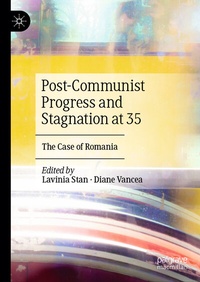
Post-Communist Progress and Stagnation at 35
Description

This book examines Romania's efforts to consolidate liberal democracy and market economy, as desired by the generation who effected change in 1989 and required by the European Union. The ousting of Nicolae Ceausescu, leader of an autarchic and nationalistic dictatorship, underscored the limitations of politically engineering change when rule of law is weak, institutions are misused, and intolerance and cheating are prevalent. Despite initial hopes, Romania's transition combined progress and stagnation, missed opportunities, detours, unintended consequences, and success. The contributions illustrate the tenuous relationship between continuity and change in a country that is yet to catch up with its neighbors.
Reviews / Votes
"For anyone interested in contemporary Romania, the publication of Post-Communist Progress and Stagnation at 35, is an exciting event. Ably edited by distinguished Professors Lavinia Stan and Diane Vancea, this volume brings together sophisticated analyses by some of the most clear-sighted specialists to argue that Romania's post-communist transformation has failed to achieve even an approximation of a liberal democracy or to create conditions in which the mainstream media, the educational system, or the economy itself can operate free of corruption and abuse." (--Sabrina P. Ramet, author of East Central Europe and Communism: Politics, Culture, and Society, 1943-1991 (Routledge, 2023))
"This book ably edited by Lavinia Stan and Diane Vancea offers a welcome and timely reassessment of Romania's protracted transition to democracy by examining a wide range of topics from political elites, education, and the miliary to healthcare reform, the media, and civil society. The chapters cast light on the country's slow but steady progress toward economic development and bureaucratic modernization. They highlight the major societal changes that have taken place in Romania since 1989 and point out the steps that the country must still take to catch up with the other members of the European Union." (--Aurelian Craiutu, Indiana University, Bloomington, USA)
"Romania is the transition case that has never seemed to fit the pattern-and as the outlier, it warrants close inspection. The contributors to this volume are unafraid of analytical comparisons, grounding their research in sophisticated social science while making the twists and turns of Romanian politics accessible. The reader will discover that post-Communist Romania is not so different, and that this case is an excellent pathway intounderstanding where Eastern Europe has gone in the 35 years since Communism." (--Padraic Kenney, University of Kentucky, Lexington, USA)
More details
Other editions
Additional editions
Persons
Lavinia Stan is Professor of Political Science and Director of the Center for Post-Communist Studies at St. Francis Xavier University, Canada.
Diane Vancea is Professor of Economics and International Affairs and President of the Senate of the University "Ovidius" in Constanta, Romania.
