

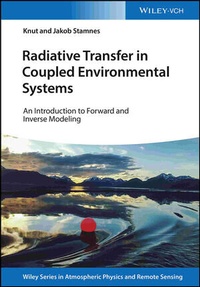
Radiative Transfer in Coupled Environmental Systems
An Introduction to Forward and Inverse Modeling
1st Edition
Published on 18. March 2016
XIV, 368 pages
978-3-527-69662-8 (ISBN)
Description

This book is dedicated to the formulation and solution of forward and inverse problems related to coupled media, and provides examples of how to solve concrete problems in environmental remote sensing of coupled atmosphere-surface systems.
The authors discuss radiative transfer in coupled media such as the atmosphere-ocean system with Lambertian as well non-Lambertian reflecting surfaces at the lower boundary. The spectral range from the ultraviolet to the microwave region of the electromagnetic spectrum is considered, as are multi-spectral as well as hyperspectral remote sensing, while solutions of the forward problem for unpolarized and polarized radiation are discussed in detail.
The authors discuss radiative transfer in coupled media such as the atmosphere-ocean system with Lambertian as well non-Lambertian reflecting surfaces at the lower boundary. The spectral range from the ultraviolet to the microwave region of the electromagnetic spectrum is considered, as are multi-spectral as well as hyperspectral remote sensing, while solutions of the forward problem for unpolarized and polarized radiation are discussed in detail.
More details
Other editions
Additional editions
Knut Stamnes | Jakob J. Stamnes
Radiative Transfer in Coupled Environmental Systems - An Introduction to Forward and Inverse Modeling
Software
12/2015
Wiley-Blackwell
€191.57
No shipping information available
Knut Stamnes | Jakob J. Stamnes
Radiative Transfer in Coupled Environmental Systems
An Introduction to Forward and Inverse Modeling
Book
09/2015
1st Edition
Wiley-VCH
€145.00
Article exhausted; check different version
Persons
Knut Stamnes is a Professor in the Department of Physics and Engineering Physics, and Director of the Department of Physics and Engineering Physic as well as the Light and Life Laboratory at Stevens Institute of Technology in Hoboken, New Jersey. Stamnes began his career in upper atmospheric physics, and has since specialized in atmospheric radiation, remote sensing, and climate-related studies. He has published more than 175 research papers and one book on radiative transfer in the atmosphere. He is a fellow of OSA, a member of SPIE, and was elected member of the Norwegian Academy of Technological Sciences in 2009. Knut Stamnes earned his B. Sc. and M. Sc. in physics from the University of Oslo, Norway, and his Ph.D. in Astro-Geophysics from the University of Colorado, USA.
Jakob J. Stamnes is professor of physics in the Department of Physics and Technology at the University of Bergen, Norway. He has published more than 160 papers on wave propagation, diffraction, and scattering as well as on remote sensing of the atmosphere and ocean and of biological tissue. Jakob J. Stamnes is author of a book and editor of an SPIE book series. He is fellow of the OSA, founding member and fellow of the EOS (European Optical Society), a member of SPIE, and was elected member of the Norwegian Academy of Technological Sciences in 2009. He obtained his M.Sc. degree in applied physics from the Norwegian Technical University, Trondheim, Norway, in 1969 and his Ph.. degree in optics from the University of Rochester, USA, in 1975.
Jakob J. Stamnes is professor of physics in the Department of Physics and Technology at the University of Bergen, Norway. He has published more than 160 papers on wave propagation, diffraction, and scattering as well as on remote sensing of the atmosphere and ocean and of biological tissue. Jakob J. Stamnes is author of a book and editor of an SPIE book series. He is fellow of the OSA, founding member and fellow of the EOS (European Optical Society), a member of SPIE, and was elected member of the Norwegian Academy of Technological Sciences in 2009. He obtained his M.Sc. degree in applied physics from the Norwegian Technical University, Trondheim, Norway, in 1969 and his Ph.. degree in optics from the University of Rochester, USA, in 1975.
Content
INTRODUCTION
Brief History
What is Meant by a Coupled System?
Scope
INHERENT OPTICAL PROPERTIES (IOPs)
General Definitions
Examples of Scattering Phase Functions
Scattering Phase Matrix
IOPs of a Polydisperision of Particles - Integration Over the Size Distribution
Scattering of an Electromagnetic Wave by Particles
Absorption and Scattering by Spherical Particles - Mie Theory
Atmosphere IOPs
Snow and Ice IOPs
Water IOPs
Fresnel Reflectance and Transmittance at a Plane Interface between Two Coupled Media
Surface Roughness Treatment
Problems
BASIC RADIATIVE TRANSFER THEORY
Derivation of the Radiative Transfer Equation (RTE)
Radiative Transfer of Unpolarized Radiation in Coupled Systems
Radiative Transfer of Polarized Radiation in Coupled Systems
Methods of Solution of the RTE
Calculation of Weighting Functions - Jacobians
Problems
FORWARD RADIATIVE TRANSFER MODELING
Quadrature Rule - The Double-Gauss Method
Discrete Ordinate Equations - Compact Matrix Formulation
Discrete Ordinate Solutions
Problems
THE INVERSE PROBLEM
Probability and Rules for Consistent Reasoning
Parameter Estimation
Model Selection of Hypothesis Testing
Assigning Probabilities
Generic Formulation of the Inverse Problem
Linear Inverse Problems
Bayesian Approach to the Inverse Problem
Ill-Posedness of Ill-Conditioning
Nonlinear Inverse Problems
Problems
APPLICATIONS
Principal Component (PC) Analysis
Simultaneous Retrieval of Total Ozone Column (TOC) Amount and Cloud Effects
Coupled Atmosphere-Snow-Ice Systems
Coupled Atmosphere-Water Systems
Simultaneous Retrieval of Aerosol and Aquatic Parameters
Polarized RT in a Coupled Atmosphere-Ocean System
What if MODIS Could Measure Polarization?
APPENDIX
Scattering of Electromagnetic Waves
Spectral Sampling Strategies
Rough Surface Scattering and Transmission
Bundary Conditions
Brief History
What is Meant by a Coupled System?
Scope
INHERENT OPTICAL PROPERTIES (IOPs)
General Definitions
Examples of Scattering Phase Functions
Scattering Phase Matrix
IOPs of a Polydisperision of Particles - Integration Over the Size Distribution
Scattering of an Electromagnetic Wave by Particles
Absorption and Scattering by Spherical Particles - Mie Theory
Atmosphere IOPs
Snow and Ice IOPs
Water IOPs
Fresnel Reflectance and Transmittance at a Plane Interface between Two Coupled Media
Surface Roughness Treatment
Problems
BASIC RADIATIVE TRANSFER THEORY
Derivation of the Radiative Transfer Equation (RTE)
Radiative Transfer of Unpolarized Radiation in Coupled Systems
Radiative Transfer of Polarized Radiation in Coupled Systems
Methods of Solution of the RTE
Calculation of Weighting Functions - Jacobians
Problems
FORWARD RADIATIVE TRANSFER MODELING
Quadrature Rule - The Double-Gauss Method
Discrete Ordinate Equations - Compact Matrix Formulation
Discrete Ordinate Solutions
Problems
THE INVERSE PROBLEM
Probability and Rules for Consistent Reasoning
Parameter Estimation
Model Selection of Hypothesis Testing
Assigning Probabilities
Generic Formulation of the Inverse Problem
Linear Inverse Problems
Bayesian Approach to the Inverse Problem
Ill-Posedness of Ill-Conditioning
Nonlinear Inverse Problems
Problems
APPLICATIONS
Principal Component (PC) Analysis
Simultaneous Retrieval of Total Ozone Column (TOC) Amount and Cloud Effects
Coupled Atmosphere-Snow-Ice Systems
Coupled Atmosphere-Water Systems
Simultaneous Retrieval of Aerosol and Aquatic Parameters
Polarized RT in a Coupled Atmosphere-Ocean System
What if MODIS Could Measure Polarization?
APPENDIX
Scattering of Electromagnetic Waves
Spectral Sampling Strategies
Rough Surface Scattering and Transmission
Bundary Conditions
