

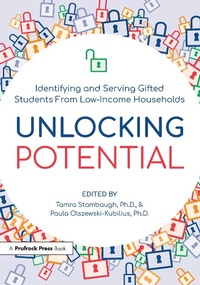
Unlocking Potential
Identifying and Serving Gifted Students From Low-Income Households
1st Edition
Published on 3. September 2021
344 pages
978-1-000-49614-7 (ISBN)
Description

Winner of NAGC's 2021 Book of the Year Award
This edited book, written by authors with extensive experience in working with gifted students from low-income households, focuses on ways to translate the latest research and theory into evidence-supported practices that impact how schools identify and serve these students. Readers will:
Learn about evidence-supported identification systems, tools, and strategies for finding students from low-income households.
Discover curriculum models, resources, and instructional strategies found effective from projects focused on supporting these students.
Understand the important role that intra- and interpersonal skills, ethnicity/race, families, school systems, and communities play.
Consider the perceptions of gifted students who grew up in low-income households.
Learn how educators can use their experiences to strengthen current services.
Unlocking Potential is the go-to resource for an up-to-date overview of best practices in identification, curriculum, instruction, community support, and program design for gifted learners from low-income households.
This edited book, written by authors with extensive experience in working with gifted students from low-income households, focuses on ways to translate the latest research and theory into evidence-supported practices that impact how schools identify and serve these students. Readers will:
Learn about evidence-supported identification systems, tools, and strategies for finding students from low-income households.
Discover curriculum models, resources, and instructional strategies found effective from projects focused on supporting these students.
Understand the important role that intra- and interpersonal skills, ethnicity/race, families, school systems, and communities play.
Consider the perceptions of gifted students who grew up in low-income households.
Learn how educators can use their experiences to strengthen current services.
Unlocking Potential is the go-to resource for an up-to-date overview of best practices in identification, curriculum, instruction, community support, and program design for gifted learners from low-income households.
Reviews / Votes
Thoroughly 'educator friendly' in organization and presentation, Unlocking Potential: Identifying and Serving Gifted Students From Low-Income Households is a seminal and unreservedly recommended addition to professional, school district, college, and university library Teacher Education collections and Gifted Education supplemental curriculum studies lists.,James A. Cox,Midwest Book Review, 12/18/20More details
Edition
1. Auflage
Language
English
Place of publication
London
United Kingdom
Publishing group
Taylor & Francis Ltd
Target group
College/higher education
Professional and scholarly
ISBN-13
978-1-000-49614-7 (9781000496147)
Copyright in bibliographic data and cover images is held by Nielsen Book Services Limited or by the publishers or by their respective licensors: all rights reserved.
Schweitzer Classification
Other editions
Additional editions
Tamra Stambaugh | Paula Olszewski-Kubilius
Unlocking Potential
Identifying and Serving Gifted Students From Low-Income Households
Book
12/2020
1st Edition
Prufrock Press
€53.40
Shipment within 3-4 weeks
Persons
Dr. Tamra Stambaugh is the Director of Programs for Talented Youth at Vanderbilt University. She is the coauthor (with Dr. Joyce VanTassel-Baska) of Comprehensive Curriculum for Gifted Learners, Overlooked Gems: A National Perspective on Low-Income Promising Students, and the Jacob's Ladder Reading Comprehension Program.
Paula Olszewski-Kubilius is currently the director of the Center for Talent Development at Northwestern University. She has more than 24 years of experience designing and conducting educational programs for learners of all ages including summer programs, weekend programs, distance learning programs, programs for underrepresented gifted students, as well as workshops for parents and teachers. She is active and has had leadership positions in national- and state-level advocacy organizations for gifted children. She was the recipient of the Early Scholar Award from the National Association of Gifted Children in 1987 and selected as the Esther Katz Rosen lecturer in 1997 by the American Psychological Foundation. She has conducted research and published more than 80 articles and book chapters on issues of talent development, particularly the effects of accelerated educational programs and the needs of special populations of gifted children She recently served as the editor of Gifted Child Quarterly and formerly was a coeditor of the Journal of Secondary Gifted Education. She has served on the editorial advisory board of the Journal for the Education of the Gifted, and Gifted Child International, and was a consulting editor for Roeper Review. She is a member of the Board of Trustees of the Illinois Mathematics and Science Academy and currently is a member of the boards of the National Association for Gifted Children and the Illinois Association for Gifted Children.
Paula Olszewski-Kubilius is currently the director of the Center for Talent Development at Northwestern University. She has more than 24 years of experience designing and conducting educational programs for learners of all ages including summer programs, weekend programs, distance learning programs, programs for underrepresented gifted students, as well as workshops for parents and teachers. She is active and has had leadership positions in national- and state-level advocacy organizations for gifted children. She was the recipient of the Early Scholar Award from the National Association of Gifted Children in 1987 and selected as the Esther Katz Rosen lecturer in 1997 by the American Psychological Foundation. She has conducted research and published more than 80 articles and book chapters on issues of talent development, particularly the effects of accelerated educational programs and the needs of special populations of gifted children She recently served as the editor of Gifted Child Quarterly and formerly was a coeditor of the Journal of Secondary Gifted Education. She has served on the editorial advisory board of the Journal for the Education of the Gifted, and Gifted Child International, and was a consulting editor for Roeper Review. She is a member of the Board of Trustees of the Illinois Mathematics and Science Academy and currently is a member of the boards of the National Association for Gifted Children and the Illinois Association for Gifted Children.
Content
Foreword Chapter 1: Poverty, Academic Achievement, and Giftedness:A Literature Review Chapter 2: Intersections of Culture, Context, and Race With Poverty: Implications for Services for Gifted Learners From Low-Income Backgrounds Chapter 3: Macro-Identification Approaches and Systems for Students From Low-Income Backgrounds Chapter 4: Micro-Identification Processes Chapter 5: A Curriculum Design Model for Students From Low-Income Households 109 Chapter 6 : Instructional Strategies to Support Learners From Low-Income Backgrounds: The Humanities Chapter 7: Instructional Strategies to Support Talented Students From Low-Income Households: The STEM Fields Chapter 8: Effective Intervention Models to Support the Talent Development of Students From Low-Income Households Beyond the School Day Chapter 9: Effective Strategies for Career Counseling of Gifted Learners From Low-Income Backgrounds Chapter 10: Teaching Psychosocial Skills and Modeling Habits of Achievement Chapter 11: Tapping Into Family Resources to Support Gifted Learners From Low-Income Backgrounds Chapter 12: A Systems Approach to Identifying and Serving Gifted Learners From Low-Income Backgrounds Chapter 13: Voices and Reflections About the Editors About the Authors
