

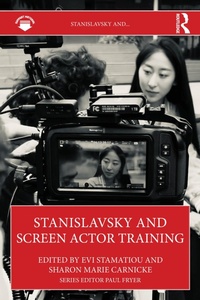
Stanislavsky and Screen Actor Training
Published on 17. December 2025
196 pages
978-1-040-59644-9 (ISBN)
Description

Stanislavsky and Screen Actor Training is a collection of essays mapping the acting field's current engagement with Stanislavsky practices and concepts for training in the screen industries across continents.
This edited volume collates the efforts of teachers of screen acting to identify, investigate, articulate, document, and disseminate Stanislavsky-inspired practical tools for actor training for the screen. Providing reflections from instructors and teachers of acting for the screen, it interrogates the ways in which the actor's craft affects cinematic processes and experiences through the lens of Stanislavskian methods. Part one looks at the ways in which Stanislavsky's concepts can be applied within the screenacting studio. Then, part two moves on to investigate the process of active analysis within the studio. Part three presents ways in which Stanislavsky's methodologies can be adapted for the screenacting process. Finally, part four looks at Stanislavsky-inspired pedagogical innovations for training screen actors. Support material for this book is available at www.routledge.com/9781032986081
Stanislavsky And... is a series of multi-perspectival collections that bring the enduring legacy of Stanislavskian actor training into the spotlight of contemporary performance culture, making them ideal for students, teachers, and scholars of acting, actor training, and directing.
This edited volume collates the efforts of teachers of screen acting to identify, investigate, articulate, document, and disseminate Stanislavsky-inspired practical tools for actor training for the screen. Providing reflections from instructors and teachers of acting for the screen, it interrogates the ways in which the actor's craft affects cinematic processes and experiences through the lens of Stanislavskian methods. Part one looks at the ways in which Stanislavsky's concepts can be applied within the screenacting studio. Then, part two moves on to investigate the process of active analysis within the studio. Part three presents ways in which Stanislavsky's methodologies can be adapted for the screenacting process. Finally, part four looks at Stanislavsky-inspired pedagogical innovations for training screen actors. Support material for this book is available at www.routledge.com/9781032986081
Stanislavsky And... is a series of multi-perspectival collections that bring the enduring legacy of Stanislavskian actor training into the spotlight of contemporary performance culture, making them ideal for students, teachers, and scholars of acting, actor training, and directing.
More details
Series
Language
English
Place of publication
London
United Kingdom
Publishing group
Taylor & Francis Ltd
Target group
College/higher education
Professional and scholarly
Illustrations
1 Tables, black and white; 4 Halftones, black and white; 4 Illustrations, black and white
File size
2,28 MB
ISBN-13
978-1-040-59644-9 (9781040596449)
Copyright in bibliographic data and cover images is held by Nielsen Book Services Limited or by the publishers or by their respective licensors: all rights reserved.
Schweitzer Classification
Other editions
Additional editions
Evi Stamatiou | Sharon Marie Carnicke
Stanislavsky and Screen Actor Training
Book
approx. 12/2025
1st Edition
Routledge
€63.30
Not yet published
Evi Stamatiou | Sharon Marie Carnicke
Stanislavsky and Screen Actor Training
Book
approx. 12/2025
1st Edition
Routledge
€207.40
Not yet published
Persons
Evi Stamatiou is a practitioner-researcher of actor training, bringing two decades of international experience as an actor and creative. She is a Senior Lecturer in Acting for Stage and Screen at the University of East London and holds a PhD from The Royal Central School of Speech and Drama, University of London, UK. A recipient of multiple awards and research grants, she is also a Senior Fellow of the Higher Education Academy and currently serves as Chair of the Acting Focus Group at the Association for Theatre in Higher Education. Evi's interdisciplinary work bridges acting with technology, education, psychology, and health sciences-advancing inclusive actor training and exploring the broader applications of acting in human development.
Sharon Marie Carnicke is best known for her groundbreaking study, Stanislavsky in Focus. Her other books include the recent Dynamic Acting through Active Analysis, Anton Chekhov: 4 Plays and 3 Jokes, and Checking out Chekhov. She has also published widely on screen performance and co-authored Reframing Screen Performance with Cynthia Baron. As a teacher of acting, she has conducted many intensive workshops on Active Analysis in the US, Europe, and Scandinavia. She is currently a professor of Dramatic Arts and Slavic Studies at the University of Southern California, USA, and founder of the Stanislavsky Institute for the 21st century.
Sharon Marie Carnicke is best known for her groundbreaking study, Stanislavsky in Focus. Her other books include the recent Dynamic Acting through Active Analysis, Anton Chekhov: 4 Plays and 3 Jokes, and Checking out Chekhov. She has also published widely on screen performance and co-authored Reframing Screen Performance with Cynthia Baron. As a teacher of acting, she has conducted many intensive workshops on Active Analysis in the US, Europe, and Scandinavia. She is currently a professor of Dramatic Arts and Slavic Studies at the University of Southern California, USA, and founder of the Stanislavsky Institute for the 21st century.
Content
Introduction
A. Positioning The Anthology Within Contemporary Screen Actor Training
B. Stanislavsky on Cinema and Film Acting
Part 1: Stanislavsky's concepts in the screen acting studio
1. Visualization: Stanislavsky and Rosenstein on Fostering Imagination and Concentration
2. "Fragmented" Radiation [Izlucheniya] for Camera
3. Accessing Stanislavsky's state of 'experiencing' [Perezhivanie] for the screen actor
4. Presence [Prisutstviye] Without Rehearsal: States of Being in Daily Television Production
Part 2: Active Analysis in the screenacting studio
5. Prompting Inner Monologue through Active Analysis
6. Embodying Active Analysis and Inner Monologue for the Screen
7. Reimagining Active Analysis: Cultivating Spontaneous Actor Responses for the Screen
Part 3: Adapting Stanislavsky for screenacting processes
8. Exploring Internal vs. External Tempo-Rhythm: Live-Editing in Screen Acting Training
9. The Film Actor Prepares with Michael Chekhov and SynthAnalysis (TM)
10. In-Camera Etudes: Delivering Purposeful, Precise, and Readable Performances in Every Take
Part 4: Pedagogical Innovations Inspired by Stanislavsky
11. Discovering Sensorial Shakespeare Through Language and Focal Points
12. Bridging Practices: Enhancing Mike Leigh's Method Through Stanislavsky's Tools
13. Ethnoacting in VR for Resilience in Screen Actors: a Vakhtangov-inspired intervention
Index
A. Positioning The Anthology Within Contemporary Screen Actor Training
B. Stanislavsky on Cinema and Film Acting
Part 1: Stanislavsky's concepts in the screen acting studio
1. Visualization: Stanislavsky and Rosenstein on Fostering Imagination and Concentration
2. "Fragmented" Radiation [Izlucheniya] for Camera
3. Accessing Stanislavsky's state of 'experiencing' [Perezhivanie] for the screen actor
4. Presence [Prisutstviye] Without Rehearsal: States of Being in Daily Television Production
Part 2: Active Analysis in the screenacting studio
5. Prompting Inner Monologue through Active Analysis
6. Embodying Active Analysis and Inner Monologue for the Screen
7. Reimagining Active Analysis: Cultivating Spontaneous Actor Responses for the Screen
Part 3: Adapting Stanislavsky for screenacting processes
8. Exploring Internal vs. External Tempo-Rhythm: Live-Editing in Screen Acting Training
9. The Film Actor Prepares with Michael Chekhov and SynthAnalysis (TM)
10. In-Camera Etudes: Delivering Purposeful, Precise, and Readable Performances in Every Take
Part 4: Pedagogical Innovations Inspired by Stanislavsky
11. Discovering Sensorial Shakespeare Through Language and Focal Points
12. Bridging Practices: Enhancing Mike Leigh's Method Through Stanislavsky's Tools
13. Ethnoacting in VR for Resilience in Screen Actors: a Vakhtangov-inspired intervention
Index
