

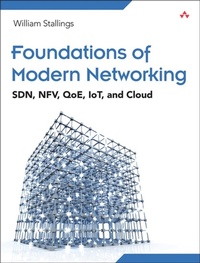
Foundations of Modern Networking
SDN, NFV, QoE, IoT, and Cloud
1st Edition
Published on 27. October 2015
560 pages
978-0-13-417602-4 (ISBN)
Description

Foundations of Modern Networking is a comprehensive, unified survey of modern networking technology and applications for today's professionals, managers, and students. Dr. William Stallings offers clear and well-organized coverage of five key technologies that are transforming networks: Software-Defined Networks (SDN), Network Functions Virtualization (NFV), Quality of Experience (QoE), the Internet of Things (IoT), and cloudbased services.
Dr. Stallings reviews current network ecosystems and the challenges they face-from Big Data and mobility to security and complexity. Next, he offers complete, self-contained coverage of each new set of technologies: how they work, how they are architected, and how they can be applied to solve real problems. Dr. Stallings presents a chapter-length analysis of emerging security issues in modern networks. He concludes with an up-to date discussion of networking careers, including important recent changes in roles and skill requirements.
Coverage:
Elements of the modern networking ecosystem: technologies, architecture, services, and applications
Evolving requirements of current network environments
SDN: concepts, rationale, applications, and standards across data, control, and application planes
OpenFlow, OpenDaylight, and other key SDN technologies
Network functions virtualization: concepts, technology, applications, and software defined infrastructure
Ensuring customer Quality of Experience (QoE) with interactive video and multimedia network traffic
Cloud networking: services, deployment models, architecture, and linkages to SDN and NFV
IoT and fog computing in depth: key components of IoT-enabled devices, model architectures, and example implementations
Securing SDN, NFV, cloud, and IoT environments
Career preparation and ongoing education for tomorrow's networking careers
Key Features:
Strong coverage of unifying principles and practical techniques
More than a hundred figures that clarify key concepts
Web support at williamstallings.com/Network/
QR codes throughout, linking to the website and other resources
Keyword/acronym lists, recommended readings, and glossary
Margin note definitions of key words throughout the text
Dr. Stallings reviews current network ecosystems and the challenges they face-from Big Data and mobility to security and complexity. Next, he offers complete, self-contained coverage of each new set of technologies: how they work, how they are architected, and how they can be applied to solve real problems. Dr. Stallings presents a chapter-length analysis of emerging security issues in modern networks. He concludes with an up-to date discussion of networking careers, including important recent changes in roles and skill requirements.
Coverage:
Elements of the modern networking ecosystem: technologies, architecture, services, and applications
Evolving requirements of current network environments
SDN: concepts, rationale, applications, and standards across data, control, and application planes
OpenFlow, OpenDaylight, and other key SDN technologies
Network functions virtualization: concepts, technology, applications, and software defined infrastructure
Ensuring customer Quality of Experience (QoE) with interactive video and multimedia network traffic
Cloud networking: services, deployment models, architecture, and linkages to SDN and NFV
IoT and fog computing in depth: key components of IoT-enabled devices, model architectures, and example implementations
Securing SDN, NFV, cloud, and IoT environments
Career preparation and ongoing education for tomorrow's networking careers
Key Features:
Strong coverage of unifying principles and practical techniques
More than a hundred figures that clarify key concepts
Web support at williamstallings.com/Network/
QR codes throughout, linking to the website and other resources
Keyword/acronym lists, recommended readings, and glossary
Margin note definitions of key words throughout the text
All prices
More details
Edition
1. Auflage
Language
English
Place of publication
Boston
United States
Publishing group
Pearson Education (US)
Target group
College/higher education
File size
24,64 MB
ISBN-13
978-0-13-417602-4 (9780134176024)
Copyright in bibliographic data and cover images is held by Nielsen Book Services Limited or by the publishers or by their respective licensors: all rights reserved.
Schweitzer Classification
Other editions
Additional editions
William Stallings
Foundations of Modern Networking: SDN, NFV, QoE, IoT, and Cloud
SDN, NFV, QoE, IoT, and Cloud
Book
11/2015
1st Edition
Addison Wesley
€54.49
Shipment within 15-20 days
Person
Dr. William Stallings has made a unique contribution to understanding the broad sweep of technical developments in computer security, computer networking, and computer architecture. He has authored 18 textbooks, and, counting revised editions, a total of 70 books on various aspects of these subjects. His writings have appeared in numerous ACM and IEEE publications, including the Proceedings of the IEEE and ACM Computing Reviews. He has 13 times received the award for the best computer science textbook of the year from the Text and Academic Authors Association.
In over 30 years in the field, he has been a technical contributor, technical manager, and an executive with several high-technology firms. He has designed and implemented both TCP/IP-based and OSI-based protocol suites on a variety of computers and operating systems, ranging from microcomputers to mainframes. Currently, he is an independent consultant whose clients have included computer and networking manufacturers and customers, software development firms, and leading-edge government research institutions.
He created and maintains the Computer Science Student Resource Site at ComputerScie nceStudent.com/. This site provides documents and links on a variety of subjects of general interest to computer science students (and professionals). He is a member of the editorial board of Cryptologia, a scholarly journal devoted to all aspects of cryptology.
Dr. Stallings holds a Ph.D. from M.I.T. in Computer Science and a B.S. from Notre Dame in electrical engineering.
In over 30 years in the field, he has been a technical contributor, technical manager, and an executive with several high-technology firms. He has designed and implemented both TCP/IP-based and OSI-based protocol suites on a variety of computers and operating systems, ranging from microcomputers to mainframes. Currently, he is an independent consultant whose clients have included computer and networking manufacturers and customers, software development firms, and leading-edge government research institutions.
He created and maintains the Computer Science Student Resource Site at ComputerScie nceStudent.com/. This site provides documents and links on a variety of subjects of general interest to computer science students (and professionals). He is a member of the editorial board of Cryptologia, a scholarly journal devoted to all aspects of cryptology.
Dr. Stallings holds a Ph.D. from M.I.T. in Computer Science and a B.S. from Notre Dame in electrical engineering.
Content
Chapter 1: Elements of Modern Networking
Chapter 2: Requirements and Technology
Chapter 3: SDN: Background and Motivation
Chapter 4: SDN Data Plane and OpenFlow
Chapter 5: SDN Control Plane
Chapter 6: SDN Application Plane
Chapter 7: Network Functions Virtualization: Concepts and Architecture
Chapter 8: NFV Functionality
Chapter 9: Network Virtualization
Chapter 10: Quality of Service
Chapter 11: QoE: User Quality of Experience
Chapter 12: Network Design Implications of QoS and QoE
Chapter 13: Cloud Computing
Chapter 14: The Internet of Things: Components
Chapter 15: The Internet of Things: Architecture and Implementation
Chapter 16: Security
Chapter 17: The Impact of the New Networking on IT Careers
Appendix A: References
Glossary
Chapter 2: Requirements and Technology
Chapter 3: SDN: Background and Motivation
Chapter 4: SDN Data Plane and OpenFlow
Chapter 5: SDN Control Plane
Chapter 6: SDN Application Plane
Chapter 7: Network Functions Virtualization: Concepts and Architecture
Chapter 8: NFV Functionality
Chapter 9: Network Virtualization
Chapter 10: Quality of Service
Chapter 11: QoE: User Quality of Experience
Chapter 12: Network Design Implications of QoS and QoE
Chapter 13: Cloud Computing
Chapter 14: The Internet of Things: Components
Chapter 15: The Internet of Things: Architecture and Implementation
Chapter 16: Security
Chapter 17: The Impact of the New Networking on IT Careers
Appendix A: References
Glossary
