

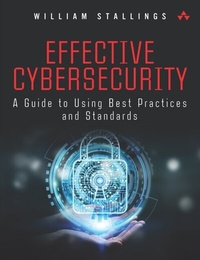
Effective Cybersecurity
A Guide to Using Best Practices and Standards
1st Edition
Published on 20. July 2018
800 pages
978-0-13-477295-0 (ISBN)
Description

The Practical, Comprehensive Guide to Applying Cybersecurity Best Practices and Standards in Real Environments
In Effective Cybersecurity, William Stallings introduces the technology, operational procedures, and management practices needed for successful cybersecurity. Stallings makes extensive use of standards and best practices documents that are often used to guide or mandate cybersecurity implementation. Going beyond these, he offers in-depth tutorials on the "how" of implementation, integrated into a unified framework and realistic plan of action.
Each chapter contains a clear technical overview, as well as a detailed discussion of action items and appropriate policies. Stallings offers many pedagogical features designed to help readers master the material: clear learning objectives, keyword lists, review questions, and QR codes linking to relevant standards documents and web resources.
Effective Cybersecurity aligns with the comprehensive Information Security Forum document "The Standard of Good Practice for Information Security," extending ISF's work with extensive insights from ISO, NIST, COBIT, other official standards and guidelines, and modern professional, academic, and industry literature.
* Understand the cybersecurity discipline and the role of standards and best practices
* Define security governance, assess risks, and manage strategy and tactics
* Safeguard information and privacy, and ensure GDPR compliance
* Harden systems across the system development life cycle (SDLC)
* Protect servers, virtualized systems, and storage
* Secure networks and electronic communications, from email to VoIP
* Apply the most appropriate methods for user authentication
* Mitigate security risks in supply chains and cloud environments
This knowledge is indispensable to every cybersecurity professional. Stallings presents it systematically and coherently, making it practical and actionable.
In Effective Cybersecurity, William Stallings introduces the technology, operational procedures, and management practices needed for successful cybersecurity. Stallings makes extensive use of standards and best practices documents that are often used to guide or mandate cybersecurity implementation. Going beyond these, he offers in-depth tutorials on the "how" of implementation, integrated into a unified framework and realistic plan of action.
Each chapter contains a clear technical overview, as well as a detailed discussion of action items and appropriate policies. Stallings offers many pedagogical features designed to help readers master the material: clear learning objectives, keyword lists, review questions, and QR codes linking to relevant standards documents and web resources.
Effective Cybersecurity aligns with the comprehensive Information Security Forum document "The Standard of Good Practice for Information Security," extending ISF's work with extensive insights from ISO, NIST, COBIT, other official standards and guidelines, and modern professional, academic, and industry literature.
* Understand the cybersecurity discipline and the role of standards and best practices
* Define security governance, assess risks, and manage strategy and tactics
* Safeguard information and privacy, and ensure GDPR compliance
* Harden systems across the system development life cycle (SDLC)
* Protect servers, virtualized systems, and storage
* Secure networks and electronic communications, from email to VoIP
* Apply the most appropriate methods for user authentication
* Mitigate security risks in supply chains and cloud environments
This knowledge is indispensable to every cybersecurity professional. Stallings presents it systematically and coherently, making it practical and actionable.
All prices
More details
Edition
1. Auflage
Language
English
Place of publication
Boston
United States
Publishing group
Pearson Education (US)
Target group
College/higher education
File size
11,35 MB
ISBN-13
978-0-13-477295-0 (9780134772950)
Copyright in bibliographic data and cover images is held by Nielsen Book Services Limited or by the publishers or by their respective licensors: all rights reserved.
Schweitzer Classification
Other editions
Additional editions
Book
11/2018
Addison Wesley
€56.00
Shipment within 15-20 days
Person
Dr. William Stallings has made a unique contribution to understanding the broad sweep of technical developments in computer security, computer networking, and computer architecture. He has authored 18 textbooks, and, counting revised editions, a total of 70 books on various aspects of these subjects. His writings have appeared in numerous ACM and IEEE publications, including the Proceedings of the IEEE and ACM Computing Reviews. He is a 13-time recipient of the award for the best computer science textbook of the year from the Text and Academic Authors Association.
In more than 30 years in the field, he has been a technical contributor, technical manager, and an executive with several high-technology firms. He has designed and implemented both TCP/IP-based and OSI-based protocol suites on a variety of computers and operating systems, ranging from microcomputers to mainframes. Currently, he is an independent consultant whose clients have included computer and networking manufacturers and customers, software development firms, and leading-edge government research institutions.
He created and maintains the Computer Science Student Resource Site at ComputerScienceStudent.com/. This site provides documents and links on a variety of subjects of general interest to computer science students (and professionals). He is a member of the editorial board of Cryptologia, a scholarly journal devoted to all aspects of cryptology.
Dr. Stallings holds a Ph.D. from M.I.T. in Computer Science and a B.S. from Notre Dame in Electrical Engineering.
In more than 30 years in the field, he has been a technical contributor, technical manager, and an executive with several high-technology firms. He has designed and implemented both TCP/IP-based and OSI-based protocol suites on a variety of computers and operating systems, ranging from microcomputers to mainframes. Currently, he is an independent consultant whose clients have included computer and networking manufacturers and customers, software development firms, and leading-edge government research institutions.
He created and maintains the Computer Science Student Resource Site at ComputerScienceStudent.com/. This site provides documents and links on a variety of subjects of general interest to computer science students (and professionals). He is a member of the editorial board of Cryptologia, a scholarly journal devoted to all aspects of cryptology.
Dr. Stallings holds a Ph.D. from M.I.T. in Computer Science and a B.S. from Notre Dame in Electrical Engineering.
Content
1. Guides to Practical Cybersecurity
2. Security Governance
3. Information Risk Assessment
4. Security Management
5. People Management
6. Information Management
7. Physical Asset Management
8. System Development
9. Business Applications Management
10. System Access
11. System Management
12. Networks and Communications
13. Supply Chain Management
14. Technical Security Management
15. Threat and Incident Management
16. Local Environment Management
Part Three: Security Monitoring and Improvement
17. Business Continuity
18. Security Monitoring and Improvement
2. Security Governance
3. Information Risk Assessment
4. Security Management
5. People Management
6. Information Management
7. Physical Asset Management
8. System Development
9. Business Applications Management
10. System Access
11. System Management
12. Networks and Communications
13. Supply Chain Management
14. Technical Security Management
15. Threat and Incident Management
16. Local Environment Management
Part Three: Security Monitoring and Improvement
17. Business Continuity
18. Security Monitoring and Improvement
